Fulbright Fellowship Takes Amelia Huntsman ’25 to Kazakhstan
The recent graduate will begin her career by experiencing a new culture.
July 17, 2025
Communications Staff
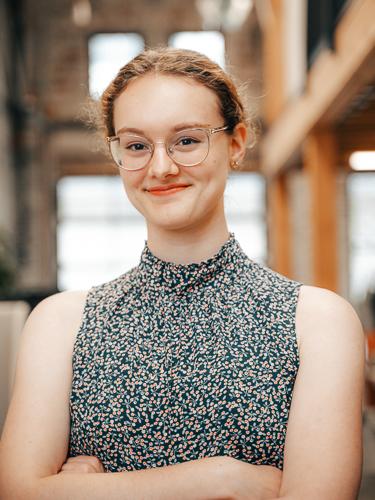
Photo credit: Amelia Huntsman
As a Russian, Eastern European, and Eurasian Studies (REEES) major, recent grad Amelia Huntsman is excited to begin her Fulbright English Teaching Assistantship (ETA) in Central Asia. “This opportunity to work in Kazakhstan and learn how to approach cultural exchange effectively is invaluable,” she says.
How did Oberlin shape or influence you to pursue the Fulbright?
Without Oberlin and the particular professors of the REEES department I really don’t think this would have been the path I pursued at all. I was originally a creative writing student; I didn’t intend to focus so much on international relations. I took Russian 101 with Professor Tom Newlin, and then his class on the culinary culture and history of the post-Soviet sphere, which allowed me to merge my new interest in language and culture with my existing academic interest in politics and history. That merger forms the basis of what the Fulbright is: a cross-cultural exchange that allows nations to build deeper academic and political ties. Even so, I probably wouldn’t have applied to the Fulbright if I hadn’t been brought into Oberlin. It felt way too big and important and distant to even try. I decided to apply when a friend of mine received a Fulbright grant after working with Danielle Abdon, director of fellowships and awards. That office made it feel a bit more attainable and approachable, and so I decided to give it a shot.
How does pursuing the Fulbright align with your post-college life and career goals?
Fundamentally, the best way to understand a place and its people is to go there and meet them, so a full year of living and working in Kazakhstan with other Kazakhs outside of the bubble of being a student at university is quite unique… It’s a dream of mine to be able to work in the Foreign Service.
What’s the best advice you’ve received from your Oberlin faculty mentor?
I got a piece of advice from Vladimir Ivantsov, assistant professor of Russian, Eastern European, and Eurasian Studies, a few years ago on a final project. We were trying to read and analyze short stories in my Russian class and I had chosen a particularly tricky one. What Professor Ivantsov told me to do was to stop working on it, stop annotating, and just to read. If I took out a dictionary for every unfamiliar word in the text I would never finish the project in the time allotted. I had to just find the words I knew and accept the pieces I was missing. I could go back through and fill in my gaps later, but right then I needed to move ahead with what I had and try to make the most of it. It really forced me to reconstruct how I was approaching assignments where I knew I was missing the necessary toolkit, and to stop obsessing over minutia I couldn’t solve and focus on putting together what I could.
Connect with Fellowships & Awards to learn more about the opportunities available to students.
You may also like…
Reyna Berry ’27 earns a 2026-27 Newman Civic Fellowship
The theater major will continue her work supporting prison and detention center programming

Andy Roshal '26 earns DAAD scholarship
The Hartsdale, New York, native will travel to Germany to expand on the Yiddish studies they began here at Oberlin.
Nissa Berle ’24 earns Fulbright Study/Research Award
The psychology major will earn a master’s degree in disaster and emergency management at York University