Food for Thought
January 7, 2026
Annie Nickoloff
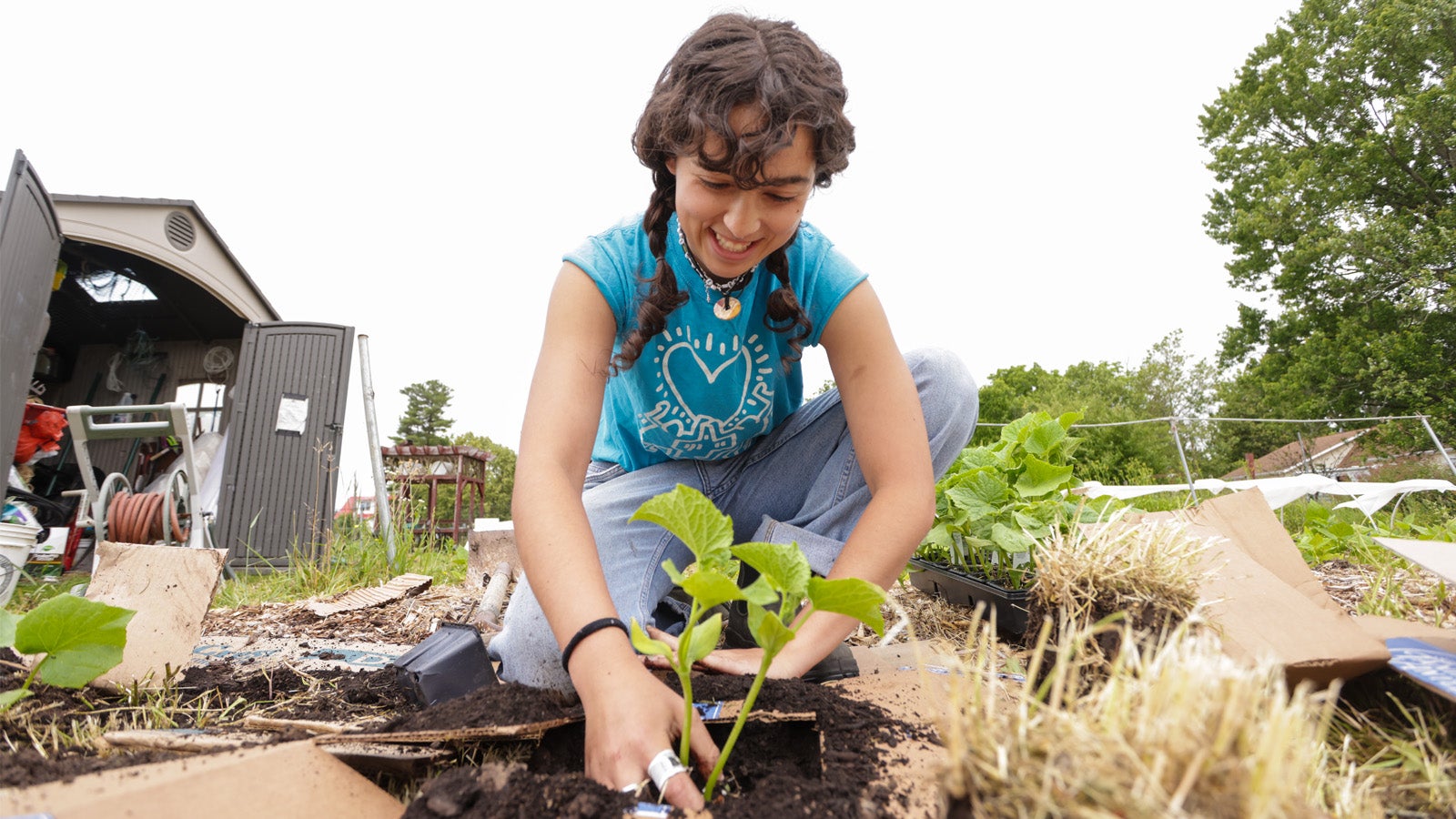
Header photo: Since launching in 2023, the food studies program has empowered students to get involved with grassroots local organizations and kick-started entrepreneurial incubation projects on Oberlin’s George Jones Memorial Farm.
Header photo credit: Mathias Reed
At Village Family Farms in Cleveland’s Hough neighborhood, peppers, tomatoes, green beans, and herbs flourish on the lots that once housed apartment complexes for the community. Bees buzz around the site’s hives while, just a few blocks away, traffic rumbles in and out of the city’s east side.
Last summer, Vic Zuno ’26 sank his hands in the dirt here, contributing to the farm’s day-to-day operations and assisting founder Jamel Rahkeera with the property as part of an internship centered on food justice, fulfilling the experiential requirement of Oberlin’s food studies integrative concentration.
But Zuno’s focus went deeper than the topsoil. Working with neighborhood teens, he created a new summer youth curriculum, designed to explore the intersections of urban farming, the environment, societal issues like redlining, and food sovereignty.
“It took me back to my roots,” says Zuno, who’s from Chicago. “I come from an area where there’s a lot of obstacles you have to jump over to get what should be given to you—like a good education, healthy food options, and safety in general. These kids have their own testimonies and their own struggles that they’ve overcome or are going through.”
The experience made a mark on Zuno. After graduating, he plans to look for similar opportunities in his career, working with sustainable organizations like Village Family Farms as a consultant in business development or community engagement.
“It was a transformative experience,” he says about both Village Family Farms and food studies.
The integrative concentration is about more than food. Often, it’s about community. Since launching in 2023, the food studies program has empowered students to get involved with grassroots local organizations, kick-started entrepreneurial incubation projects on Oberlin’s George Jones Memorial Farm, and strengthened connections between Oberlin and Lorain County Community College.
“It’s been really powerful for students to be getting engaged in the local area beyond the town of Oberlin,” says Jay Fiskio, professor of environmental studies and comparative American studies. “Students do get a lot of opportunities to do stuff in Oberlin if they want, but we have a lot of community partners in Lorain, Elyria, and Cleveland. That’s been really great.”
Oberlin’s approach to food studies is broad and interdisciplinary, focusing on history, foodways, and even neuroscience in addition to food justice and equity. The latter topics are important to Northeast Ohio communities. According to 2023 data compiled by Feeding America, Lorain County has a 15.4 percent food insecurity rate, and adjacent Cuyahoga County, where Cleveland is located, has a rate of 16.6 percent; both are above the national average of 14.3 percent. Locally, the nonprofit Healthy Northeast Ohio found that those rates increase in Black and African American communities (33 percent in Cuyahoga County, 32 percent in Lorain County) and in Hispanic communities (29 percent in both Cuyahoga and Lorain Counties).
At Oberlin College and in Northeast Ohio, the study of food is about more than just flavor: It’s about the systems and stories behind each bite.
An Academic Approach
Rolling fields of towering cornstalks and lush, green soybeans surround Oberlin with typical Lorain County farmland. It’s quite different from Gavriella Perez ’25’s urban and suburban hometown of Pennsauken, New Jersey, seven miles from Philadelphia. Perez says healthy food wasn’t always accessible in their community, though credits her parents with showing how to source nutritious groceries and meals.
When Perez came to Oberlin in September 2022, the quiet, rural campus felt like “a complete 180” from their hometown. But there was some overlap. According to 2019 USDA food access research, which analyzed food access with and without a vehicle, much of Oberlin lacks easy access to nutritionally dense food—even with all the surrounding farms of corn and soy.
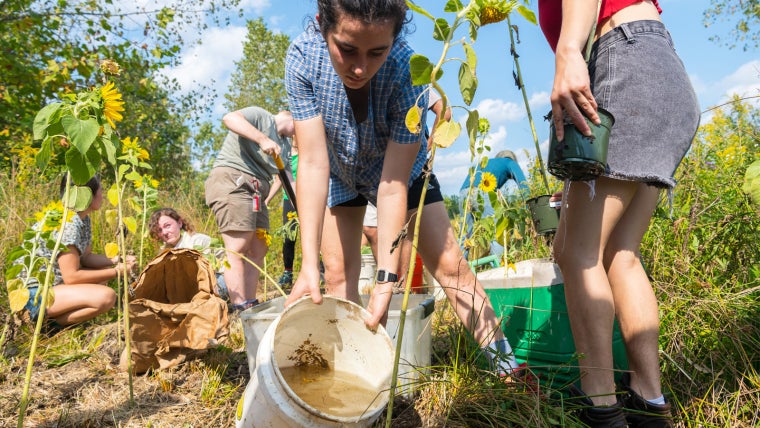
“Here we are in a county that is very food production heavy, but it’s very cash-crop heavy,” they say. “Corn, for the most part, most of it isn’t for human consumption. You will never eat that corn. That corn is going, maybe, 100 miles away.”
Initially drawn to Oberlin for its environmental studies program, Perez quickly jumped into the food studies integrative concentration when it became available during their sophomore year because of her passions for culinary and agricultural studies. “It aligned with every interest I have,” Perez says.
Food studies includes a range of classes on healthy eating, Lorain County foodways, the Great Lakes’ Indigenous nations, restaurant labor, colonization and agriculture, and even a French class where students sample wine and cheese.
In addition to her food studies classes, Perez completed an internship with chef Shontae Jackson’s Steel Farm and Gardens in Lorain in the summer after their second year. There, on land that once held an abandoned house, Jackson has regenerated and returned nutrients into the soil to grow things such as fruit trees, berries, and cacti in Northeast Ohio’s often unpredictable climate.
“She’s someone I’ve admired for years, and so being able to work with her was honestly a dream,” Perez says. “She’s also an amazing chef, and she’s able to also foster that, helping me actually work in kitchens, working in food service, being able to see what it’s like to be on the executive side of that culinary world.”
Perez used their experiences at Steel Farm and Gardens to research Northeast Ohio’s food ecosystem, and that segued into their capstone project, which analyzes Puerto Rico’s farming history and culture and the impacts of American imperialism. She hopes to continue her research in a graduate program.
“[Oberlin’s] a completely different food scene,” Perez says. “I was able to take the ways that food exists in Ohio as a whole and just transplant different ways of thinking to it.”
Plenty of Obies found passions for sustainability and agriculture on campus before the food studies program was established. So far, only two classes have graduated with the concentration as an option, says Fiskio.
“The food studies program is really new, but we’ve had students doing agriculture and food work for years before there was a program,” Fiskio says. “And that gives a better sense of what the field is—that it’s very interdisciplinary. It stretches in all kinds of directions, and it’s really up to the students to direct where they want it to go.”
The Great Outdoors
Sitting on the patio to George Jones Memorial Farm’s straw bale house, Leah Finegold ’20’s energetic dog Squash leaps jubilantly through the grasses near a garden’s rows of blossoming flowers.
Finegold found their way to a community-supported agriculture program thanks to their early experiences at Oberlin. As an undergraduate, they were a part of the Oberlin Student Cooperative Association (OSCA) and worked as a food security associate for Oberlin Community Services. After graduation, Finegold worked at Bellwether Farm in Wakeman, Ohio, and for a low-income housing program for the city of Cleveland.
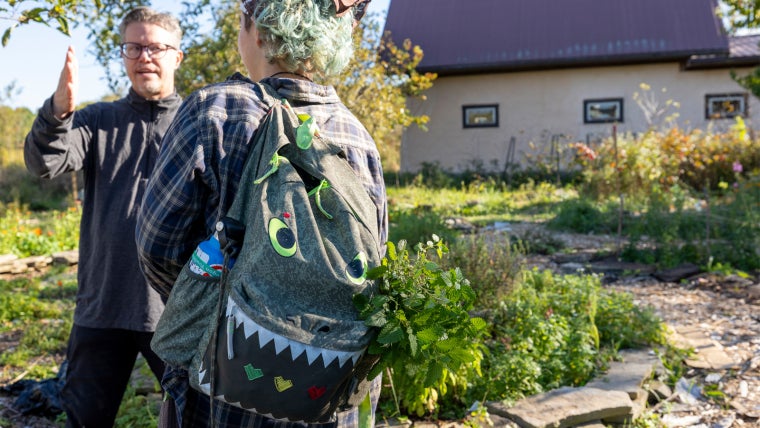
Today, they work at City Fresh, a nonprofit that sells locally grown produce boxes to Northeast Ohio community members at a reasonable price. The organization was another perfect fit for Finegold’s interests—and was just a mile away from Oberlin. (The college owns George Jones Memorial Farm and rents space to City Fresh.) Finegold is the program director of the organization’s farm box program, a subscription of in-season, locally grown produce shares delivered weekly to various pickup stations in Northeast Ohio.
“I came to Oberlin knowing that I wanted to do at least something with environmental studies,” they say. “I explored a lot of facets of environmentalism during my time at Oberlin and really found food to be a connector of all of them and just something that I loved.”
George Jones Memorial Farm hosts City Fresh, along with a regular crew of student workers from Oberlin. It hosts a new incubator farm program with six farmers using land to work on agriculture projects. And, for the past decade, visiting environmental studies lecturer Brad Melzer can often be seen out on the farm with his class of agroecology practicum students.
Depending on the season, the group builds garden beds, plants seeds, crafts water systems, and harvests crops—all while exploring the sciences of sustainable agriculture and ecology. Field trips bring students to urban farms in Cleveland, like Rid-All Green Partnership in the Kinsman neighborhood and the Ben Franklin Community Garden in Old Brooklyn.
These spaces spurred the local food movement in Northeast Ohio—something that’s reflected in some of the region’s most popular farm-to-table restaurants today, Melzer says.
“Ohio is an agricultural state as it is, but those community gardens, especially on [Cleveland’s] East Side, just have really deep roots of community,” Melzer says. “Those decades and decades of connection and community created this fabric that enriched the soil in which the local food movement in Cleveland grew out of.”
Small, biodiverse farms such as George Jones, along with the urban lots peppering Lorain and Cuyahoga County, are the future of the agriculture industry, Melzer says—and by experiencing these spaces firsthand, students create pathways for careers in fields like mycology, horticulture, environmental policy, and more.
Their work gives back to the land, too.
“It’s exciting because we’re just at the beginning of this programming,” Melzer says, “and certainly it’s created a renaissance here at the farm.”
This article originally appeared in the Fall 2025 Oberlin Alumni Magazine.
Annie Nickoloff is a Cleveland-based journalist who has written for a variety of local and national publications. She enjoys taking care of her small garden, checking out live music, and playing pinball.
You may also like…
Jane Wickline ’21 Finds Community in Comedy
A Q&A with the Saturday Night Live cast member and Dukes cofounder

When Stars Align
The Oberlin Contemporary Music Ensemble shines on Jennifer Koh ’97’s "The American Concerto, Volume One."

Wright On, Sister
Would the Wright brothers have invented their airplane without the support of their sister, Katharine Wright Class of 1898? Probably. But they might not have been the first.