Oberlin Alumni Magazine
The Power of Preservation
Dr. Dorothy Koster Washburn ’67's passion for archaeology led to generous gifts to support language study at Oberlin.
October 15, 2025
Annie Zaleski
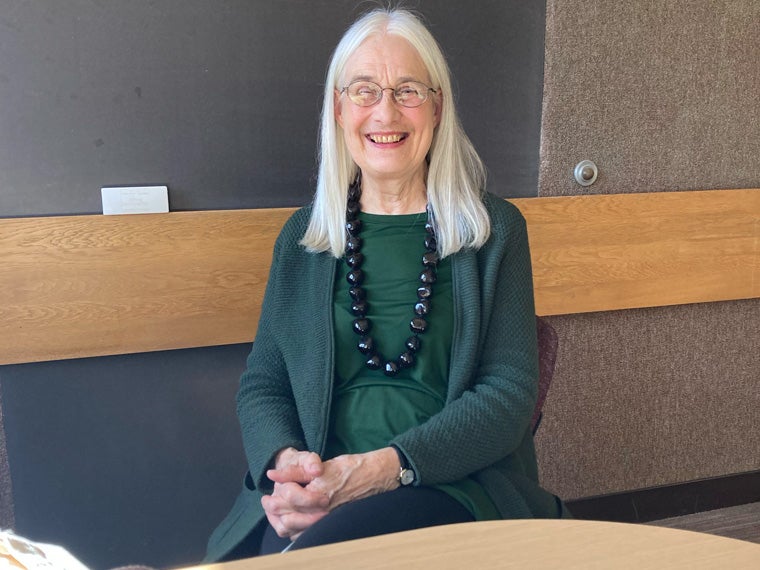
Dr. Dorothy Koster Washburn ’67
Photo credit: Layla Wallerstein/The Oberlin Review
When Dr. Dorothy Koster Washburn ’67 was earning her doctorate in anthropology at Columbia University, students were tested in four fields: archeology, cultural anthropology, linguistics, and physical anthropology. “I received this broad-based background in the study of human beings and how we live on this earth—including how we create cultures and what allows some cultures to succeed and some to fall apart,” she says.
In the years since graduation, her research has focused on archaeology—a calling she discovered at Oberlin. During her second year, she overheard two classmates discussing a trip to an archaeological dig in Wyoming. Her ears perked up: As a child, she had been fascinated by an exhibition of ceramics in Mesa Verde National Park. “I remember standing in front of an exhibit case that had a bunch of ceramics and other artifacts. There was a little sign that asked, What are these? Because nobody at that time knew what they were. I never forgot that.”
Emboldened, she asked her classmates if she could join them on the dig, which was run by National Geographic and Harvard University’s Peabody Museum of Archaeology and Ethnology. “I applied, and that summer, I was on a train,” Washburn recalls. “It was in 1965—and I have never looked back.”
She spent her career studying geometric design on pottery and other decorated artifacts through the lens of mathematical principles. “Every summer, I would go to a different museum and record the designs in the pots, because without a huge database, I could not compare patterns across time and space or demonstrate the value of this approach,” Washburn explains. “To date, I have a database of over 20,000 signs that I personally have drawn.”
Through this work, she met Hopi scholar Emory Sekaquaptewa, who introduced her to the Hopi language and to Katsina songs. “He said, ‘We are going to translate these songs, and we will show that the same principles voiced in these songs are what you see in your designs,’” Washburn says. She gathered tapes of Katsina songs and listened to them with Emory, who would write out the words in Hopi. Together with linguist Kenneth C. Hill, they published the transcriptions, English translations, and accompanying commentary in the 2015 book Hopi Katsina Songs.
Studying these texts “brought front and center how important language is to people,” Washburn says. “Emory always said that when a culture loses its language, it loses its culture, so you have to preserve these languages.”
In a nod to the importance of languages, Washburn made generous gifts to Oberlin to support both programming in Middle East and North Africa Studies (MENA) and a faculty position: the Dorothy Koster Washburn ’67 Endowed Lecturer in Arabic Language.
“From my appreciation of the nuance and the fundamental importance of a culture's ideas embedded in its language—if it's true for the Hopi, it's certainly true for every other culture and language,” she says. “I want to support the study of Arabic so that more people can learn the language and be able to understand its nuances.”
You may also like…
Jane Wickline ’21 Finds Community in Comedy
A Q&A with the Saturday Night Live cast member and Dukes cofounder

When Stars Align
The Oberlin Contemporary Music Ensemble shines on Jennifer Koh ’97’s "The American Concerto, Volume One."
Wright On, Sister
Would the Wright brothers have invented their airplane without the support of their sister, Katharine Wright Class of 1898? Probably. But they might not have been the first.