Crossing Mediums
Virginia Wagner ’08 tells immersive stories through her art.
August 26, 2025
Lucy Curtis ’24
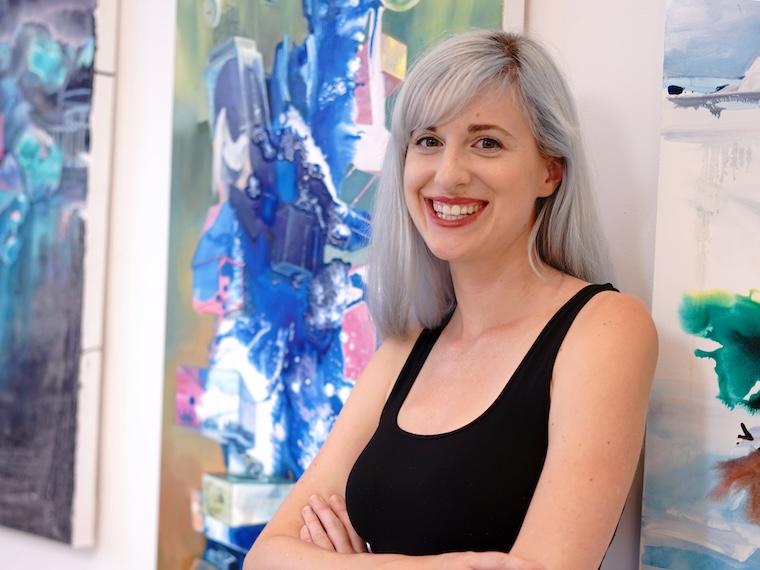
Photo credit: Chris Banks Carr
Virginia Wagner ’08 is an artist in the truest sense of the word. A double major in creative writing and studio art, she exhibits paintings in galleries across New York City, founded an online journal called Painters on Paintings, and is working on a graphic novel. After teaching at Pratt Institute for eight years, she is now a full-time lecturer of painting and drawing at Purchase College.
“My interests are—and have always been—at the intersection of different media,” she says. “I started as an actor and I danced and I sang, I write, and I’m interested in film. When I have an idea, it doesn’t necessarily sit squarely in one medium.”
Fittingly, one of Wagner’s explicit goals with her art is to capture a narrative. Her surreal paintings are rich with texture, featuring layers upon layers of shapes and colors that instill a level of emotion in the viewer.
“I’ve always loved stories that can transport you and take you out of your head into a new realm where you can grow or be challenged or escape,” Wagner says.
Her recent solo show Backdrop, which focuses on the Newtown Creek area, a toxic and ecologically problematic river where the Radiator Gallery sits between Brooklyn and Queens, explores multiple mediums and immersivity.
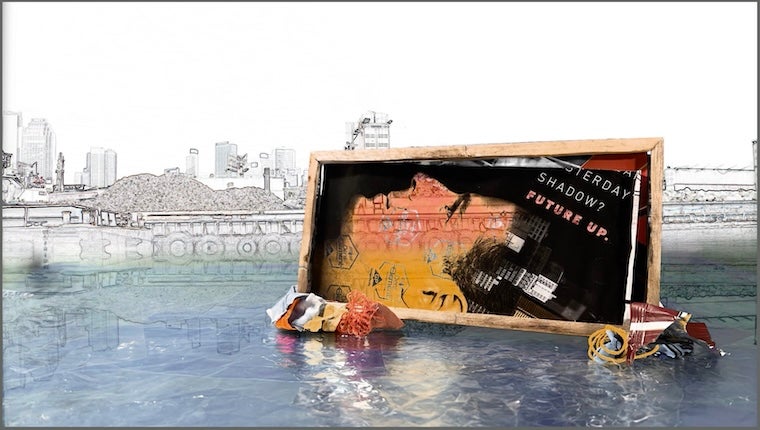
Drift, 2023, single-channel video.
“The imagery within the paintings pictured those fractured, fragmented green spaces,but also the actual paintings themselves—which were seven feet tall—were built out of found wood from those sites,” Wagner explains. “The backs of the pieces were visible because everything stood like a backdrop for theater. People could walk around and interact with the paintings, and also become ‘on stage’ because of the way that the paintings position bodies within the space.”
Backdrop also featured an animation that Wagner made; in it, she used trash that she found in the area. It included an ambient soundtrack by the musician OHYUNG that “oozed through the space and helped connect all the different works,” she explains. “There was a lot of mixed media because I found it to be the best way to capture all the senses and to really draw people into this space.”
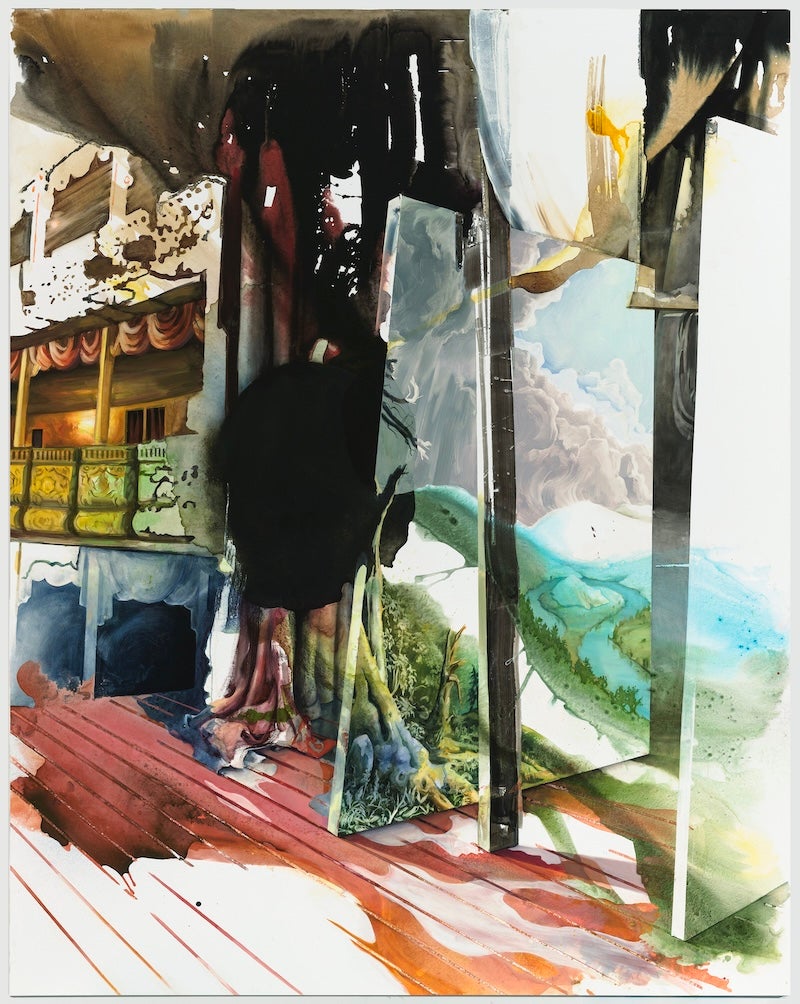
Stage Right, 2023, Ink and oil on canvas, 88 x 64 inches.
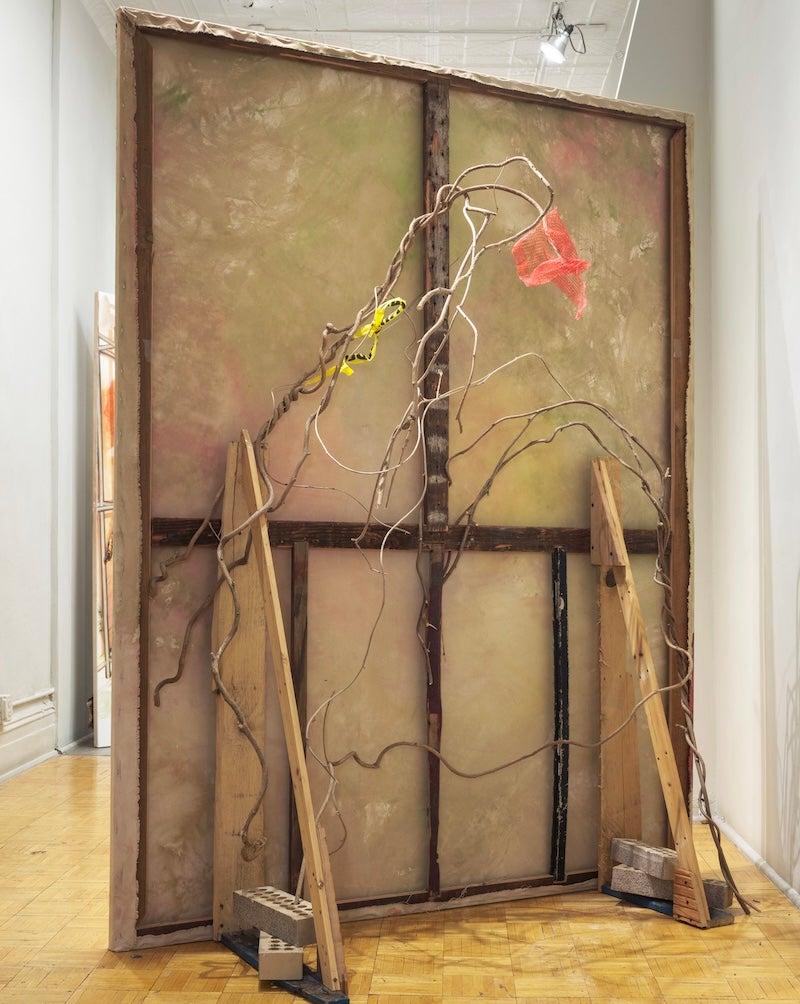
Stage Right (back view).
While Wagner has always been a storyteller, at Oberlin she honed her skills and found both her individual voice and a sense of community.
“The creative writing program is quite strong because there’s so much individual focus and attention between the students and faculty,” she reflects. “Because of the small class size and the community nature of the program, we all grew very quickly together.
The art education that I received at Oberlin was very supportive and helped me develop my individual voice. It was a ‘yes, and…’ program ... [as well as] expansive and playful and community oriented.
In fact, her time at Oberlin continues to fuel both her career and work. Wagner met two of her best friends in an art history class her second year; today, one of those friends is curating at MoMA, and the other is the director of development at PS1. For about seven years after her graduation, she also worked under a number of artists, particularly painter Julie Heffernan, whom she’d originally met by bringing her to Oberlin as a visiting artist; Wagner later taught under Heffernan at Montclair State University.
“If you learn how to learn, which Oberlin is good at teaching, and you get into a dedicated and sustained way of working, then you can carry that forward,” she says.
To Wagner, “the best part about Oberlin is the people and the rigor of thinking and the richness of ideas,” she says. “We live in a time where imagining a different political system or imagining a brighter ecological future feels difficult. I feel that the Oberlin community was more willing to go out of their comfort zone and take time out of their day and make decisions to bring a slightly better world forward.”
Oberlin’s BA+BFA in Integrated Arts program combines the rigor of an arts school with the well-rounded, interdisciplinary education of a liberal arts college. Learn more about this five-year program that’s tailored to each student’s academic and artistic interests.
You may also like…
Oberlin Welcomes New Integrated Arts Faculty
Visiting artists Ian Page ’08 and Scott Crandall bring their talents to new BA+BFA program.
Jane Wickline ’21 Finds Community in Comedy
A Q&A with the Saturday Night Live cast member and Dukes cofounder
Center for Media and Integrated Arts Taking Shape
New Center for Media and Integrated Arts to debut in fall 2027.