Building Blocks for a Dynamic Future
October 21, 2026
Rory Gielty ’27
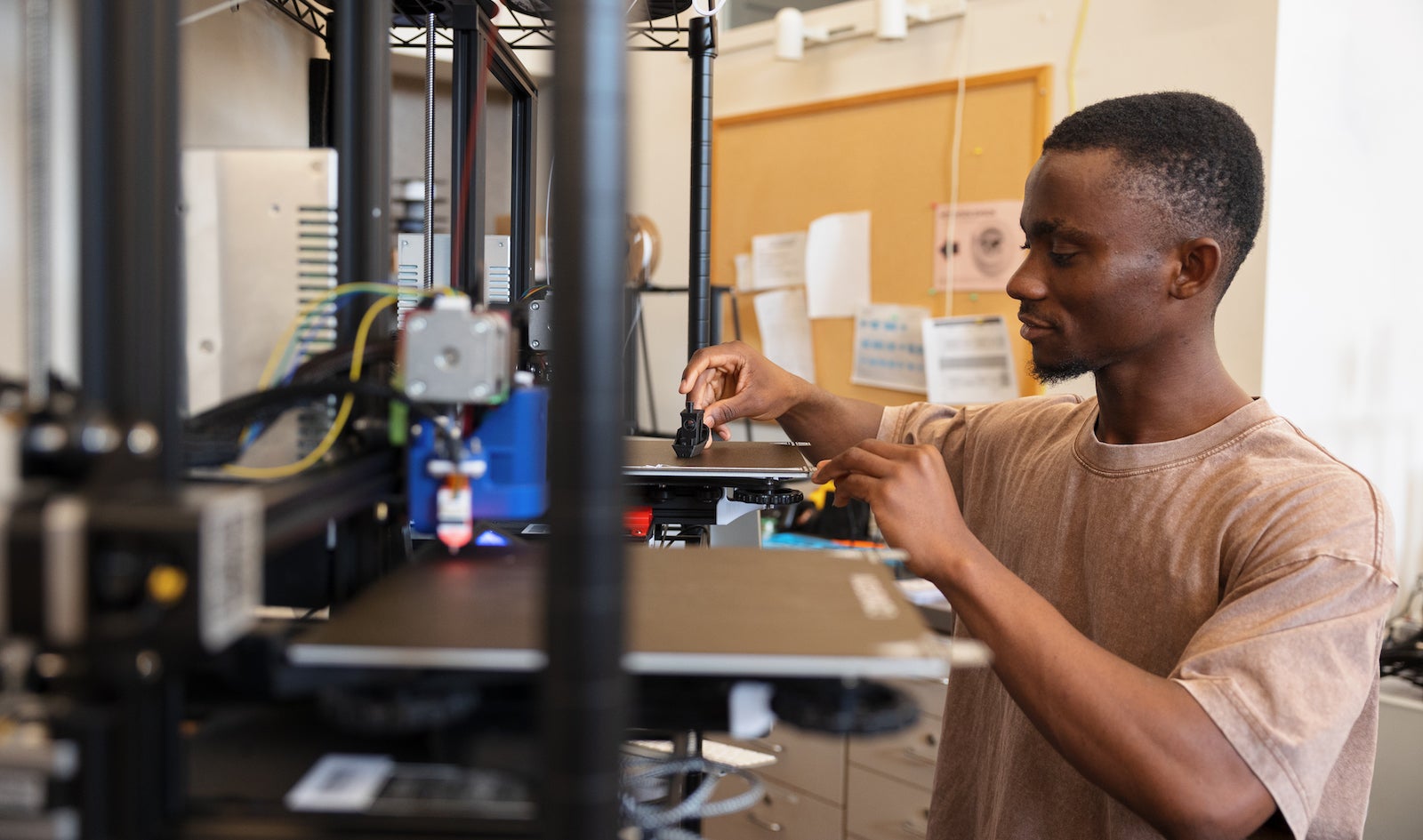
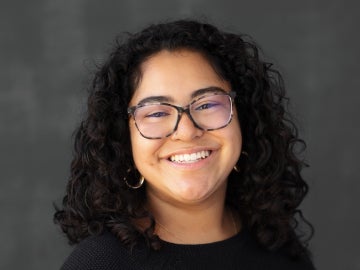
Header photo: “Oberlin is an environment where everyone wants to learn across fields, too. Getting this liberal arts education with my engineering degree helped me know I was in the right place.”
Header photo credit: Tanya Rosen-Jones '97
Frank Kusi Appiah ’29 started tinkering with technology as a kid, learning how devices work by fixing his friends’ broken electronics. In 2023, his passion for building brought him from Kumasi, Ghana, to the U.S., to compete in the Robofest World Championship with his high school’s robotics team. The team won two titles with their autonomous robots: one for completing timed tasks the fastest, and another for the “BottleSumo” challenge, where the robots push water bottles (or other competitors’ robots) off the table.
When he began searching for the right college, Kusi Appiah was drawn to Oberlin for its engineering and research opportunities, in and outside the classroom. He joined the 3–2 Engineering Program, where students spend three years at Oberlin studying the liberal arts and then attend an affiliated engineering school for two years, earning two degrees: a bachelor of arts and a bachelor of engineering.
“I’m a very curious person, and I never like being limited to one field,” he says. “Oberlin is an environment where everyone wants to learn across fields, too. Getting this liberal arts education with my engineering degree helped me know I was in the right place.”
Kusi Appiah quickly made an impact, founding the Oberlin Engineering Club. Created as a community and resource hub for 3–2 Engineering students and others interested in engineering projects, the space is now a place for students to explore academic pathways, formal research opportunities, and learn from each other.
Kusi Appiah also connected with Oberlin’s community of STEM staff, faculty, and students as part of the STRONG (Science and Technology Research Opportunities for a New Generation) program. STRONG Scholars come from backgrounds traditionally underrepresented in STEM. Throughout their first year at Oberlin, the cohort builds a close community through a specialized pre-orientation, a first-year seminar class, faculty mentorship, and residence in a dedicated “Roots in STEM” living and learning community.
His STRONG Scholar experience taught him to “think beyond the technical side of engineering,” he says, and specifically calls out a first-year seminar, Research and Reasoning, taught by Professor of Neuroscience Gunnar Kwakye. “It exposed me to writing research papers and how to criticize my methods. Now, when I’m doing something scientific, I approach it the way I was taught in that class.”
STRONG also allowed Kusi Appiah to design his own Winter Term research project. Under the guidance of faculty mentor David H. and Margaret W. Barker Associate Professor of Computer Science Adam Eck, he used machine learning to improve outcomes in micro-agriculture.
“We deployed sensors to get data on temperature and soil moisture in the winter, so algorithms can analyze and predict the environmental conditions in the near future,” Kusi Appiah says.
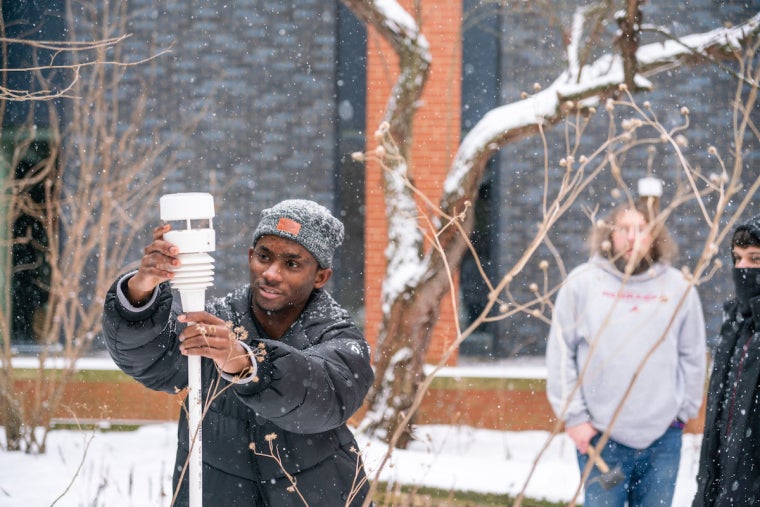
Environmental engineering work has since come to define his time at Oberlin. Beginning in summer 2025, Kusi Appiah has worked with Paul Sears Distinguished Professor of Environmental Studies and Biology John Petersen ’88.
Kusi Appiah manages hardware and software for Environmental Dashboard, a project co-founded by Petersen which displays real-time data visualization on water and electricity usage from the college and buildings in the Oberlin City School District. His longevity with the project allowed him and Petersen to assess when their technology wasn't working anymore, and design a pilot test for upgraded sensors.
Recently, Kusi Appiah and Petersen were awarded an AI Micro Grant through the college to pilot a unified events calendar for the campus and City of Oberlin. They proposed the use of AI for web scraping and aggregation from Oberlin’s existing calendar websites into one source; then, the event entries are then reviewed by the human team.
“We know there are concerns about AI, and we know AI is not always right,” Kusi Appiah says. “We want to use it as a tool, not a replacement for us—that’s where the human review comes in. A single calendar subscription can help our community stay connected.”
This summer, Kusi Appiah plans to go back to Ghana and apply his knowledge of sensor technologies to build something to visualize the environmental impact there. Next year, he plans to attend Columbia University. His long-term goal is to start an agricultural engineering company in Ghana, creating technological solutions for land and crop production.
“I’ve always liked coming up with solutions for problems I have, and sometimes they’re useful for others, too. But now, I know to ask, ‘Are my solutions good for society?’ and ‘How do they affect the people using it?’” Kusi Appiah says. “Technology should be used to help humanity. Whatever that involves, is my focus.”
Learn more about studying engineering at Oberlin and the undergraduate research opportunities available to students.
You may also like…
The ABCs of STEM Research
At Oberlin, undergraduates work alongside faculty members on incredible scientific breakthroughs.
From Capitol Hill to Mellon Mays: A Journey in Engaged Scholarship
Through CELA, Aina Tasso ’27 integrates Bonner service, Congressional internships, and Mellon Mays research to build a future in scholarship and public service.
Advancing AI Accessibility and Policy
Oberlin student Tanisha Shende ’26, a Goldwater Scholar and STRONG program participant, bridges the gap between generative AI innovation, disability accessibility, and international tech policy.