
Student Project Profile
A Framework for Passive Machine Sensing
Project Title
A Framework for Passive Machine Sensing
Faculty Mentor(s)
Project Description
Modern sensing systems such as radar and LiDAR actively transmit signals into the environment to detect and track objects. My research explores a different approach: whether machines can recover meaningful information using only light already present in the environment. I developed a computational framework that combines observations from multiple low cost cameras to detect and reconstruct the three dimensional motion of objects that may be too small, distant, or faint to identify in any single image. By accumulating weak evidence across multiple viewpoints and over time, the system can recover trajectories that would otherwise remain hidden within image noise. Throughout the project, I developed simulation environments, evaluated different multi camera fusion strategies, and performed real world experiments using synchronized camera arrays. This work demonstrates that passive camera systems can provide three dimensional spatial awareness without emitting any signals, opening possibilities for applications such as bird strike prevention near airports, low signature drone detection, and other situations where traditional active sensing systems may be impractical.
Why is your research important?
Many existing sensing technologies require specialized hardware, consume significant power, or reveal their own presence by transmitting signals. My research explores whether passive camera arrays can provide meaningful three dimensional awareness at lower cost while remaining completely passive, potentially making advanced sensing more accessible across a wider range of applications.
What does the process of doing your research look like?
My research combines software development, simulation, experimentation, and data analysis. I build computational models, evaluate them under controlled simulated conditions, perform real world testing, analyze the results, and continuously refine the framework based on what each experiment reveals.
What knowledge has your research contributed to your field?
This research demonstrates how weak visual evidence can be combined across multiple cameras and over time to recover object motion that would otherwise remain hidden in noise. It also explores the practical challenges of deploying passive multi camera sensing systems outside of simulation, including calibration, synchronization, and camera placement.
In what ways have you showcased your research thus far?
I presented my work through the Oberlin Summer Research Institute and shared the project through presentations, demonstrations, and visualizations showing both simulated and real world experiments. The project includes interactive demonstrations that illustrate how the framework reconstructs object motion from noisy visual data.
How did you get involved in research? What drove you to seek out research experiences in college?
I had an idea I wanted to explore, so I started looking for a professor who would give me the freedom to pursue it rather than assigning me an existing project. Professor Zeinab Mohamed was willing to let me develop that idea, and that's how this research began.
What is your favorite aspect of the research process?
I found the simulation and synthetic testing stage the most rewarding because it let me quickly test ideas and understand how the system behaved. Real world testing, on the other hand, is much more demanding than everything that can go wrong usually does, from calibration and synchronization to lighting and hardware issues but overcoming those challenges is ultimately what makes the research meaningful.
How has the research you’ve conducted contributed to your professional or academic development?
This project strengthened my skills in computer vision, computational modeling, simulation, data analysis, and scientific communication. It also reinforced my long term goal of developing new sensing technologies that can eventually become real world products.
What advice would you give to a younger student wanting to get involved in research in your field?
Don't think too hard.
Students
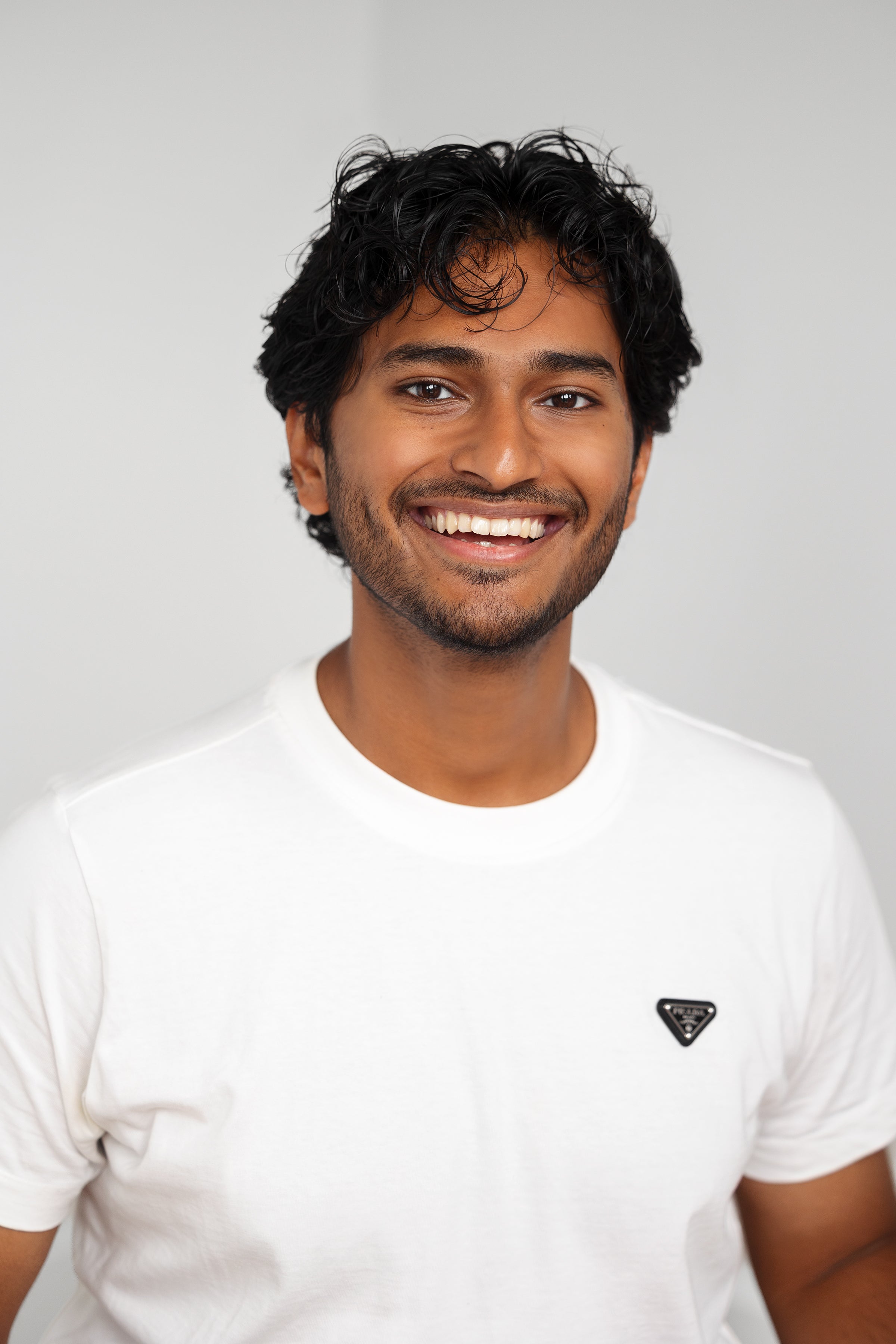
Zarif ’28
- Major(s):
- Engineering