Student Project Profile
Effect of Curli on E. coli Biofilm Growth
Project Title
Effect of Curli on E. coli Biofilm Growth
Faculty Mentor(s)
Project Description
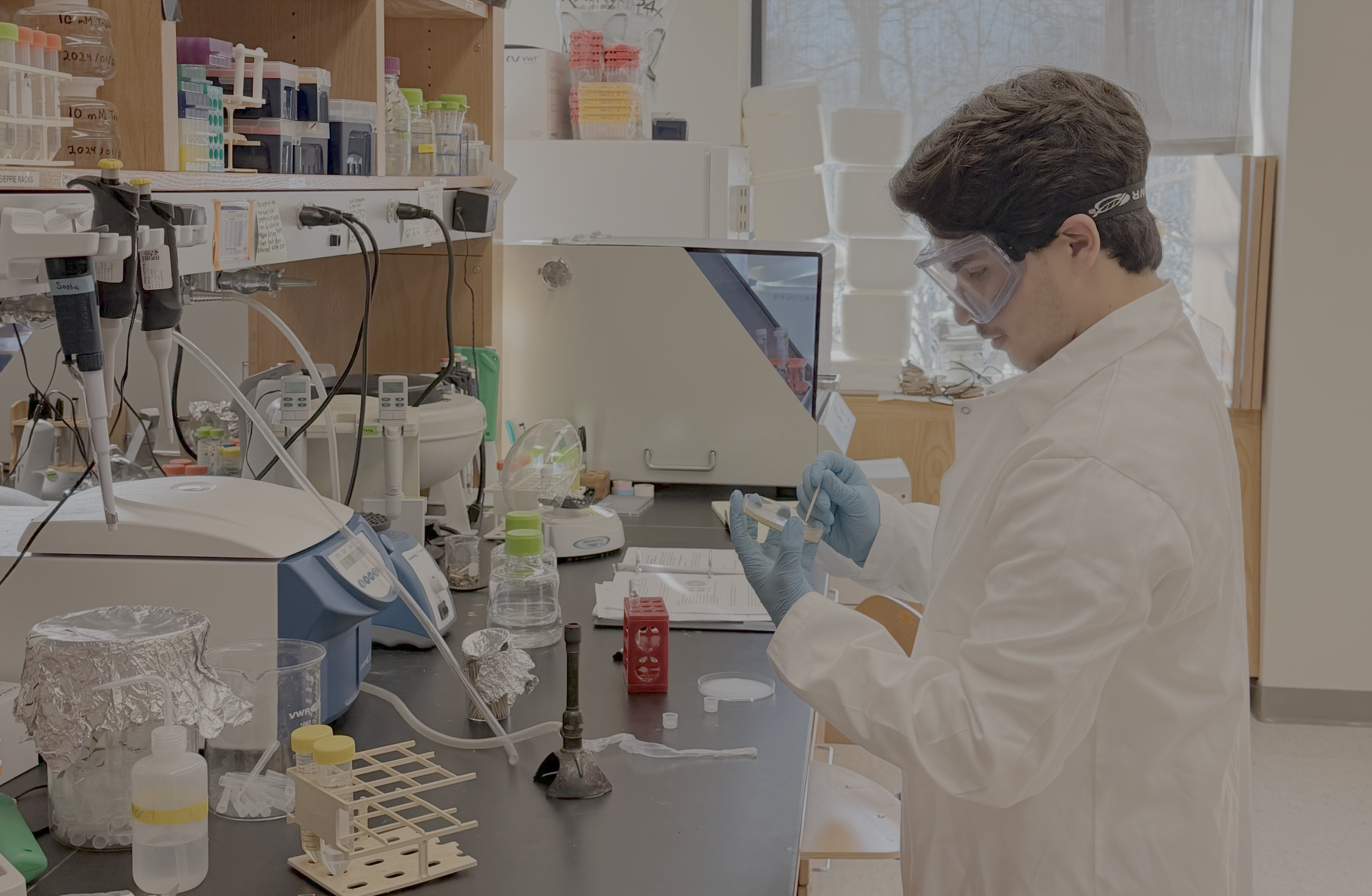
Rowan Duncan '29 handles E. coli experiments in the Ryno Lab
Project Description:
Bacterial biofilm is an aggregation of individual cells that enhances the fitness of the colony and increases antibiotic resistance. Biofilm requires the presence of nutrients and extracellular structures to support its growth; consequently, the Ryno lab seeks to explore how different sugars contribute to bacterial growth. In my specific research, I am exploring how the absence of the csgA gene, which codes for a specific extracellular structure called curli that improves surface attachment of growing biofilms, in a strain of E. coli affects its biofilm growth in media containing different sugars. We conduct colony and lawn growth experiments in which the strain is grown in a 37 °C incubator for 48 hours. These experiments will allow us to gauge the importance of curli in biofilm growth and what sugars most contribute to the growth of biofilm in the absence of curli. Additionally, this could inform us of what sugars to avoid, those that enhance biofilm growth and stability, when using specific classes of antibiotics.
Why is your research important?
Exploring how the presence of curli impacts biofilm growth will help determine the exact mechanisms behind biofilm growth and further efforts combating antibiotic resistance.
What does the process of doing your research look like?
My research involves the creation of bacterial growth plates composed of different sugar mediums which are swabbed and pipetted with bacterial colonies and left to grow in an incubator. After 48 hours the mass and size of these colony and swab growths are collected and the data is interpreted.
What knowledge has your research contributed to your field?
My research has produced data that hints at the speculation that certain sugars do not affect the mass growth of E. coli strains that do not contain curli however
In what ways have you showcased your research thus far?
I have presented at the STRONG Winter Term symposium along with my fellow STRONG scholars.
How did you get involved in research? What drove you to seek out research experiences in college?
I shadowed at a hospital in my hometown for a few months and observed firsthand how important research on bacterial antibiotic resistance is. This led me to seek opportunities where I might learn more about the topic and aid in the combating of this phenomenon in any way possible.
What is your favorite aspect of the research process?
I thoroughly enjoy the wet lab work. Although sometimes tedious, learning all the new procedures and perfecting the methodologies was the most rewarding part.
How has working with your mentor impacted the development of your research project? How has it impacted you as a researcher?
My mentor has been instrumental in helping me become acquainted with not only the specific methodologies of the lab, but the research process as a whole and has introduced me to what research as a profession would be like.
What advice would you give to a younger student wanting to get involved in research in your field?
I would advise them to pursue any opportunities they can and if they find themselves not enjoying the work of a particular lab, to keep pursuing other research opportunities until they find a fit for them.
Students