
Student Project Profile
Quae tibi causa fugae: Destabilizing the Ovidian Spectacle Through Female Character Focalizers and Storytellers
Project Title
Quae tibi causa fugae: Destabilizing the Ovidian Spectacle Through Female Character Focalizers and Storytellers
Faculty Mentor(s)
Project Description
My research examines how Ovid develops a distinct mode of focalization for female characters and internal narrators that destabilizes the ocularcentrism of the ‘male gaze’ in the Metamorphoses. Focalization- the perspective or viewpoint through which a narrative is presented- controls what information the reader receives and how they receive it, thus influencing the way the reader interprets the story. Male character focalizers in the Metamorphoses often filter information through a sight-heavy perspective which corresponds to the manner in which readers are most accustomed to receiving information in a text. On the other hand, female character focalizers frequently present information through senses other than sight, like sound or bodily sensation. These are often sensory channels the reader is less familiar with interpreting, contributing to an interpretive process centered on the familiar male perspective. As a result, there is a critical lack of understanding of the ways in which female character focalizers “communicate” with the audience. Through the close reading of Ovidian tales in conjunction with the theoretical frameworks of Mieke Bal, Jacques Derrida and Wolfgang Iser, my research seeks to explore the ways in which Ovid challenges the reader’s interpretive process through unconventional modes of female focalization and to illuminate new opportunities for Ovidian criticism which recenter the female voice.
Why is your research important?
Readers have power, and as Western readers, we typically assume other cultures read and interpret narrative like we do, predominantly through a process of visual signification. However, this isn’t always the case, whether in Ancient Greek and Latin literature or in world literature more broadly. Through my research, I hope that decentering sight as a dominant interpretive power can help readers appreciate the narrative complexity of Ovid’s work, as well as aid readers in understanding how they too can destabilize systems of power through a nuanced and intentional reading practice.
What does the process of doing your research look like?
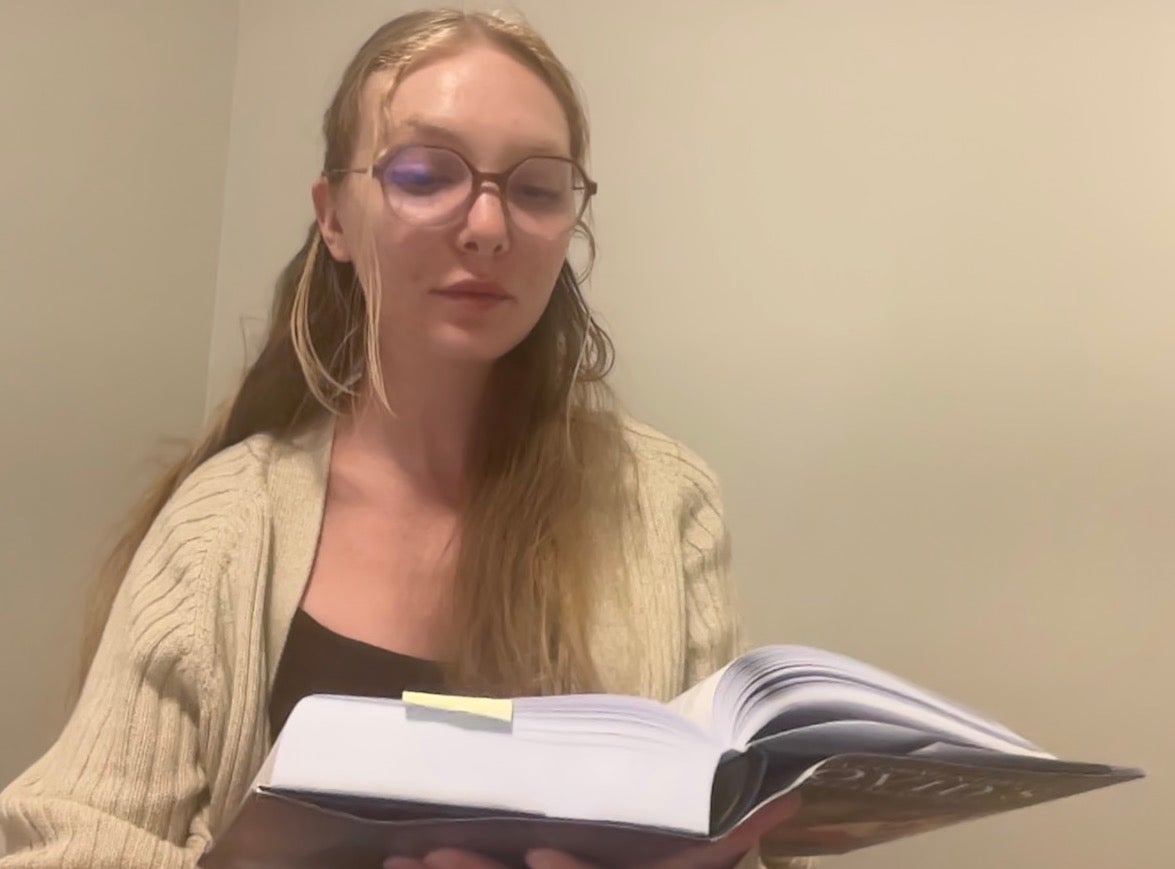
I spend many long hours in the library, pouring over many books with many cups of coffee. As I freewrite, draft and edit, I typically have one copy of the Latin text, one lexicon, two commentaries and about seven secondary sources piled onto my desk. It gets crowded!
What knowledge has your research contributed to your field?
The manner in which Ovid crafts his poetry through sensory cues and synaesthetic narration has been little understood by classicists, if at all. My research brings this vocabulary and way of understanding narrative to Ovid’s Metamorphoses and explores its capacities as an interpretive modality.
In what ways have you showcased your research thus far?
So far, I have presented my research both formally and informally throughout the Oberlin Summer Research Institute (OSRI), culminating in a final presentation at the Summer Research Symposium. In the future, I hope to attend one of the undergraduate conferences for Classics and present my paper. Most of all, I enjoy chatting individually with my peers and learning about their research as well!
How did you get involved in research? What drove you to seek out research experiences in college?
The project I’m currently working on happened to evolve organically out of a final paper I submitted for a class on postmodern literary theory. While writing and researching that paper, I realized I had stumbled into a much larger issue that had not yet been given much attention in Ovidian scholarship. Fortunately, I had the opportunity to apply for OSRI and start work on this project over the course of the summer.
What is your favorite aspect of the research process?
Reading Latin literature, and especially Ovid, has changed the way in which I understand the world through language. When language so heavily influences how we see and describe our realities, learning there is another way to navigate our lives linguistically provides a powerful agent for change.
How has working with your mentor impacted the development of your research project? How has it impacted you as a researcher?
Professor Trinacty and I have different interests, priorities and sensibilities as readers, and having that alternate perspective has been especially valuable in expanding the scope of my research and viewing problems I encounter from new angles. Additionally, through Professor Trinacty’s mentorship, I have found a greater sense of confidence in my ideas and my work.
How has the research you’ve conducted contributed to your professional or academic development?
Conducting research has helped me become a better writer, communicator and collaborator. In addition, I have developed intention for my work, the ability to set clear and achievable goals, and the grit to carry through long projects, all of which will be helpful in academia and beyond.
What advice would you give to a younger student wanting to get involved in research in your field?
It really only takes one passage, sentence, or word to spark an idea that becomes a larger project. Hold on to what stands out, and your experience, curiosity and intuition will guide the rest!
Students
Lily MacDonald ’27
third-year- Major(s):
- Latin Language and Literature, Greek Language and Literature