
Student Project Profile
Perceiving Minute Differences in Sound: A Percussionist’s Approach
Project Title
Perceiving Minute Differences in Sound: A Percussionist’s Approach
Faculty Mentor(s)
Project Description
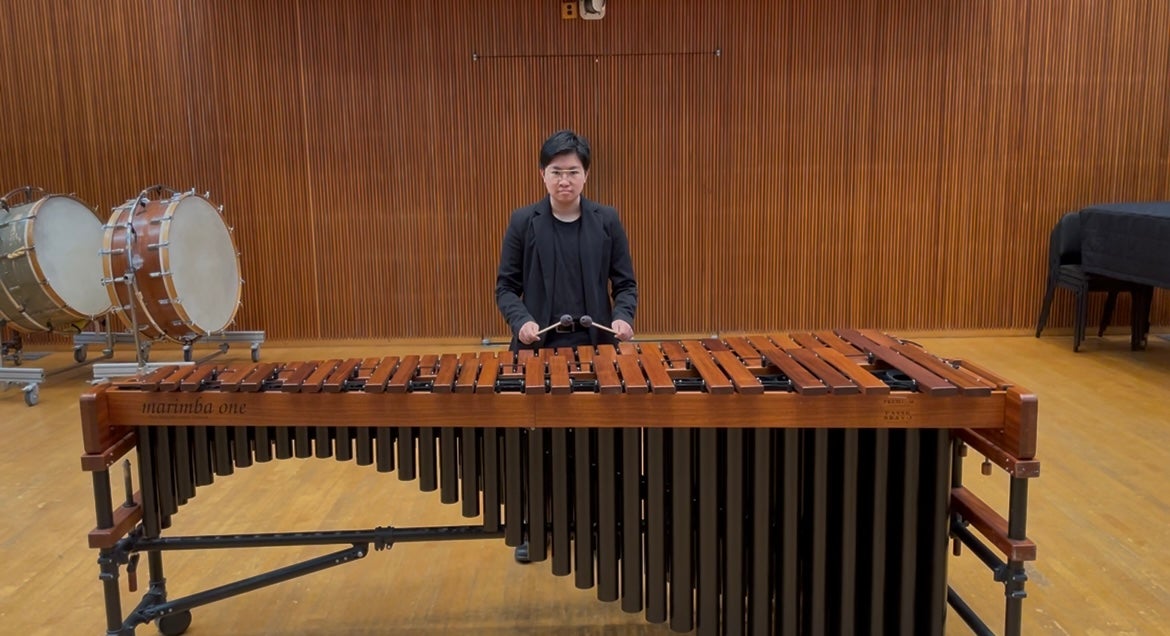
I am researching how minute changes in mallet hardness and drum size affect how participants perceive the musical sounds. I’m interested in the small choices that music performers make that influence how instruments can sound. Additionally, I’m interested in how those who see these instruments play a role in what they hear. I ran three experiments to test if slight differences in mallets could be perceived, and how the diameter of a bass drum would affect the perception of the sound duration.
Why is your research important?
I am a percussion performance major, and in my studio we often do “Coke-Pepsi tests” whenever someone is unsure about which mallet to use in a piece. We blindly listen to a few different mallets hit the instrument, then we decide which mallet produces the sound we believe fits the context better. We do this because we think these minor instrumental choices have an impact on what we, and others hear. Interestingly, there has already been research done on the marimba, Schutz and Lipscomb (2007), that shows how our vision can overwrite what we hear. I am interested in to what degree can we expand on this, to what degree do these small choices we make matter, from the visual, to the aural.
What does the process of doing your research look like?
My research involves a lot of me thinking critically about what it means to be a performer, so it was important to make the stimuli for my study mirror how I approach performing as a conservatory student. I selected mallets that varied slightly in hardness levels to use for my experiment, and my mentor and I went to Warner Concert Hall to record the stimuli and play with sound. When analyzing the data, I thought of reasons why participants with and without musical experience answered the way they did.
In what ways have you showcased your research thus far?
Over the summer, I presented my research at the Oberlin Summer Research Institute Symposium. I also intend to present my findings to the Oberlin Percussion Studio in the fall.
How did you get involved in research? What drove you to seek out research experiences in college?
As a conservatory student, summer is all about attending music festivals and gaining more performance experience. I figured I also needed to do something to supplement my college degree, and research seemed like the best fit. I met with Emily Spezia-Shwiff, she put me in touch with Prof. Gardner, who was happy to work with me.
What is your favorite aspect of the research process?
I’ve really enjoyed collecting and analyzing data, it was exciting to see if the data aligned with my hypothesis or if it told a completely different story. I’ve also been able to apply what I’ve learned to my own study. Although I usually look at music through a qualitative lens, I like to think about it with regards to hypotheses and statistics as well.
How has working with your mentor impacted the development of your research project? How has it impacted you as a researcher?
Before pursuing research, I knew very little about music cognition, but Prof. Gardner showed me some of what the field can encompass. He helped guide me through the process of conducting my own study, and has introduced me to literature that has made significant contributions to the field of music cognition. He also promotes making time to think when researching which has helped me come back to my work with a clear mind and new ideas.
How has the research you’ve conducted contributed to your professional or academic development?
Conducting research has been another outlet for me to engage with my two fields of study. It’s been a way to strengthen my reading and data analysis skills, as well as learn how to design my own experiments. Since participating in Oberlin Summer Research Institute, I hope to continue conducting research in the music cognition field.
What advice would you give to a younger student wanting to get involved in research in your field?
Reach out to Oberlin Undergraduate Research and they’ll help you find a starting point, it’s ok not to have any experience at all! If you are a dual degree student, don’t be afraid to combine your two fields of study! Look for a connection between the two and dive deeper!
Students

Axel Martin ’28
third-year- Major(s):
- Percussion Performance, Psychology