
Student Project Profile
Does Estradiol Affect Cocaine-Induced Impulsivity and Dopamine Release?
Project Title
Does Estradiol Affect Cocaine-Induced Impulsivity and Dopamine Release?
Faculty Mentor(s)
Project Description
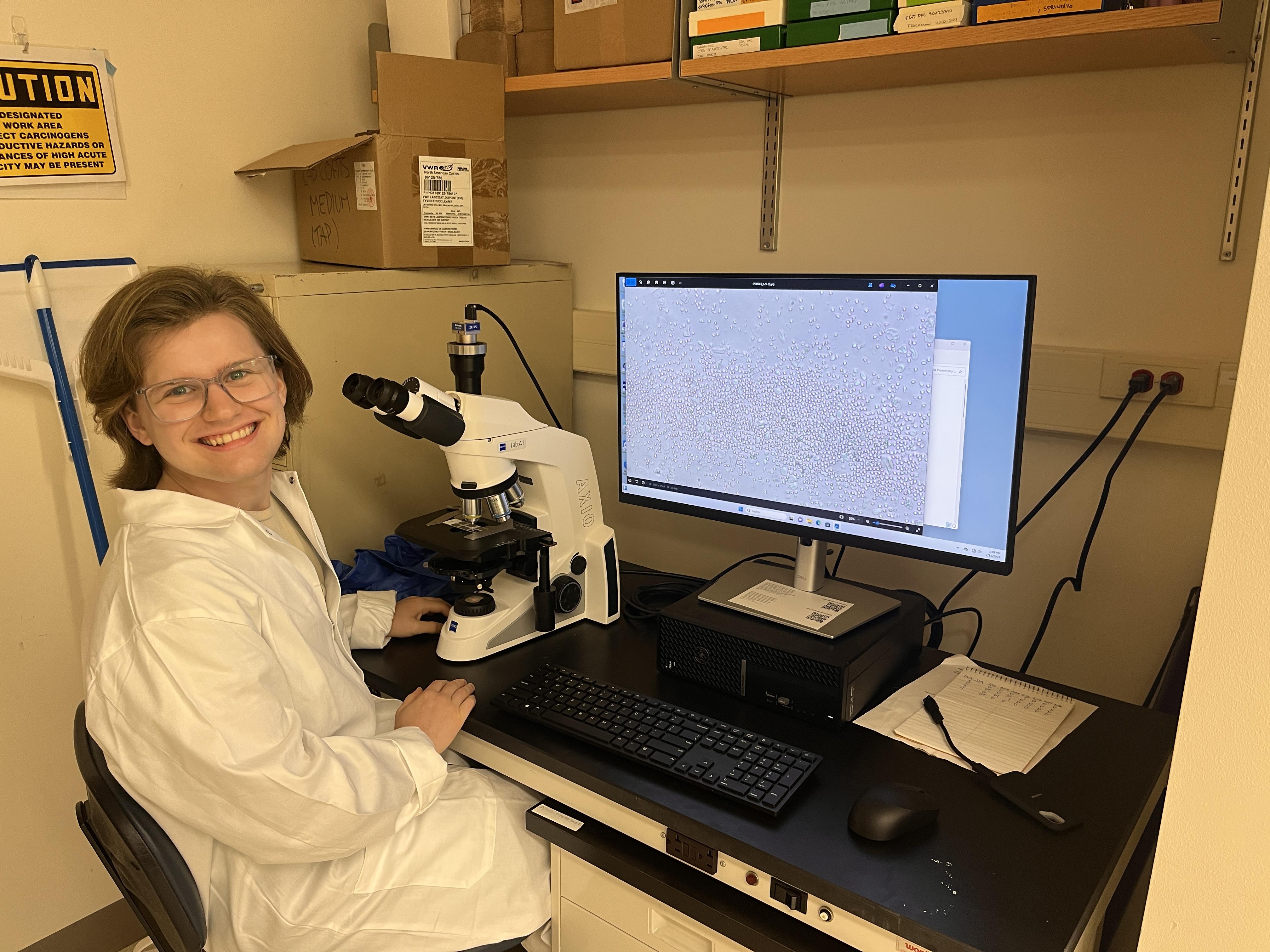
The project employs a rat model to examine the effects of the ovarian hormone estradiol on two facets of cocaine use: impulsivity and dopamine release. We are assessing impulsivity with a task called differential reinforcement of low rates of responding (DRL), in which rats are trained to wait to press a lever for a food reward. We are also using fiber photometry to measure dopamine release in rats’ brains on a moment-to-moment basis. By performing these tests in ovariectomized females and administering cocaine with and without estradiol, we can investigate the potential synergistic interactions between estradiol and cocaine and how they pertain to dopamine and impulsive behaviors.
Why is your research important?
Evidence shows that women tend to progress faster from controlled cocaine use to full-blown cocaine use disorder, take greater amounts of cocaine, and tend to experience more severe withdrawals when compared to men. However, research into treatments for cocaine use disorder is generally oriented toward men.
What does the process of doing your research look like?
We train the DRL rats daily and drug test them during the DRL training a few days per week. We perform fiber photometry several days per week as well.
In what ways have you showcased your research thus far?
I have presented at the Oberlin Undergraduate Research Symposium in spring 2025 and the Oberlin Summer Research Institute Symposium in summer 2025.
How did you get involved in research? What drove you to seek out research experiences in college?
I became interested in research in my first year, but I wasn’t quite sure what I wanted to study. During my second year, I took Neuropharmacology with Prof. Tracie Paine and I really enjoyed the lab experiments. I joined her lab during the winter term of my third year.
What is your favorite aspect of the research process?
I love running behavior experiments on the rats. It’s fascinating to watch how their behavior changes in response to different drugs in real time.
How has working with your mentor impacted the development of your research project? How has it impacted you as a researcher?
Prof. Paine and I have spent a lot of time troubleshooting when our experiments didn’t go as originally planned. She has taught me how to handle unexpected setbacks in research while staying patient and having a good sense of humor.
How has the research you’ve conducted contributed to your professional or academic development?
Conducting research full-time this summer has solidified my plans to pursue a career in research after I graduate. Also, my research this summer has served as a gateway to my honors project which I am starting this fall.
What advice would you give to a younger student wanting to get involved in research in your field?
It can be competitive to get a spot in a lab, so cast a wide net and be persistent. If you don’t get into a lab the first time you ask a professor, don’t take it personally and don’t let it discourage you. Even if their lab is full now, they might have an open spot a semester or two down the line.
Students

Julian Hurley ’26
fourth-year- Major(s):
- Neuroscience