

Volume 1 — 2025
Oberlin Research Review
A Galaxy of Options
Associate Professor of Physics Jillian Scudder is making sure astronomers can trust old data before leaping into new research.
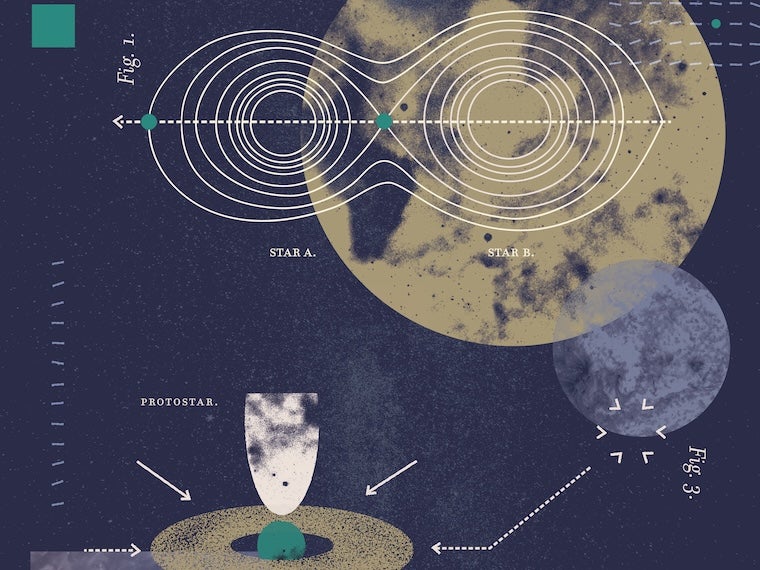
Photo credit: Andrea Wang ’19
More Stories
Building Blocks
How Shuming Chen uses virtual chemistry to develop real-world solutions

Unpacking Baffling Bacterium
Gaybe Moore ’15 has made a genetic library to help uncover the secrets of the bacteria Caulobacter crescentus.

Agents of Change
Adam Eck is studying whether artificial intelligence-powered robots can fight wildfires more efficiently.

Active Learning, Transformative Education
Cynthia Taylor ’02 is identifying the most effective ways to teach computer science—and understanding how to make it easier for professors to adopt them.

Marketing For Good
Cindy Frantz and John Petersen ’88 found that leveraging stealth marketing can encourage pro-environmental thoughts and action.

The Drawbacks of “Black Don’t Crack”
Alicia Smith-Tran ’10 investigated how looking younger can be detrimental to the professional lives of Black women.

Telling Complicated Stories
Sebastiaan Faber asked Spaniards how they deal with their country’s dictatorial past—and their answers explain the politically polarizing present.

The New South
In her new book, The Jewish South: An American History, Shari Rabin finds unexpected stories of the lives of Jews in the South.

Transcending the Atlantic
Studying amulet pouches associated with the African diaspora in 17th- and 18th- century Brazil helped Matthew Rarey uncover hidden history.

The Meaning Behind the Motions
Samuel Gardner reveals the profound ways a musician’s gestures deepen our connections to music.

A Cosmic Duet
For Julia Christensen, the distinctive convergence of art and technology is explored through connections with leading aerospace engineers—and the music created by trees.

Expressive Machines
How Steven Kemper’s musical robots enhance human creativity.

Why All Life on Earth is Made of Cells
Associate Professor of Biology Aaron Goldman wants to know how and when cellularity became the organizing principle of life.
Photo credit: Laurindo Feliciano
Oberlin Faculty on Research and Mentorship
Sebastiaan Faber, Latin American Studies
“There’s something really special about being there when students discover something new that is interesting to them, and seeing their passion ignite in the moment…”
Samuel Gardner, Music Theory
“Lately we’ve been really interested in this idea that, like if all pop songs have the same four chords, which as a music theorist is like, really kind of true, why does no one tell the difference?”
Cynthia Taylor, Computer Science
“I want my students who are passionate about equity and social justice and art and making the world a better place... I want them to be the people who are deciding what we use computers for...”