Where Sound Takes Shape
Oberlin’s recording arts and production major prepares students for a career in live performance and studio work.
April 29, 2026
Elizabeth Weinstein ’02
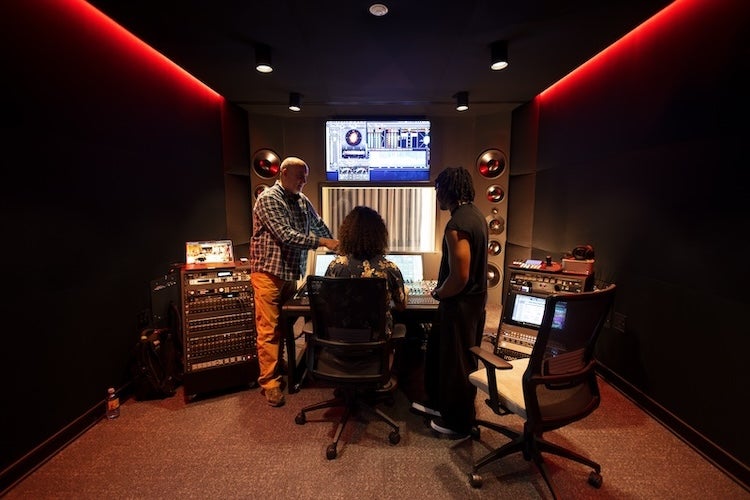
Photo credit: Tanya Rosen-Jones ’97
When Riley Newfield ’29 applied early decision to Oberlin, he hadn’t yet been admitted to the conservatory—he just knew the campus felt right. A guitarist who spent the pandemic learning Metallica and Black Sabbath, he first encountered studio work in high school while watching an engineer record his band, I’d Rather Sleep. “Being on the performance side of that process, I was really intrigued and wanted to learn more about how that works,” Newfield says. Now the student from Albany, California, who’s planning to pursue a Double Degree in music and Africana studies, is part of the inaugural cohort of the recording arts and production (RA&P) major.
Oberlin launched the major in fall 2024 in response to intense interest in a previous recording arts program geared toward postgraduates, says Associate Professor of Recording Arts and Production Andrew Garver, the cochair alongside Director of Conservatory Audio Services Andrew Tripp. That interest only continued to grow: Garver says they were aiming to enroll three students in the major’s first class but immediately expanded the program to six students per year due to the number of applicants.
Housed in the conservatory’s Division of Contemporary Music alongside composition and the electronic music-geared TIMARA, the program is grounded in both musical fluency and technical skill. Students take courses in aural skills, music theory, and audio engineering. They also work in the conservatory’s recording studio in Clonick Hall, which Garver describes as the audio equivalent of an IMAX theater: “You can hear every detail of what you’re doing.”
“A lot of what we learn in our first year is, ‘How do you plug a mic in correctly? How do you wrap a cable?’” Newfield says. “You get good at it—you get fast at it—by just doing it over and over.”
A tailored approach
By their second year, students are in the studio class alongside first-year students, recording several large ensemble performances a semester. “It’s about getting your hands dirty,” says Jay Musasa ’28, “navigating sound equipment, setting everything up for a performance—with large ensembles, the approach to recording is more sophisticated than a regular student recital.”
Musasa, a singer and multi-instrumentalist from Zimbabwe, came to Oberlin with experience in production and recording, but he hadn’t formally trained in music. “My idea of a studio session was doing top-line songwriting with a vocalist,” he says. “The approach to that is totally different from when you’re doing recording sessions for an orchestra or with classical music.”
Ultimately, Musasa was drawn to Oberlin for the opportunity to study music alongside business within a liberal arts curriculum. He produced his first album in high school, collaborating with Blank Space Records in South Africa, before signing a distribution deal with EMPIRE Africa. Musasa records music under the name WUNDERCHILD., blending his African roots with contemporary sounds. When he arrived on campus, he worried his sound wouldn’t fit. “Most of the music I make is a far cry from what a lot of other students here are playing and making,” Musasa says. “But the more I’ve grown, the less I feel out of place.”
The program gets more tailored as students progress. By the third year, students take on independent projects, choosing electives to specialize in live sound, studio work, or wherever their interests lead.
Musasa’s goal is to create music professionally with other artists and eventually compose for film. “The world of songwriting and producing isn’t something where you get a 9-to-5 job,” he says. “That’s part of why I decided to also get a business degree—I could channel it toward my music dreams.”
Professional preparation
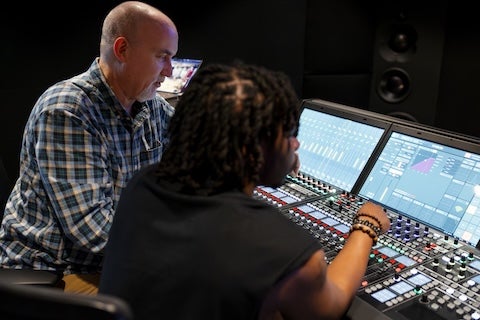
Before joining the conservatory faculty in 2015, Tripp worked at Music@Menlo, at the Aspen Music Festival and School, and as a freelance engineer in Cincinnati. Garver, who came to Oberlin in 2022, is a Grammy-nominated mastering engineer with more than 30 years in the industry. He worked at A&M Studios, cutting lacquer masters for vinyl—a high-stakes process with no margin for error—for albums by artists like U2, Rage Against the Machine, and Madonna.
Tripp and Garver bring complementary strengths to the major—the former on the musical side, the latter on the technical. In their classrooms, they focus less on specific gear or software and more on fundamentals.
“There’s the hobby approach, where you’re doing it for yourself and you’re really your own critic,” Garver says. “And then there’s doing this for other people. How do you get your expertise up to the level where people want to pay for the work you’re doing?
“It’s not just sitting in class talking theoretically about gear,” he adds. “It’s more, ‘Here are the pieces of gear—now go use them.’”
For Newfield, that has meant unlearning what he calls “privileging myself in the process” and instead focusing on supporting a performance from behind the scenes. After getting his start running sound for high school theater, he’s leaned into theatrical audio at Oberlin, working as a sound designer or assistant sound designer on student productions including Legally Blonde and the student-written Eurydice Tells Orpheus Goodbye.
“It’s another way that I can be part of a performance through the expertise I’ve gained,” he says, citing things like making sure the audience for a musical in Wilder Main Theater can hear the singers over the pit band. “Once you’re going, you’re going. There’s no going back and fixing something. It’s happening in the moment.”
For Garver, that’s ultimately what the training is for: catching dream moments in action.
Visit Oberlin Conservatory to explore more music opportunities for students.
You may also like…
An Obie’s Guide to the Juilliard String Quartet
“The most important American quartet in history,” now celebrating its 80th year, opens the Artist Recital Series at Oberlin on September 26.
When Stars Align
The Oberlin Contemporary Music Ensemble shines on Jennifer Koh ’97’s "The American Concerto, Volume One."
Telling Stories Through Sound: The Verona Quartet and Mendelssohn's String Quartets
Storytelling has always been at the heart of the Verona Quartet. With its latest release, the ensemble turns to a composer who knew something about transforming stories into music: Felix Mendelssohn.