Campus News
Robert W. Fuller ’56, 10th President of Oberlin College, Dies at 88
Physicist and author presided over the institution between 1970 and 1974.
July 29, 2025
Office of Communications
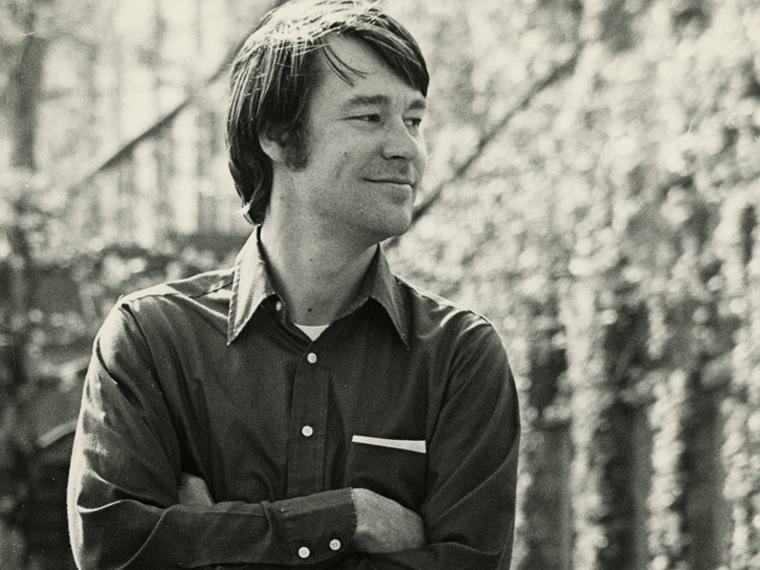
After leaving Oberlin, Robert W. Fuller became a celebrated author.
Photo credit: Courtesy of the Oberlin College Archives
Robert “Bob” Works Fuller ’56, the 10th president of Oberlin College, died July 15, 2025, in Berkeley, California. He was 88.
Fuller first arrived at Oberlin—at age 15—on a Ford fellowship. He was likewise just 33 years old when he was appointed Oberlin’s president in 1970 via unanimous selection, making him the college’s youngest president.
When Fuller returned to campus in the role of chief administrator, he described what it was like to rediscover Oberlin after 15 years away in an essay published in the December 1970 Oberlin Alumni Magazine:
“The commitment to academic and artistic excellence in itself is really a dual goal that no other institution has. Simultaneously with this commitment to intellectual excellence, there is the compassionate concern for mankind that permeates everything that occurs here. Many schools have one of these goals, and many have the other, but no school I know has both and recognizes so explicitly the interdependence of these two goals.”
During his tenure, Fuller worked diligently on initiatives in the spirit of his remarks, many of which transformed Oberlin’s campus and curriculum.

He tripled the enrollment of minority students, expanded coed residence halls, and hired Black head coaches, including the Olympic gold medal sprinter Tommie Smith. Fuller also supported construction of the Seeley G. Mudd Learning Center, which remains a cornerstone of campus today, as well as students’ feminist and gay liberation movements. In 1971, Fuller created the Committee on the Status of Women, on which his then-wife Ann L. Fuller was a member; the committee's research and work eventually led to the hiring of more women on the faculty and in administrative positions. Under Robert Fuller’s leadership, Oberlin also eliminated distribution requirements and incorporated student representation into the institution’s decision-making structure.
Fuller promoted the development of the modern dance program and the hiring of the first professional string quartet in the conservatory. He also established an Education Commission, through which several programs were created, including the innovative and beloved Inter-Arts Program, which fostered opportunities for interdisciplinary campus collaboration across multiple art forms. And as chairman of the Honorary Degrees Committee, Fuller recommended that trustees establish the Distinguished Community Service Award, which is now awarded annually to Oberlin-area residents who have made significant contributions to the community. (Ann L. Fuller received this award in 1991.)
“President Fuller’s contributions to the college met the moment, particularly how he created academic programs that responded to student interest,” says Oberlin President Carmen Twillie Ambar. “Among his many achievements, he created a Master of Fine Arts degree, which today can be seen as a precursor to our new BA/BFA program. My condolences to his friends and family.”
Born in Summit, New Jersey, Fuller earned an honorary bachelor’s degree from Oberlin at his 1970 presidential inauguration ceremony. He later earned a doctorate in physics at Princeton University. With the theoretical physicist John Wheeler, he coauthored a foundational paper on wormholes, “Causality and Multiply Connected Space-Time.” The paper’s emphasis on quantum topology inspires quantum gravity researchers today.
Fuller also taught physics and mathematics at Columbia University, as well as at Barnard and Wesleyan, and he coauthored the book Mathematics of Classical and Quantum Physics, which is still in print. After leaving Oberlin in 1974, he traversed the globe, devoting himself to causes he believed in, like arms control and world hunger. Later, he wrote several influential books based on the concept of “Dignity for All,” which he pioneered based on his travels and career experience.
Fuller returned to Oberlin several times, including by participating in reunion activities at the invitation of the Class of 1974. “We invited him to our 25th reunion, where he gave a packed auditorium of classmates, seniors, and others a speech on rankism,” says Jan Heininger ’74. “We invited him to join us for our 50th reunion in 2024 as an honorary member of the class and participant in our extensive weekend of activities, as well as a separate session with him on what makes Oberlin unique. We mourn his passing.”
Fuller leaves his beloved wife of 35 years, Claire Sheridan; children Karen, Ben, Noah, and Adam Fuller ’00; first wife Ann L. Fuller; and four grandchildren. For more information on his life and work, visit www.RobertWorksFuller.com and his New York Times obituary.
You may also like…
Oberlin Reimagines Humanities Education Through $1.487M Grant
New “HOPE” initiative centers humanities learning with real-world impact.
The ABCs of STEM Research
At Oberlin, undergraduates work alongside faculty members on incredible scientific breakthroughs.