Oberlin Alumni Magazine
How Alison Bechdel ’81 Blends Fact and Fiction
A Q&A with the writer and cartoonist behind "Fun Home."
May 11, 2026
Sloane DiBari ’27
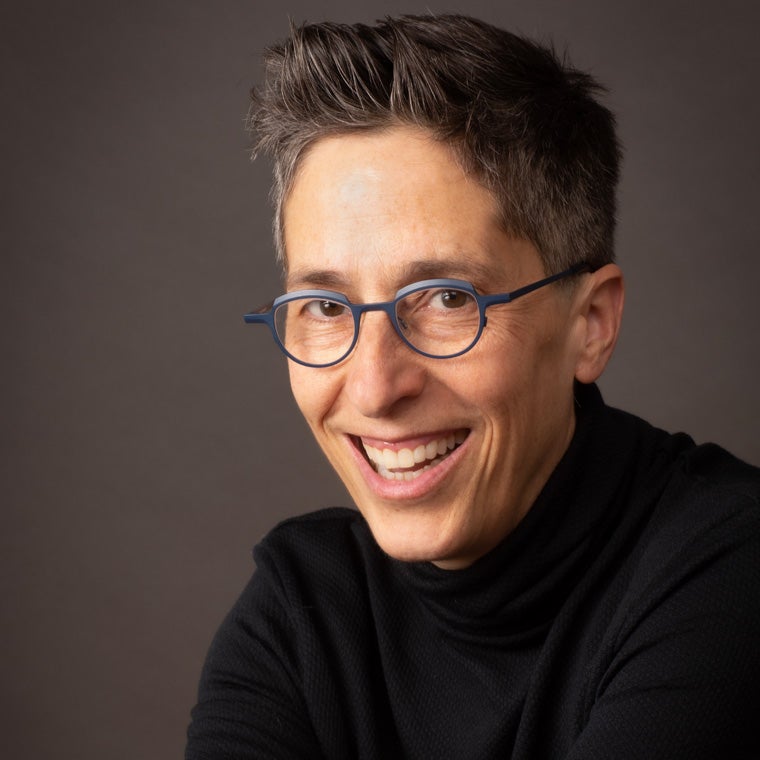
Photo credit: Elena Seibert
Alison Bechdel ’81 has been very busy since Oberlin last talked to her in 2018. She’s become a professor in the practice at Yale, published two graphic novels (2021’s The Secret to Superhuman Strength and 2025’s Spent), and has seen the musical adaptation of her landmark graphic memoir Fun Home produced at Oberlin for the first time, by the theater department.
For Bechdel, having her alma mater stage Fun Home was a full-circle moment: Much of her coming-out story takes place during her time as a studio art and art history student at Oberlin. “I guess I've gotten so used to the surreality of this story being out there in the world at all, in musical form, that this just seems like another funny meta twist in the whole thing,” Bechdel says.
Oberlin’s production of Fun Home comes relatively soon after the publication of Spent. The graphic novel calls back to Bechdel’s time on campus in a different sense: In Spent, Bechdel and her real-world partner, Holly Rae Taylor, are best friends with members of the colorful cast of Bechdel’s beloved comic strip Dykes to Watch Out For and become quasi-parental figures to two fictional, present-day Oberlin students.
Bechdel’s deft blending of fact and fiction doesn’t stop there: While she and Taylor really do live in rural Vermont, Spent takes their hipster lifestyle up a notch, placing the couple at the helm of a goat farm and sanctuary outside Burlington. With her signature acerbic wit—and plenty of fondness for Oberlin—Bechdel delivers a hilarious yet appropriately nuanced portrait of modern queer life in America.
On a snowy February afternoon, Bechdel spoke about Oberlin’s production of Fun Home, the anticapitalist values behind Spent, and the enduring idealism of college campuses.
This interview has been edited for length and clarity.
Sloane DiBari: Can you say more about that “funny little meta twist” you mentioned? That's an interesting phrase.
Alison Bechdel: It's just funny to think of my coming-out story at Oberlin being produced at Oberlin. Interestingly, this play was a Winter Term project. So much of my own coming-out process, and the stuff that went into the experiences I described in Fun Home, happened during Winter Term. I transferred to Oberlin after two years at another school in the fall of 1979, so a lot of the action in the book actually happens during Winter Term 1980.
I was taking this Ulysses seminar, which figures largely in the book; in fact, it structures the whole book, as we start to realize Alison’s in kind of an odyssey. But it was also a really dark and painful time for me. As a transfer student, I was still really lonely. Everyone else was already in the flow of their college career, and I came in late in the game and had a hard time meeting people.
I had realized I was a lesbian the previous November, and I was still in the thick of figuring out what that meant, and I hadn't told anyone. So, that Winter Term was just really potent, difficult, lonely, but a time very much filled with potential. I was reading everything I could about queerness, combing the campus library, the town library, the co-op bookstore.
There was a lot of independent and collaborative study that went into the production of Fun Home here. There was an exploration of the archives that the faculty director, Visiting Assistant Professor of Theater Katy Early ’16, was leading. How does it feel to know about some of the heart and the research that went into Oberlin's production?
That's super touching. I wonder what kind of stuff they came across?
They found old photos of queer students and queer couples and posters from the Gay Union [an Oberlin College student group that supported LGBTQ+ students through organizing efforts, programming, and community spaces], which is a thing in Fun Home, and other flyers for different queer student organizations.
In a way, that time feels very close to me. It was a huge part of my life, and it's very imprinted in my mind. It feels very present. But it was a long time ago. Generations of Oberlin students have come and gone over these decades. So that's weird, too, and just a funny kind of time travel to think of people revisiting my tortured Winter Term of 1980.
The other thing about that Winter Term was that I was desperate for people to come back to campus. It felt like a ghost town. So I was super lonely. My roommate was gone. All my friends were gone, my few friends that I had managed to make, and I was desperate for the semester to start, because I knew that's when this Gay Union thing was going to resume. I was determined to go to the first meeting I possibly could.
In an Oberlin Alumni Magazine Q&A with you in 2018, you talked about how different Oberlin was then from when you were a student. How does it feel for Fun Home to return to where a lot of it took place, but in this different cultural landscape?
I think that's more for people there now to say. What's it like to see this vision of life 40 years ago, or 45 years ago? Does it feel different? Obviously, it was a big deal then to come out.
One thing that I've been aware of my whole adult life after Oberlin is the rather rapid pace of progress in terms of acceptance of queer people. It was always kind of like, “Wow. This is really happening. This is amazing.” It was not something I expected would proceed so quickly or so thoroughly, like with the Supreme Court decision in 2015 about gay marriage.
And now, of course, we're learning that all that progress is easily undone. So, that's a strange moment, too. I'm not feeling terribly triumphant, like, “Oh, look at all the progress we've made.” I used to feel that way, but that is very much under revision right now.
Definitely. A lot of people still think of Oberlin as kind of a bubble in that regard. Do you think that persistent emphasis on progress and acceptance still exists at Oberlin?
I think that's the most wonderful thing about Oberlin. Clearly, it has persisted over time. I'm pretty certain that if I had transferred to any other college, I would not have come out as soon as I did. There was just something about the atmosphere at Oberlin, which was exactly what I needed then. People were talking about these things in a way that they weren't at other places, so I feel very lucky.
It's easy to poke fun at Oberlin’s incredible openness and progressivism, but it's real. It's a real thing and a worthy goal. I’m very proud of my association with it.
Something that I see in Fun Home and in your most recent book, Spent, is that you do kind of poke fun at Oberlin. But I feel like there's still a lot of affection there. How do you balance those two things?
That's what I've done in my whole career. I write about lesbians, I write about queer culture, I write about my own life. I'm poking fun at it; as a cartoonist, that's my beat. It's funny, because as the culture shifts and morphs in these strange ways around us, I can see now that maybe some people don't get the humor. Maybe some people think I'm making fun of these people, not laughing with them, and that's something I'm just recently thinking about.
What was the genesis for Spent? It's different from your other graphic novels in a lot of ways. It’s responding more directly to what's happening politically right now, kind of like your comic strip, Dykes to Watch Out For. How did that come together?
That book was going to be another straightforward memoir, like Fun Home or my memoir about my mother. [It was] very much exploring my own life in relation to money and privilege and capitalism, because that seemed to be a really pressing issue of the moment.
But when I started to write that as pure nonfiction, as a serious memoir, I just wasn't that psyched about it. I didn't want to have to learn about economics or have to think about that stuff. And it just turned into this funny mix of memoir and fiction. It's kind of about my real life. I don't actually live on a goat farm, but I do live in the country in Vermont, so there are a lot of similarities.
I’m merging memoir with my comic strip. I loved doing my comic strip because it was a way for me to look at what was happening in the world and try to make sense of it. I would have the characters often discussing what was going on politically, and people would air their different takes.. So it was nice to be able to get back to that, because I desperately need to figure out what's happening in the world right now.
How did you decide which characters from Dykes to Watch Out For to include in Spent?
I did try to get more of the characters into this narrative, but it was already too sprawling to fit any more people in. I chose the housemates [Stuart, Sparrow, Ginger, and Lois], this gang of people who live together in a group, because I feel like, in some ways, that was the core of this book for me.
The main character [in Dykes to Watch Out For] was Mo, but I'm kind of Mo, and here I was in this book, so I didn't need to bring Mo back. I was also Sydney, who came along later in Spent, the evil women's studies professor. I didn't need those guys because I represented that perspective.
And then I just love this communal gang. I feel like at this point in time, there's something very compelling about people choosing to live together in that collective way. It's just very moving to me. I never knew about co-ops until I came to Oberlin. I love this concept of being in solidarity with a group of people.
Was there anything else about that aspect of solidarity that informed Spent?
That felt like the opposite of capitalism: thinking about resource-sharing as opposed to resource-hoarding. That was just a fundamental opposition that I wanted to have in place.
There are quite a few references to Oberlin in Spent, particularly through JR, since they’re a student there. Speaking as a current student, your take on the mid-2020s Obie was spot-on. Where were you drawing from as you were creating that fictional Oberlin student?
Honestly, from my own experience at Oberlin, just that amazing purity of youthful idealism that I was surrounded with. I was trying to channel how I felt as a young person before I got all bought into the system in all the ways that I have been. But I'm so glad to hear that you liked those characters. I was a little worried that people might think I was making fun of those kids, but I totally wasn't. I love Badger and JR so deeply.
No, definitely. I do too. They seem like wonderful people. I would probably be their friend. They remind me of a lot of my friends here, which I really appreciate. You’ve also been teaching at Yale. What kinds of things have you been teaching, and how did you end up there?
I'm teaching students how to write comics. I got invited to apply for this professor-in-the-practice position, which is a really cool thing where someone works in their field and gets a gig teaching half-time. Then you do your work for the other half of the year.
That's been really nice, because, as I've just learned, teaching is all-consuming. I don't know how anyone gets their own work done while teaching, but I've been enjoying it. I like being that busy. I didn't think I'd like having to get up in the morning and get dressed and go out, because I've had this great life of just being an artist, but I really do. I like that structure. I like being on a campus. I love the students. It feels like an amazing privilege to get to teach right now.
What else have you enjoyed about teaching at Yale?
I just love being around young people who are quite gifted, but also really kind, generous, engaged activists to different degrees. Some kids are activists; some kids aren't. It's a privilege to be around young people who see the world so differently than I do, who really have to grapple with this place and make a future for themselves, and who are engaged in that process in a really moving way.
Have your students informed any of the artistic work that you've been working on?
There's a bit of their spirit in the characters of JR and Badger. Just being around young people helped me to flesh those characters out. It's making me feel less caught up in my doom spiral, being in contact with people who need to make their lives in this world.
You've always kind of been sort of an expert in the tragicomic, as we've kind of talked about. But do you see any tragedy in Spent? It might be very easy to interpret Spent as your least tragic graphic novel.
Apart from the political tragedy unfolding in the background, the story is quite upbeat, and that was my intention. Part of why I didn't want to continue in the straightforward memoir vein is because things are so bleak, and I feel like it's hard to think about creating art in these times. What is the point of sitting down and trying to make anything? Why don't you just go out on the streets? But I'm a better artist than I am an activist, and what I can do with my art is entertain people. That's been my mission all along: to entertain the people who are out there doing the real work. So I went back to that mission, and I thought, I'm going to make something that will cheer people up.
Do you have any advice or insights for current Oberlin students, or just creative people in general?
It was easier and safer for me to divulge all this very intimate stuff about my life in the early 2000s and in the late 20th century. Now, in this weird new world of doxxing and attacking people, I feel like it's not quite the same to put your own intimate material out in the world. It feels kind of risky, so I don't necessarily feel like people have to do that.
I did encourage that in earlier phases of my career, because that was my animating mission: the personal is political. Share the intimacies of your personal life, and that will ripple out and change things. And it did, but things are different now, so I wouldn't necessarily encourage people to divulge themselves to the world. Maybe you need to be a little more self-protective right now. But there are certainly ways to be expressive and creative without being that self-revealing. So try to take care of yourself.
You may also like…
Jane Wickline ’21 Finds Community in Comedy
A Q&A with the Saturday Night Live cast member and Dukes cofounder
When Stars Align
The Oberlin Contemporary Music Ensemble shines on Jennifer Koh ’97’s "The American Concerto, Volume One."
Wright On, Sister
Would the Wright brothers have invented their airplane without the support of their sister, Katharine Wright Class of 1898? Probably. But they might not have been the first.