Oberlin Welcomes New Integrated Arts Faculty
Visiting artists Ian Page ’08 and Scott Crandall bring cross-disciplinary expertise to Oberlin’s new BA+BFA program
September 25, 2026
Eva Recinos
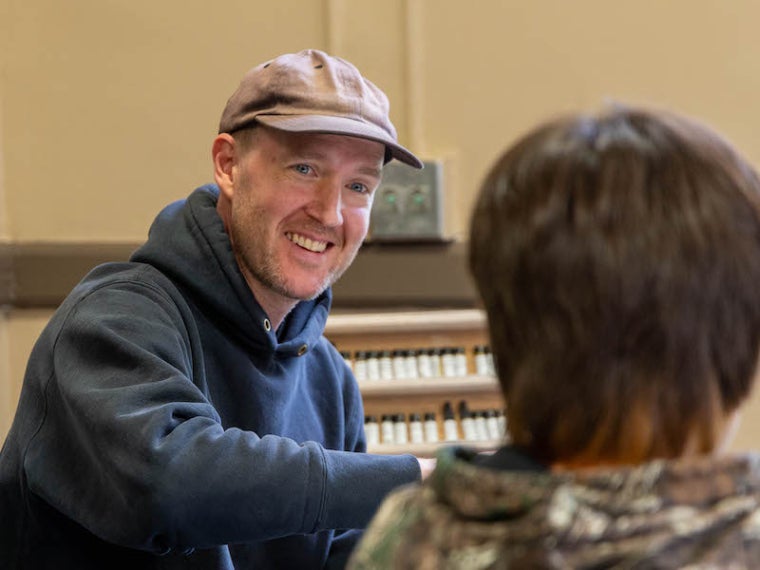
Through his work with Oberlin students, returning alum Ian Page looks forward to "finding new relations to Oberlin, Cleveland, and Ohio.”
Photo credit: Office of Communications
Visual artists Ian Page ’08 and Scott Crandall have joined Oberlin as visiting faculty members for the college’s new BA+BFA in Integrated Arts program. Alongside teaching specialized courses, the duo will co-lead the required third-year Integrated Arts Workshop with Julia Christensen, Oberlin's Eva and John Young-Hunter Professor of Art. They are also slated to teach at the new Park Arts campus in Cleveland Heights next fall.
“The practicing arts faculty at Oberlin—which encompasses professors in the theater, dance, studio art, cinema and media, creative writing, and music departments—are thrilled to have Scott and Ian as the inaugural visiting artists,” Christensen says. “Their energy, their love of building community, and their truly integrated arts practices all make them the perfect leaders for this moment.”
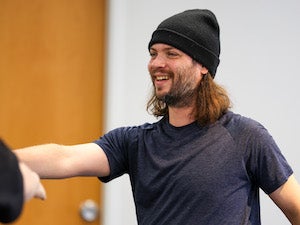
Crandall, who is a transdisciplinary performance maker, dramaturg, and designer, brings improvisation-based physical practice to their work. They are one half of the Detroit-based performance duo Thank You So Much For Coming, which blends elements of dance, design, and theater. Founded in 2015, the duo has earned the Kresge Artist Fellowship and the Gilda Award, as well as accolades from the Independent Film Festival Ypsilanti and Detroit Fringe Festival. Crandall holds a BFA in theater direction and an MFA in dance from the University of Michigan.
In Crandall's course Experimenting with Scores, students will learn and perform scores from visual art, dance, performance art, and more. “I use scores in my own work consistently, as tools for development and daily artistic practice as well as an organizing principle of live performance improvisations,” Crandall says. “In a class setting, it offers entry points for students with different backgrounds and interests, and offers a common language to discuss a variety of practices.”
Page, who earned a bachelor’s degree in cinema studies at Oberlin and an MFA from Yale University, also engages with a range of media. His current focus is rooted in sculpture, though he defines that term broadly. He creates kinetic sculptures and works made from found objects, sound, video, and photographs.
Page recently began a collaboration with the American Vernacular Research Institute, a “quasi-fictional, role-playing research institute” that focuses on the material vernacular in American culture. Examples include forays into how people customize mailboxes or use lawn art. His work has appeared in solo exhibitions at the Hudson D. Walker Gallery, Galerie van Gelder, and Kunstmuseum Bochum in Germany.
At Oberlin, Page is teaching the course Authenticity is a Feeling, which focuses on “reenactment as an artistic strategy” and will explore a big problem in art: "the problem of always re-doing, or at least feeling like one is re-doing.”
In the Classroom and Beyond
Looking ahead, Page is eager to collaborate with students who approach their practice in unconventional ways—a vision he feels Oberlin supports.
“It is my dream class, full to the brim of things I think are challenging and relevant to our moment,” he says. “Teaching this class is sending me in two directions at once. I am surveying the artists and ideas that have been important to me for years, and I am situating those artists and ideas in a new context, seeing what else is possible to include in the scope of the class and finding new relations to Oberlin, Cleveland, and Ohio.”
Crandall similarly looks forward to mentoring students as they tackle novel, cross-disciplinary projects. “Puzzling out these kinds of processes is fundamental to my artistic practice, whether for my own artistic work or as a mentor to a student.”
Crandall plans to integrate their ongoing project Vulture—which combines live and video dance performance, posthumanist theory, and site-specific work in Berlin—into a course for fifth-year BA+BFA students. “I'll be working with Vulture as a way to engage with the city of Cleveland, a resilient postindustrial city that has its own relationship to collapse and perseverance.”
As an alum, Page especially looks forward to re-encountering campus resources such as Oberlin’s art collections and the Allen Memorial Art Museum. Returning to campus as a faculty member and artist has felt natural; in fact, he observes that present-day Oberlin doesn’t feel that different from 2008.
“I find it fascinating to think about what makes an institutional identity persist,” Page says. “The students change, some of the faculty change, but a continuity of spirit or ethos remains. I felt very well equipped to match pace with that spirit.”
In another full-circle moment, Christensen says that Page was in her very first class at Oberlin, called Creative Resistance. “We made art to investigate activism, social engagement, and public intervention,” she recalls. “He was in the classroom on the first day I ever taught, and he was exactly the kind of student I was thinking of when we built this program.”
Page’s return marks an exciting new era for cross-disciplinary artistic creation at Oberlin.
Oberlin’s BA+BFA in Integrated Arts program combines the rigor of an arts school with the well-rounded, interdisciplinary education of a liberal arts college. Learn more about this five-year program tailored to each student’s academic and artistic interests.
You may also like…
Center for Media and Integrated Arts Taking Shape
New Center for Media and Integrated Arts to debut in fall 2027.
Reimagining the Voice: Nick Hallett ’97 on Art Without Boundaries
Composer Nick Hallett ’97 blends linguistics, music, and performance in avant-garde ways, including performing a seminal work by late cellist and composer Arthur Russell.
The Art of Chaos and Curiosity: Tei Blow '02 Embraces Multimedia Collaboration
From interdisciplinary classrooms to New York stages, Tei Blow ’02 explores how Oberlin’s culture of collaboration shaped his career in multimedia art.