Reimagining the Voice: Nick Hallett ’97 on Art Without Boundaries
Double degree graduate draws on his musical and artistic background to create large-scale collaborative projects.
April 7, 2026
Serena Zets ’22
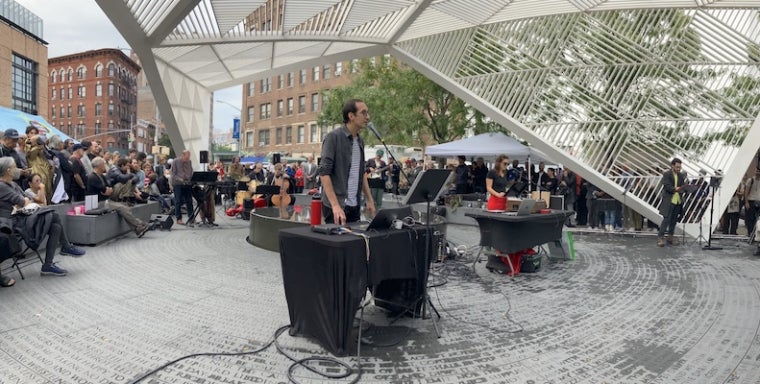
Nick Hallett ’97 performs "City Park" in New York.
Photo credit: Michael Azerrad
When Nick Hallett ’97 reconstructs a piece of music, he’s not just reviving a score—he’s reimagining a living work.
In 2025, Hallett earned a master’s degree in music composition at Wesleyan, where he had the time and opportunity to dive more deeply into new work. His final project was a musicological thesis centered on reconstructing and performing "City Park" by the late cellist and composer Arthur Russell.
"City Park" hadn’t been heard in five decades until performances held in 2023 at Wesleyan and the New York City AIDS Memorial. Returning to academia allowed Hallett to reimagine the composition for a new generation. A longtime admirer of Russell’s work, Hallett sought out the composer’s instructions for the piece, along with archival recordings and the memories of those who had participated in the premiere.
“The score is a map,” Hallett said in a New York Times feature about the work, “one that is not intended to be followed literally but one that puts agency in the performer and allows them to make choices.”
Hallett’s artistic practice has always been integrative. Initially a vocal student in Oberlin’s Conservatory of Music, he later added a self-designed linguistics major in the college and graduated with a double degree. “Linguistics stimulated my sense of interdisciplinarity,” he says. “TIMARA was a place where I could figure out how to make the things I liked learning about, and I took classes in theater and dance as well.”
Hallett studied under Richard Miller in the conservatory. The storied voice professor “had such a strong impact on my formation as an artist, but not in the ways I imagine he intended,” Hallett says. He notes that Miller’s use of scientific listening tools are still part of Hallet’s teaching and artistic practice. “Much of what I’m working on right now goes back to what I absorbed during my time in his studio.”
By his final semester at Oberlin, Hallett had ventured into experimental work. He staged a guerrilla-style performance-composition recital in Fairchild Chapel titled “The Theater of Organized Sound.” In true Obie fashion, Hallett postered across campus to spread the word outside of official channels. The performance was off the record from any academic department yet drew a rapt crowd and was reviewed in The Oberlin Review.
The success of that DIY recital gave Hallett the experience and confidence to stage his own interdisciplinary works, an approach that came in handy after moving to New York City shortly after graduating. “If Miller knew I was performing experimental vocal music within the conservatory at the same time, I would have been kicked out of his studio,” Hallett says. “But I was far from alone, and it was not hard to find faculty support to realize my ideas. The like-minded artists I identified as an Oberlin student remain my close associates.”
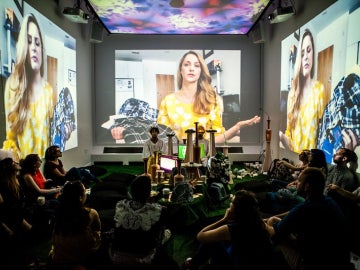
In recent years, Hallett has created scores for works by choreographer Bill T. Jones and collaborated with artist Shana Moulton on multiple projects. He will make his debut as a solo artist in fall 2026 with an art exhibition of acousmatic Voice Portraits at New York’s Klaus Von Nichtssagend Gallery. The project draws on his longtime work as a voice teacher to artists and rock singers, as well as technologies he first encountered at Oberlin.
To create the portraits, Hallett leads participants through creative prompts similar to those used in a voice lesson, then transforms the recordings into multichannel sound sculptures that capture each subject’s vocal essence.
Hallett remains deeply connected to the network of artistic Obies in New York City who champion experimentation and mixed-media work. He teaches at Eugene Lang College at the New School and the School of Visual Arts and recently published his first academic article, “Transidiomatic Orality: Anthony Braxton's Journey through the Voice,” in the book Anthony Braxton – 50+ Years of Creative Music. And while he’s come a long way as an academic and artist since his time at Oberlin, the lessons of his double-degree education continue to influence his work.
“I was on a trajectory of being the musical collaborator to artists working in non-musical fields,” Hallett says. “I wouldn't be having my first solo art exhibit if I hadn’t gone back to school and put my thinking about voice into a new creative practice.”
C Is For Collaboration
Hallett has remained close to peers from Oberlin, including Zach Layton ’99, with whom he co-organizes the annual NYC In C performance of Terry Riley’s epic 1964 composition. What began as an Oberlin rite of passage—Layton performed it in Randall Coleman's composition seminar, and Hallett remembers gathering in the conservatory courtyard to play In C with classmates—has endured as a New York City tradition.
“I’ve been lucky to have a supportive network of Obies who champion my energies across music and dance and visual art,” Hallett says. The 2025 performance featured an impressive list of Obies, including flutist Claire Chase ’01, violinist Erica Dicker ’01, trombonist Sam Kulik ’04, cellist Alex Waterman ’98, and composer Du Yun ’01.
Oberlin’s BA+BFA in Integrated Arts program combines the rigor of an arts school with the well-rounded, interdisciplinary education of a liberal arts college. Learn more about this five-year program that’s tailored to each student’s academic and artistic interests.
You may also like…
Oberlin Welcomes New Integrated Arts Faculty
Visiting artists Ian Page ’08 and Scott Crandall bring their talents to new BA+BFA program.
Center for Media and Integrated Arts Taking Shape
New Center for Media and Integrated Arts to debut in fall 2027.
The Art of Chaos and Curiosity: Tei Blow '02 Embraces Multimedia Collaboration
From interdisciplinary classrooms to New York stages, Tei Blow ’02 explores how Oberlin’s culture of collaboration shaped his career in multimedia art.