
From Oberlin Research to Cleveland Clinic Labs
Two young alums tackle the fascinating challenges of brain cancer research.
August 11, 2025
Danielle Frezza
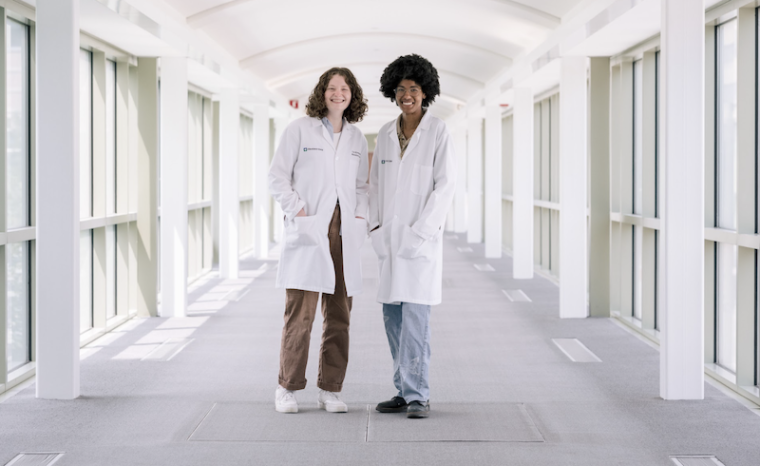
Photo credit: Yevhen Gulenko
Passionate about science, Jessie Goldberg ’24 and Dee Pegues ’24 both spent time conducting undergraduate research at Oberlin College. Now the two alums work at Cleveland Clinic investigating glioblastoma, the most common and aggressive form of brain cancer.
Jessie and Dee started looking for opportunities as they prepared for graduation. Both found their Cleveland Clinic roles through Gunnar Kwakye, the chair of neuroscience at Oberlin.
“I work in the Lathia lab,” says Jessie, referring to Dr. Justin Lathia, who leads a translational cancer stem cell research team. “My research primarily focuses on the tumor-astrocyte interaction. We’re seeing how astrocytes [central nervous system cells] work to assist in the process of tumor movement.”
One of her main goals in the lab is to discover ways of using these astrocytes to combat the cancer’s progression.
“Once glioblastoma enters the brain stem, that’s when the cancer becomes fatal,” she explains. “So we’re trying to keep it in the forebrain so that it can be resected and the patient has increased life expectancy.”
Dee, who majored in neuroscience and cinema studies, works in Dr. Matthew Grabowski’s lab at Cleveland Clinic and often collaborates with those in the Lathia lab, like Jessie. They were inspired to take this role for the “chance to try out a new area of study and experimental techniques,” they say.
In the Grabowski lab, they’re investigating another mystery regarding glioblastoma.
“There’s this protein called lactotransferrin, or LTF,” Dee explains. “We’ve found that among glioblastoma cases, LTF might have some effect on patient survival, and no one really knows why.”
Both lab technicians perform tests using pre-clinical models and cellular models to explore the impacts of cancer on the human brain, as well as possible treatments.
During her studies as a neuroscience and anthropology major, Jessie served as a research assistant and evaluated medical innovation programs in various graduate schools to identify their impact in the field of global health.
“I come from a background where I wasn’t really encouraged to go into STEM,” she says. “I think that happens with a lot of disabled people in a public school environment… So having Gunnar always there to encourage me to pursue this was great. He took me aside and said, ‘You have the mind for STEM and I think you should go into neuroscience.’”
Dee also conducted mentored research under Christopher Howard, associate professor of neuroscience. Their project explored how dopamine neurons could assess time intervals for survival.
“Doing research with Professor Howard really cemented the idea that I want to do neuroscience research as a career,” Dee says. “Working in the Howard Lab helped me realize that behavioral and systems neuroscience is the particular niche I would like to study further.”
In terms of long-term goals, both Dee and Jessie are interested in pursuing PhDs. Dee is interested in teaching in higher education as well as progressing their neuroscience career to become a principal investigator, or PI, they say. This is the same role that Drs. Lathia and Grabowski play in their respective labs, and Dee would find it fulfilling to take on a mentorship position by leading other researchers.
Jessie is also excited to explore her future possibilities, she says. She’s contemplating becoming a college professor as well as furthering her career in healthcare.
“Oberlin is just such a great environment that allows you to get really in depth in the fields that you're interested in,” she says. “So that's primarily what I'm looking for in a PhD program. I want community and the ability to grow.”
If you’re looking for STEM and research opportunities, check out Sciences at Oberlin to explore the exciting possibilities available to you.