
Oberlin Law and Society Students Attend West Point Conference
Two students represented Oberlin at the Student Conference on United States Affairs (SCUSA), a policy debate conference at West Point.
March 12, 2026
Sasha Kolb ’29
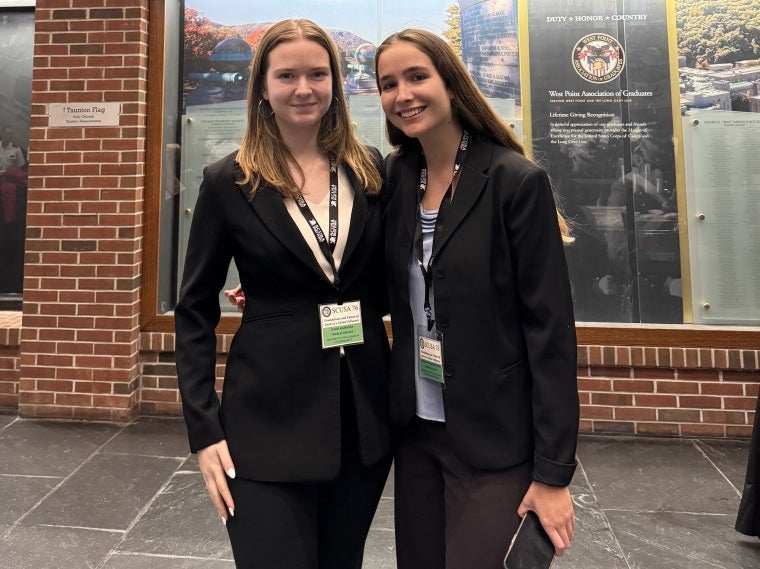
Kash Radocha '26 (left) and Charlotte Patrick-Dooling '25 (right) attend the Student Conference on United States Affairs at West Point.
Last October, Oberlin College students Kash Radocha ’26 and Charlotte Patrick-Dooling ’25 attended the 76th Student Conference on United States Affairs (SCUSA), held at the United States Military Academy at West Point. SCUSA is a prestigious four-day event where undergraduate students collaborate with scholars and leaders to develop innovative policy proposals on pressing issues in U.S. foreign affairs. We interviewed Charlotte and Kash about their experiences at the conference.
Tell me a little about your experience at SCUSA! What was it like?
Charlotte Patrick-Dooling: My committee focused on defense burden sharing and strategic partnerships, so we talked a lot about NATO and the Belt and Road Initiative. We worked on policy memos the whole time and proposed a method for the U.S. to change its strategic partnerships to be more advantageous. We then proposed it to a panel.
Kash Radocha: The overarching framework was to establish policy goals to prepare the U.S. for a multipolar world. There were about 12 to 14 different topics in different policy areas. My group discussed domestic policy, and it was a great mix of people! At the end, we presented our policy to leaders in military policy—military officials and other professionals from think tanks like the Council on Foreign Relations as well as academics in the field and the Department of Defense.
How did you end up going to this conference?
CPD: When I saw that West Point was hosting and that Oberlin was sponsoring two delegates, I was really excited! They made the application process really smooth—[administrative assistant] Tracy Tucker was a huge help, she's awesome. Oberlin flew us there and covered all the expenses. It was such a cool opportunity. There are so many opportunities here at Oberlin—there’s an endless realm of what you can do.
What sort of opportunities do conferences like these offer students? Any highlights from the conference?
CPD: I met so many students, and we were also surrounded by professors and researchers from really prestigious institutions. One of the advisors for my roundtable—Daniel Fata, president of Fata Advisory LLC—gave us career advice. It was really interesting to learn about the Peace Corps and how it opens doors to different political spaces. I met people who have had abundant careers in international development and politics.
KR: Some of the best students across the country attend SCUSA. Two people that I met were named Marshall Scholars this year. Everyone really cares about what they're doing, too—they have genuinely intellectual debates. It was a lot of fun working with these people. Everyone in our group was fabulous. We still have a text group chat to this day.
Professionally, it was great. Our advisors were a career legislative staffer who now teaches at West Point and a professor from the University of New Hampshire. They had incredible insight into legislative structures, military policy, and armed services policy. Every now and then, one of our advisors will email saying, “I saw this opportunity. You guys would be great for this.”
What do you plan to do after Oberlin?
CPD: I'm joining the Peace Corps and going to Nepal in January 2026. After that, I’ll apply for grad school through the Peace Corps’ Coverdell Scholarships, most likely in global studies. I’m also interested in foreign diplomacy work and federal work. We'll see! You never know.
KR: So, a little about me: I’m majoring in history, law and society, and politics. I also have a minor in Russian and Eastern European studies. I'm applying to grad schools overseas for research degrees in comparative politics. I want to spend some time in Europe! Then, I'd like to keep going with either a DPhil or a PhD. I'll also be studying for and taking the LSAT in June 2026. That's where my law and society major comes in: it's the crux of what I do with politics and history.
Any advice or final notes for students thinking about the Law and Society major?
CPD: If you want to go into international relations or development, participating in conferences like this is really important. But other than that, just don't limit yourself. In college, there's so much to do. Also, it's important to engage in activities that aren't academic. I think getting an off-campus job is great—I work at Kendal at Oberlin. Get involved with the community!
KR: The law and society major has given me a strong understanding of how democratic systems work in their entirety and the relationships between branches. It's a great homage to the liberal arts education. Because the major is so broad, it can take you in many directions and support your other interests. If you want to do copyright law, for instance, you can study music, too. Keep your mind open. You have so many options, especially at Oberlin.
To learn about conferences, research, and other learning opportunities outside the classroom, check out the Center for Engaged Liberal Arts.
You may also like…
Teaching in the New Normal: Translation Symposium
These days, the classroom has taken on new meaning for both faculty and students at Oberlin. In this edition of Teaching in the New Normal, Professor Kirk Ormand describes how this year’s Translation Symposium looked different than in years past.

Journalism Symposium Features Alumni Working in the Field
Alumni journalists from a range of publications will present at “A Disrupted Media Landscape: Skills, Perspectives, Solutions,” February 24 through March 1.

Students Present at Ethnomusicology Conference
Students of Jennifer Fraser traveled to Dayton last month to present their work.
