
Oberlin Drives Statewide Conversation on AI and Higher Education
Higher ed leaders convene to explore AI literacy, student discernment, and the evolving role of liberal arts.
October 13, 2026
Office of Communications
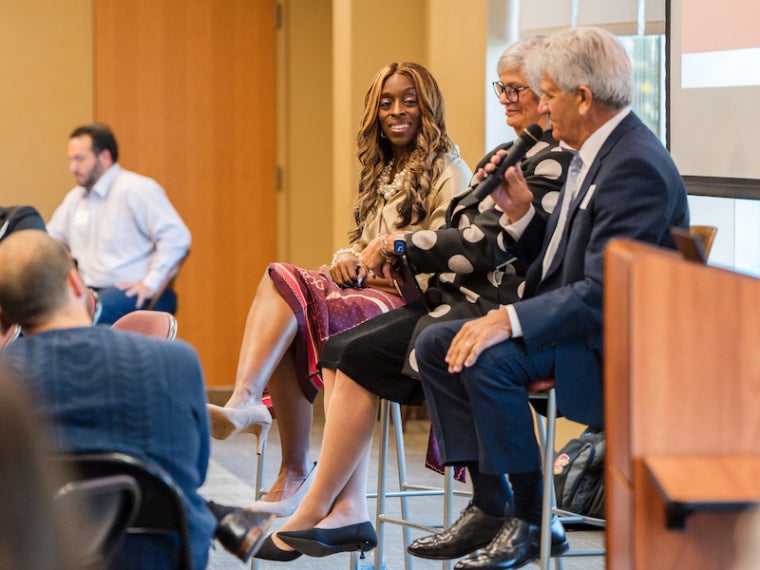
President Carmen Twillie Ambar with panelists President Richanne Mankey of Defiance College and President David Decker of Franklin University.
Artificial intelligence has prompted predictions ranging from an “age of abundance” to an existential threat to humanity. Against that backdrop, more than 200 higher education leaders from across Ohio gathered in September at Ohio Dominican University in Columbus to consider what AI means for colleges, universities, and the students they serve.
Leaders at Oberlin conceived the daylong symposium, “AI and the Human Future of Work and Learning in Ohio,” and organized it with the Association of Independent Colleges and Universities of Ohio (AICUO). It was one of AICUO’s best-attended symposiums, with another tentatively planned for spring.
A clear theme emerged: Colleges and universities must prepare students to exercise judgment about AI—understanding how it works, questioning its limitations, and deciding when and how to use it.
Oberlin President Carmen Twillie Ambar opened the program alongside Richanne Mankey of Defiance College and David Decker of Franklin University. Ambar shared the story behind Oberlin’s Year of AI Exploration, which began after a family discussion about AI a few years ago prompted her to take a closer look at the technology.
At a Thanksgiving gathering, her sister-in-law’s brother, a software engineer, said he hadn’t built a PowerPoint presentation without AI in seven months and then offered to demonstrate. He wrote a detailed prompt describing Ambar and her views, drawing on what was available online, and asked the system to produce an orientation speech by the president of Oberlin.
“It spit out a fairly accurate orientation speech,” Ambar said. “I went away from that conversation going, ‘Oh, I’d better figure out this technology a little more,’” she said. Her next thought was that she shouldn’t have to figure it out alone. “Why don’t we have the whole campus do it?” she recalled thinking.
That became Oberlin’s Year of AI Exploration, which brought faculty, staff, and students together for workshops, speakers, faculty discussions, and opportunities to experiment with AI. Oberlin also opened ChatGPT and Google's Gemini to faculty and staff, launched a Critical AI Studies minor, provided microgrants for experimentation, and, this year, introduced Gemini to students after a workshop on ethical use. Initially launched in the 2025-26 academic year, the initiative continues into 2026-27, with increased emphasis on campus policy and guidelines for use, additional workshops, and student microgrants.
“We really focused on how we could have a collective, collaborative conversation across campus around AI,” Ambar said. “The focus on learning, collaboration, and inquiry was important to try to de-escalate the anxiety around AI.”
That approach does not mean embracing AI uncritically. Ambar described the goal as becoming “healthy skeptics rather than cheerleaders for AI,” while also creating space for people with concerns—including AI’s environmental costs—to be heard.
Oberlin’s approach was explored further during a symposium session led by Laura Baudot, senior associate dean of the College of Arts and Sciences, and Adam Eck, associate professor of computer science and chair of the data science integrative concentration.
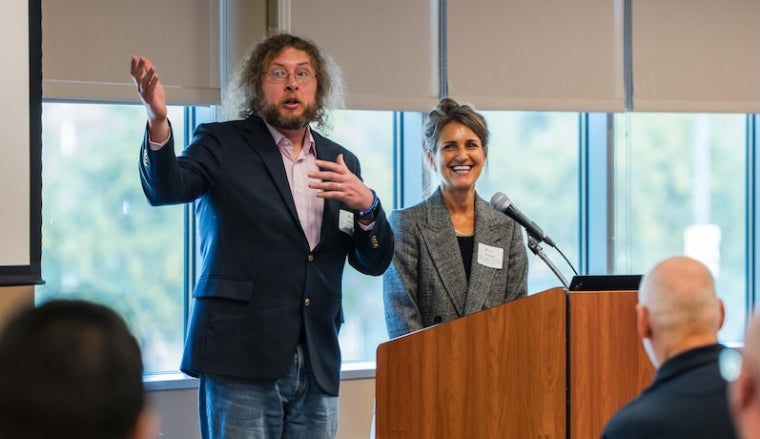
Their presentation, “Human Judgment in the Age of Artificial Intelligence,” emphasized the role of discernment, thoughtful choice, and practical wisdom—qualities Baudot said make a liberal arts education especially important in the age of AI.
Eck shared findings from Oberlin’s campus surveys: About 40 percent of faculty were already using generative AI at least weekly, while nearly the same percentage had never used it. Roughly 60 percent of incoming first-year students had used AI before arriving at Oberlin.
Those conversations helped shape the new critical AI studies minor, which launched this fall. “‘Critical’ doesn’t necessarily mean negative; it’s more in the sense of critical thinking,” Eck said. “We want to give students skills to cut through the hype and think carefully about the technologies.”
The program asks students to examine what AI is, how it differs from human intelligence, what technology's history can teach us, how AI is applied across fields, and its effects on culture, politics, people, and the economy.
“It’s important to have the skills the workforce wants, but we also want students to be leaders in how the technologies are adopted,” Eck said.
Baudot put the goal even more directly: “They don't just need to be adopters. They can be decision-makers in this space.”
Oberlin is also working with other institutions, including Rutgers University and Stevens Institute of Technology, to advance critical AI literacy and is exploring additional collaboration with educators and adult learners in Northeast Ohio.
The uncertainty surrounding AI makes this kind of cooperation more urgent than ever. As Laura Baudot warned, "If higher education doesn't band together more around AI, we’ll be less capable of absorbing the shocks."
Navigating AI’s future will require more than technical proficiency—it demands the intellectual agility and problem-solving a liberal arts education fosters. By equipping students to be decision-makers rather than mere adopters, institutions can face the uncertainty ahead with purpose, anchored by the students driving the work: "I see these 18-, 19-, 20-, and 21-year-old students every day,” Ambar said. “They give me hope that what they want to achieve is absolutely possible."
Oberlin is hosting AI: WTF? (Whose Technological Future?)—A Symposium Exploring Critical AI Studies on October 29 and 30. A host of guest experts will present lectures and workshops exploring fascinating conversations surrounding AI, from writing pedagogy to critical AI literacies to environmental politics. Learn more on the campus events calendar.