Noah Elazar Wins Oberlin's 2025 Nexial Prize
$50K award honors a graduating science student with a passion for interdisciplinary research.
May 23, 2025
Office of Communications
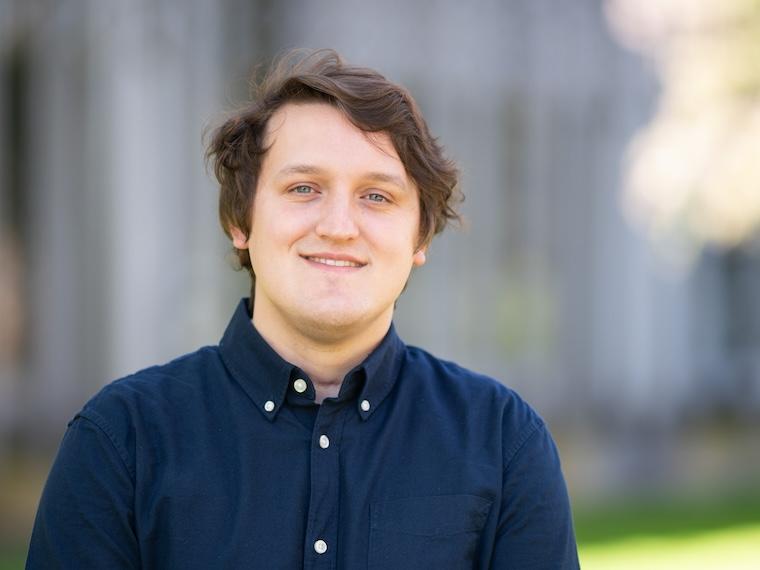
Noah Elazar ’25
Photo credit: Abe Frato ’26
Noah Elazar ’25, a double major in computer science and politics, is receiving Oberlin’s 2025 Nexial Prize, an honor presented to an outstanding science student with aspirations for interdisciplinary research.
The $50,000 cash award may be used however the recipient wishes.
What activities were you involved in at Oberlin?
Outside of classes, I’ve been primarily focused on research. I worked as a research assistant for Assistant Professor of Data Science and Computer Science Joshua H. Davidson ’12 for over two years, studying transportation accessibility, equity, and safety. I was also a research assistant for Assistant Professor of Politics and Comparative American Studies Jenny Garcia, where I developed methods to enable quantitative research about congressional committee hearings. Beyond research, I worked as a grader and peer tutor for the computer science department, helping students improve their programming skills while understanding the concepts behind programming and computation. Finally, I played for the club soccer team all four years and was captain of the team for two years, helping to ensure a safe, inclusive, and fun environment for all our players.
What will you be doing this summer, thanks to the Nexial Prize?
With the freedom that the Nexial Prize affords me, I plan to volunteer for under-resourced community organizations in Cleveland or back home in Maryland. I want to use my skills in data analysis to help organizations focused on promoting housing and public transit, assisting them in more efficiently allocating resources and identifying areas of need in the community. I’m especially interested in local community work, as I eventually want to transition to graduate school, where I intend to study how technology can be used to counter systems of inequality through a community-centered lens.
Tell us about the research you’ve done at Oberlin—and how it aligns with your career goals.
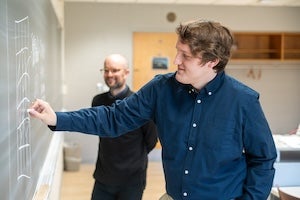
As a research assistant with Professor Davidson, I worked on two projects. In the first, we measured how accessibility changed in two underserved communities in Philadelphia with the addition of a new bus line. This project was a catalyst for my interest in studying structural inequality. In the next project, we analyzed the connection between traffic citations and access to driver training centers. I developed a software tool with Professor Garcia to parse congressional hearing transcripts. Both of these projects provided me with a significant opportunity to develop my skills in advanced quantitative analysis. Finally, as an honors student in politics, I measured the ideology of politicians using data from Twitter/X. This culminated all my experience, drawing together advanced methods and the connections between technology and society. My career goal is to continue conducting research in this vein.
How have you grown and developed as a researcher from your time at Oberlin?
My coursework has given me an incredibly strong foundation to build on when conducting research, from learning about quantitative and qualitative methods to conducting informed and considerate research. In particular, the breadth of disciplines I could explore through the liberal arts curriculum at Oberlin encouraged me to be creative in my research and to look for unexpected connections. Outside of class, the close ties between students and faculty made it easy for me to dive into the academic research process and learn every step, from developing a research question to publishing and presenting. This hands-on experience meant that I quickly felt comfortable directing my own research projects, leading me to success in both a research project at Carnegie Mellon University and as an honors student.
Who is your faculty mentor for research, and what did you learn from them?
Professor Davidson. Not only have I learned a great deal about the entire research process, but I especially discovered the value in collaborating on research and how to do so effectively. He structures his lab to encourage collaboration: with a research partner, under the direction and supervision of a professor, and by receiving feedback and a fresh perspective from other lab members working on entirely different projects.
What’s the best advice you’ve received from your Oberlin faculty mentor (or mentors)?
The best advice I received was from Professor Garcia, my honors advisor. Early in the process, I doubted my project idea and wanted to make a last-minute pivot. She saw the potential in my project and simply encouraged me to stick with it and be persistent. This was crucial in motivating me to keep pushing and improving my project. Completing it was the most rewarding part of my Oberlin experience.
Connect with Fellowships & Awards to learn more about the opportunities available to students.
You may also like…
Reyna Berry ’27 earns a 2026-27 Newman Civic Fellowship
The theater major will continue her work supporting prison and detention center programming

Andy Roshal '26 earns DAAD scholarship
The Hartsdale, New York, native will travel to Germany to expand on the Yiddish studies they began here at Oberlin.
Nissa Berle ’24 earns Fulbright Study/Research Award
The psychology major will earn a master’s degree in disaster and emergency management at York University