Oberlin Alumni Magazine
Cultivated by Co-Ops
As a leader at the Chicago Food Policy Action Council, Rodger Cooley ’95 promotes food justice and food sovereignty.
January 9, 2026
Hanna Raskin ’98
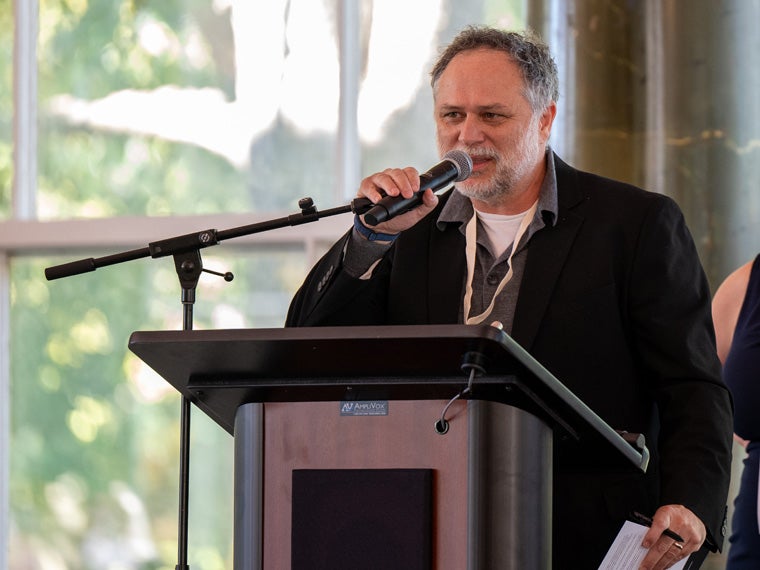
Like many alums working in food production and food policy, Cooley started thinking about food systems as a member of the Oberlin Student Cooperative Association (OSCA) member.
Photo credit: Norvell's Photography
The English language isn’t kind to folks who flit about. People who don’t commit to a single professional track or favorite sports team are dismissed as dreamers, dabblers, and dilettantes. Rodger Cooley ’95 would tell you none of those terms do justice to the creativity and strength that stems from exploration.
“[When] envisioning how we bring complex ideas to life, there is no clear path,” says Cooley, whose multifaceted interests led to his 2017 appointment as executive director of the Chicago Food Policy Action Council, a nonprofit promoting food justice and food sovereignty in the city. “You’re constantly having to respond to things that are always in flux.”
Like many alums working in food production and food policy, Cooley started thinking about food systems as a member of the Oberlin Student Cooperative Association (OSCA) member. Uniquely, though, he rarely joined the same dining co-op twice: Cooley prepared meals at Tank, scrubbed dishes at Old Barrows, and composted at Harkness. (“I got around,” he admits. “I was not monogamous.”)
Cooley took a similarly catholic approach to his studies, declining to focus on any one medium as a studio art major. “I did oil painting; I did photography,” he says. “One of the best things was being able to jump around and have a safe container in which to try a lot of different things.”
Following graduation, Cooley moved to Chicago with four fellow alums. They settled into a West Loop warehouse with space for living and making art, two activities that frequently intersected. Most notably for Cooley, the friends constructed a rooftop garden that was partly an installation and partly a tangible contribution to the community they’d begun to call home.
“We were living right next to a meat processor, but the neighborhood felt very industrial,” Cooley said of the treeless landscape he’d scan when he climbed up to the roof. “I became really interested in what it would look like to grow things, retaking urban spaces.”
Growing up in Sarasota, Florida, Cooley was surrounded by the standard suburban trappings that he now sees as distancing people from their food sources, including endless lengths of pavement and manicured lawns. But his grandfather took a different approach to his property in Lakeland, Florida. He grew citrus and kumquat trees, eventually converting his yard to a tropical fruit grove where bananas and papayas flourished.
Before he became a fruit hobbyist, Cooley’s grandfather was a pastor. He was one of many relatives who made careers of social service, with teachers, therapists, and nurses all represented in Cooley’s close familial circle.
“I was feeling a call to have more social benefit,” Cooley said. “Seeing land [in Chicago’s South Side] become vacant through redlining and disinvestment, [I wanted to] manifest a vision of real cultural foods that are almost impossible to find.”
So Cooley grew collard greens and mustard greens and okra on the warehouse roof, then expanded upon his urban agricultural work as a Heifer International project manager. While at the organization, he helped convene a local food justice summit, which has since become an annual free event; more than 1,000 people have registered for the next meeting.
“We wanted to bring together people with strong issues to find partners,” Cooley says, remembering various attendees saying, “Hey, I want to start a community garden,” or, “I’m really curious about farmers markets,” or, “I’m concerned about meals at my kids’ school.”
Connecting food activists and advocating for municipal policies that prioritize workers’ rights, animal welfare, and nutritional standards occupies most of Cooley’s paid time. At home in Chicago’s Avondale neighborhood, though, he’s still gardening. Of course, his plot isn’t devoted to any one kind of plant. He grows melons, gooseberries, kale, tomatoes, currants, herbs, and apples.
This article originally appeared in the Fall 2025 Oberlin Alumni Magazine within the feature "Rooted In Purpose."
You may also like…
Jane Wickline ’21 Finds Community in Comedy
A Q&A with the Saturday Night Live cast member and Dukes cofounder

When Stars Align
The Oberlin Contemporary Music Ensemble shines on Jennifer Koh ’97’s "The American Concerto, Volume One."

Wright On, Sister
Would the Wright brothers have invented their airplane without the support of their sister, Katharine Wright Class of 1898? Probably. But they might not have been the first.