Student Project Profile
Optimizing PEI STAR Transfection Reagent for HEK293T Cells
Project Title
Optimizing PEI STAR Transfection Reagent for HEK293T Cells
Faculty Mentor(s)
Project Description
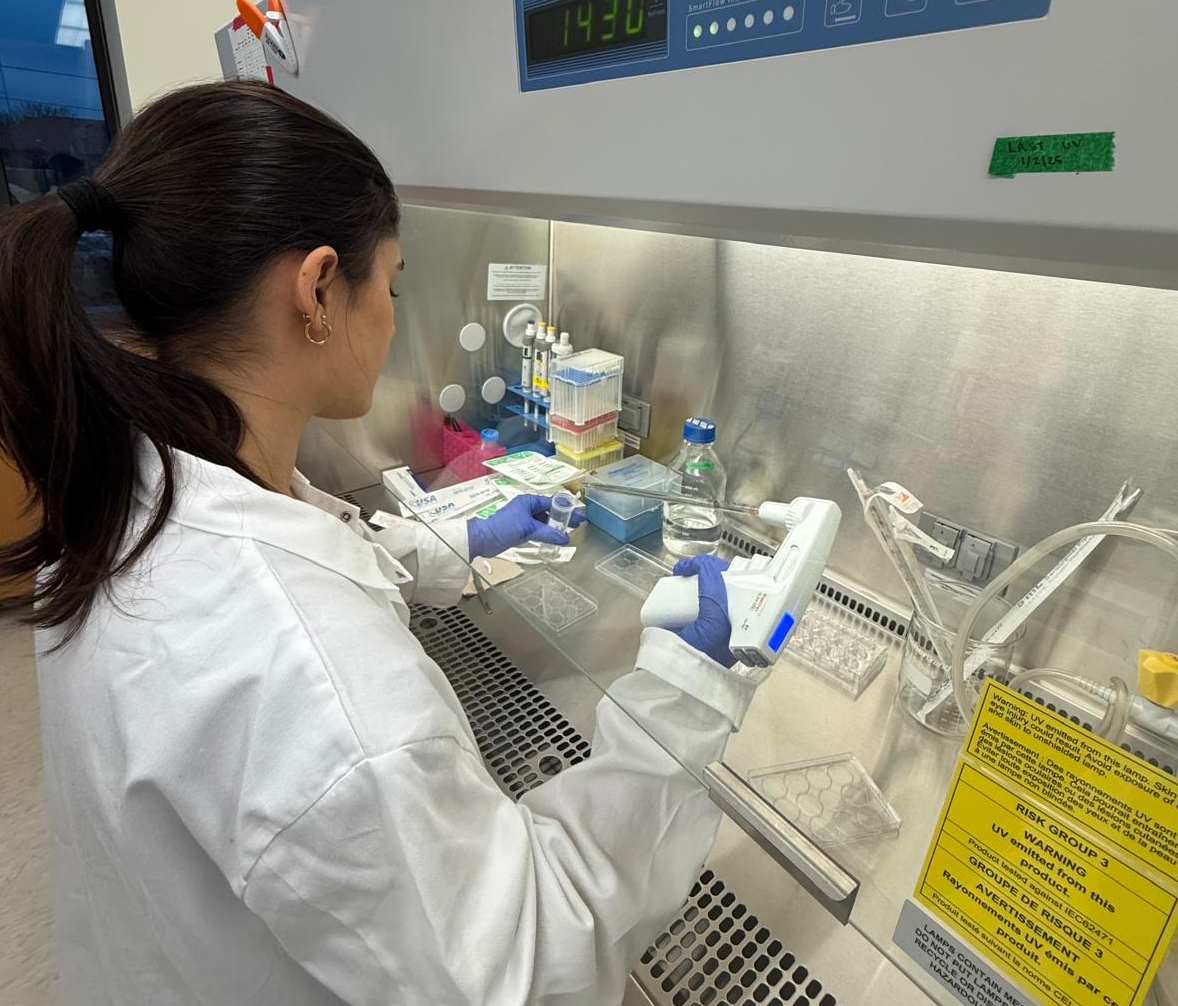
Melisa Punjani conducts experiments in the Johnson Lab.
Project Description:
Fused in Sarcoma (FUS) is a RNA/DNA-binding protein whose subcellular localization is dynamically regulated and can be altered in response to DNA damage-induced phosphorylation. To investigate how phosphorylation affects FUS localization, efficient and reproducible plasmid transfection is required. Our laboratory currently uses the commercial LT-1 transfection reagent; however, due to its high cost, we aim to evaluate polyethyleneimine (PEI STAR™) as a cost-effective alternative. This project focuses on optimizing PEI-mediated transfection conditions in HEK293T cells for wild-type FUS (WT-FUS) expression and directly comparing its efficiency to LT-1. We systematically test three key transfection parameters known to influence PEI performance: DNA:PEI (N/P) ratio, cell confluency at the time of transfection, and incubation time after bringing plasmid DNA and PEI together. Cells are transfected using a forward transfection protocol with PEI STAR™ under reduced-serum conditions, and transfection efficiency is assessed using GFP controls and WT-FUS expression. These conditions are benchmarked against the laboratory’s established LT-1 protocol.
Why is your research important?
My aim is to establish a reliable and low-cost transfection strategy suitable for downstream analyses of FUS localization following DNA damage. Successful optimization will support future studies while improving experimental scalability and cost efficiency.
What does the process of doing your research look like?
My research process starts with reading the literature to see how other labs use PEI and identifying conditions to test for the most efficient protocol. I then carefully plan each experiment from the plate type, number of wells needed, conditions to test, and timeline, before presenting my plan to my professor for feedback. Because working with cells and plasmid DNA requires strict sterility, everything has to be planned and executed very meticulously in biosafety hoods.
What knowledge has your research contributed to your field?
Thus far, my findings suggest that using PEI at a 3:1 ratio to plasmid DNA is the most effective for transfection. I observed conflicting results for confluency and incubation time, indicating that these conditions need to be retested to ensure reproducibility.
In what ways have you showcased your research thus far?
I presented my progress to my fellow labmates 3 times a week in our lab meetings, and I’ve presented my research, methodologies and outcomes to the STRONG cohort weekly.
How did you get involved in research? What drove you to seek out research experiences in college?
My interest in neuroscience research comes from a very personal place. I lost my grandpa to Alzheimer’s disease when I was five, and that experience shaped the way I think about the brain and neurodegenerative disease. I always thought I would become a neurosurgeon until I learned that there are other, and much cooler, ways to understand the brain and improve our knowledge of its diseases through research. Research allows me to ask questions, explore mechanisms, and contribute to a deeper understanding of complex neurological disorders. Moving forward, I hope to continue developing as a researcher and use both experimental and computational approaches to study neurodegenerative diseases in a meaningful way.
What is your favorite aspect of the research process?
Asking questions and always finding new areas to dig deeper. I enjoy how each answer leads to more curiosity and opens the door to exploring something I hadn’t considered before.
How has working with your mentor impacted the development of your research project? How has it impacted you as a researcher?
Working with my mentor has helped me build many wet-lab skills and become more confident in the lab, but the most important lesson was learning to accept that failures are just part of the research process. She showed me that making mistakes isn’t the end of the world because in science you can always troubleshoot and try again. That mindset has really shaped me as a researcher and made me more resilient and willing to keep experimenting.
How has the research you’ve conducted contributed to your professional or academic development?
My mentor gave me a lot of freedom to conduct my own literature review and identify different conditions to test for optimizing PEI, which helped me take more ownership of the project. That independence made me more confident as a researcher and taught me how to think critically and design experiments on my own.
What advice would you give to a younger student wanting to get involved in research in your field?
Conducting research in a lab is tedious, and it’s important to recognize that it’s not for everyone. In neuroscience, there are many different paths you can take from working with rodents, worms, birds, cell cultures, or even focusing on computational research, so there’s a lot of room to find what fits you best. I’d recommend not being afraid to try new labs and techniques, especially if you feel overwhelmed or stuck, because exploring different approaches can help you discover what you truly enjoy.
Students