Student Project Profile
Exploring Regulation of elavl1a and its Role in Red Blood Cell Development
Project Title
Exploring Regulation of elavl1a and its Role in Red Blood Cell Development
Faculty Mentor(s)
Project Description
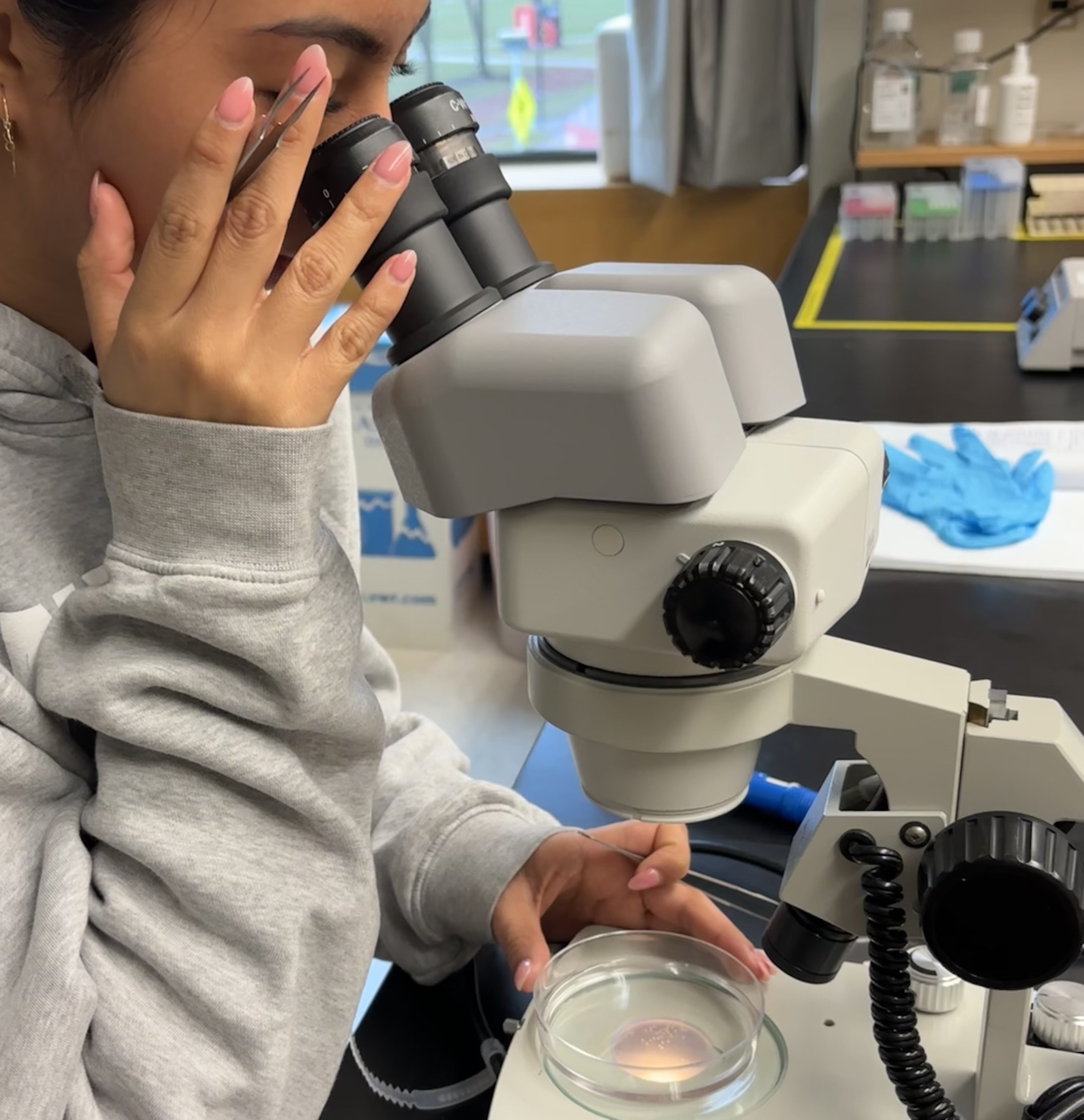
Britney Diaz '29 looks through the microscope in the Blatnik lab.
Project Description:
During winter term, I worked on a research project focused on the gene elavl1a in zebrafish and its role in blood development. This gene stood out to me because its human counterpart, elavl1 (HuR), has been strongly linked to cancer through its role in regulating cell growth and survival, which connects directly to my long-term interest in cancer research.
A major part of my project involved creating and performing a hemoglobin staining technique to visualize red blood cell development in embryos. This allowed me to compare experimental groups with controls and clearly see differences in red blood cell presence and distribution. Being able to connect gene-level changes to visible developmental outcomes made the research especially engaging and meaningful.
Overall, this project helped me build hand-on lab skills, deepen my understanding of gene regulation, and further confirm my interest in pursuing cancer-focused research in the future.
Why is your research important?
My research is important because it focuses on understanding the role of the gene elavl1a in blood development and how gene regulation can affect essential biological processes. Since the human homolog of this gene has been linked to cancer, this work helps connect basic developmental biology to disease-related questions. Understanding these mechanisms at an early, foundational level is critical for future advances in cancer research.
What does the process of doing your research look like?
My research process involved working with zebrafish embryos, analyzing genetic effects through molecular techniques, and creating and performing hemoglobin staining to visualize red blood cell development. I compared experimental groups to controls, analyzed patterns and differences, and interpreted how changes at the gene level translated into observable developmental outcomes. The process required careful planning, repetition, troubleshooting, and data interpretation.
What knowledge has your research contributed to your field?
This research contributes to a better understanding of how elavl1a influences blood development and how disruptions in gene regulation can lead to measurable phenotypic changes. It adds to ongoing work connecting gene expressions to developmental and disease-related processes, particularly those relevant to cancer biology.
In what ways have you showcased your research thus far?
I have showcased my research through presentations and figures that highlight my experimental design, staining results, and data analysis. I have also communicated my findings through slides and written summaries, focusing on clearly explaining both the methods and the significance of the results.
How did you get involved in research? What drove you to seek out research experiences in college?
I got involved in research because I wanted hands-on experience beyond coursework and a deeper understanding of how scientific questions are investigated in real labs. My long-term interest in cancer research motivated me to seek out opportunities that would allow me to explore gene regulation and disease-related biology early in my academic year.
What is your favorite aspect of the research process?
My favorite part of the research process is seeing the results come together, especially when I can visually observe differences through staining. Being able to connect abstract genetic concepts to something tangible and visible makes the work especially rewarding.
How has working with your mentor impacted the development of your research project? How has it impacted you as a researcher?
Working with my mentor has been essential to shaping my project and helping me think more critically about my results. Her guidance helped me understand not just how to perform experiments, but why each step matters. Her mentorship has made me more confident, independent, and thoughtful as a researcher.
How has the research you’ve conducted contributed to your professional or academic development?
This research has strengthened my lab skills, improved my ability to analyze and communicate scientific data, and clarified my academic interests. It has confirmed my desire to pursue cancer-related research and has prepared me for more advanced research experiences in the future.
What advice would you give to a younger student wanting to get involved in research in your field?
I would encourage younger students to not be intimidated by research and to ask questions early. Reaching out to professors, being open to learning, and staying curious are key. Even if you don’t know everything at first, being motivated and willing to learn goes a long way.
Students