Student Project Profile
Underlying Pathogens in High-Contact Surfaces
Project Title
Underlying Pathogens in High-Contact Surfaces
Faculty Mentor(s)
Project Description
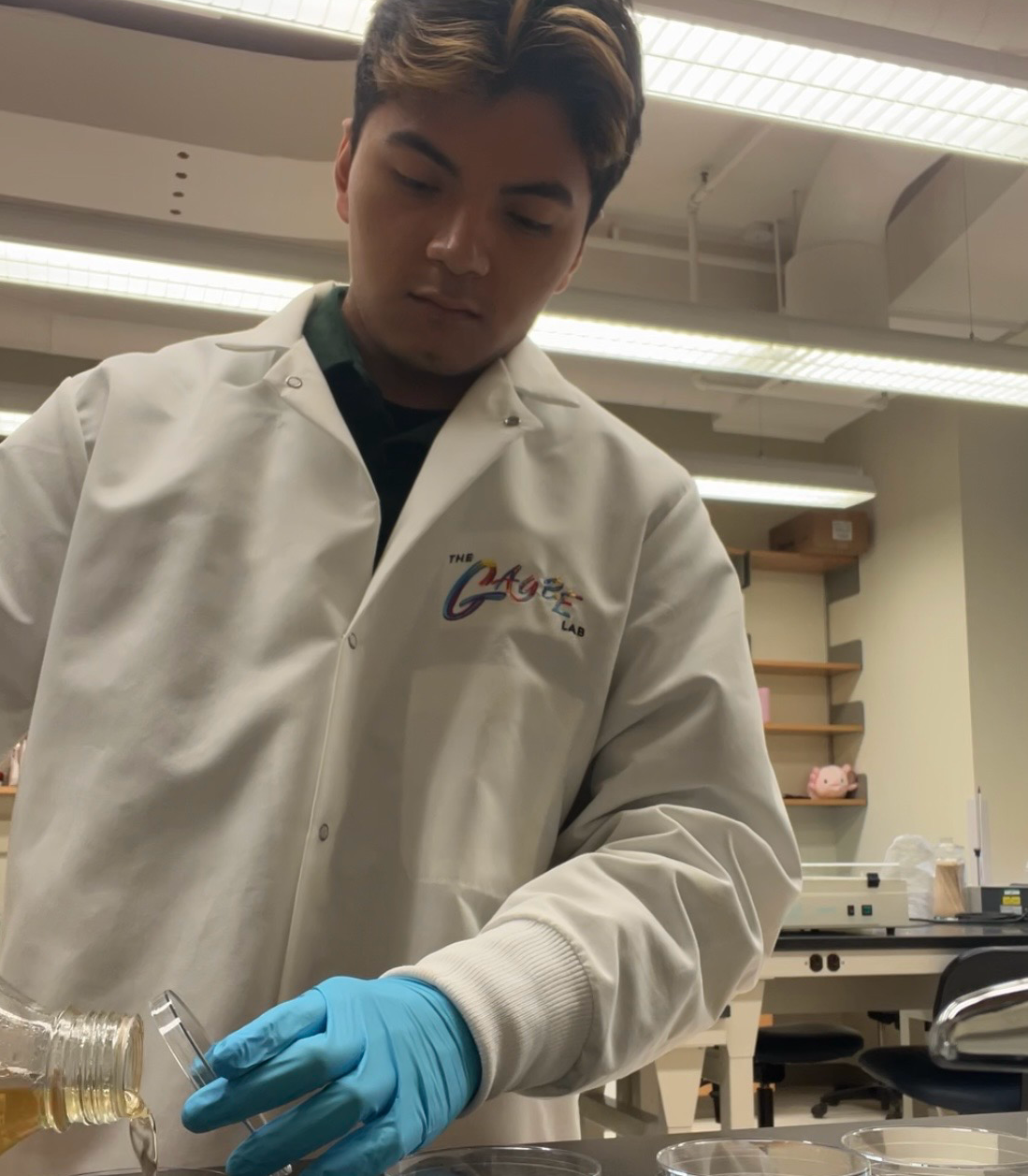
Lemuel Pacheco '29 conducts experiments in Professor Gaybe Moore's lab.
Project Description:
Pathogens on high-touch surfaces increase the risk of infection through surface transmission. Pathogenicity is often studied in animal models to better understand infection processes and treatment. Yet the degree of risks posed by pathogenicity in public settings remains unclear. We used Oberlin College as a microcosm of healthcare settings to explore the extent to which high-touch surfaces may present pathogenic potential. We collected and cultured swab samples from surfaces around Oberlin College. Distinct bacterial colonies were identified via colony morphology and used to prepare overnight cultures for infection assays with Galleria mellonella.
G. mellonella is a cost-effective model typically employed in studying human bacterial pathogens due to its similarities to mammalian immune systems. The pathogenicity of inoculated bacteria was assessed by observing the melanization of G. mellonella. We hypothesized that bacterial isolates from high-traffic surfaces would be more pathogenic than those from low-traffic areas. Our results showed that bacterial isolates from two high-traffic locations of Oberlin’s campus had higher normalized death rates, corroborating our hypothesis of greater potential pathogenicity. By understanding campus-associated pathogens, this study highlights the need for infection control mechanisms, including the potential management of microbial communities in built environments.
Why is your research important?
Humans interact with their environment more than a hundred times daily often without the awareness of microbial contact. Unfortunately this can lead to the risk of microbial pathogen transmission such as in healthcare settings. For instance, hospital-associated infections (HAIS) can be transmitted indirectly or directly through contact with medical equipment or medical personnel resulting in increased morbidity or prolonged stay for patients. Opportunistic pathogens are a notable example targeting immunocompromised hosts and other vulnerable communities. Having a foundational understanding of the potential pathogenicity of high-touch surfaces can help us advance protocols for transmission prevention and provide insights into bacterial-host relationships.
My research process involved sample collecting, cell culturing on various media, colony inoculation, infection assays with Galleria mellonella, and melanization observation. Patience and observation were key virtues of my research as I monitored bacterial colonies and G. mellonella progression over multiple days. I interpreted trends in G. mellonella melanization and concluded patterns in survival rates of Oberlin College location swabs in reference to control bacteria.
What knowledge has your research contributed to your field?
In understanding the potential pathogenicity of high-touch surfaces around Oberlin College, my research contributes to a translational basis for comprehending the colonization of pathogens in other public settings. Additionally, emphasizing the importance of potential pathogenicity encourages discussion around the implementation of disease infection prevention strategies.
In what ways have you showcased your research thus far?
Through the STRONG program, I was able to present my research to an audience of various disciplines in and outside of STEM, allowing me to strengthen my communication skills. Outside of academic settings, I have shared my research with peers, breaking down microbial roles and risks within our natural environment and health.
How did you get involved in research? What drove you to seek out research experiences in college?
Through the STRONG program, I was able to work in the Gaybe Lab under the mentorship of Professor Gaybe Moore. With a hunger for curiosity and my love of all things biology, I was enthralled to study the real-world applications of pathogens in everyday life. Applying bacterial concepts outside of the classroom such as morphology, defense mechanisms, and growth strengthened my understanding of the host relationships between bacteria and hosts.
What is your favorite aspect of the research process?
My favorite part of the research process was observing the bacterial colony growth and the melanization of G. mellonella. It was interesting to see how various factors such as the applicator type, dry or wet swab, and incubation period could impact results. Unexpected results led me to reconsider unaccounted factors that could help narrow the results we had hoped for.
How has working with your mentor impacted the development of your research project? How has it impacted you as a researcher?
Working with Professor Moore has encouraged me to expand the context of my research into broader scopes of application. As a researcher, I feel better prepared in approaching new concepts and engaging in experimental learning.
How has the research you’ve conducted contributed to your professional or academic development?
In professional contexts, I have grown comfortable with deconstructing complex concepts in biology for easier understanding for unfamiliar audiences. Academically, I appreciate research papers and have found benefits in connecting with real-world examples to build perspective.
What advice would you give to a younger student wanting to get involved in research in your field?
Don’t let jargon or new terminology intimidate you from approaching foreign concepts. Your strongest skill as a new researcher is your ability to gain new knowledge and ask questions.
Students