
Student Project Profile
Brain Mechanisms of Stereotypic Behavior
Project Title
Brain Mechanisms of Stereotypic Behavior
Faculty Mentor(s)
Project Description
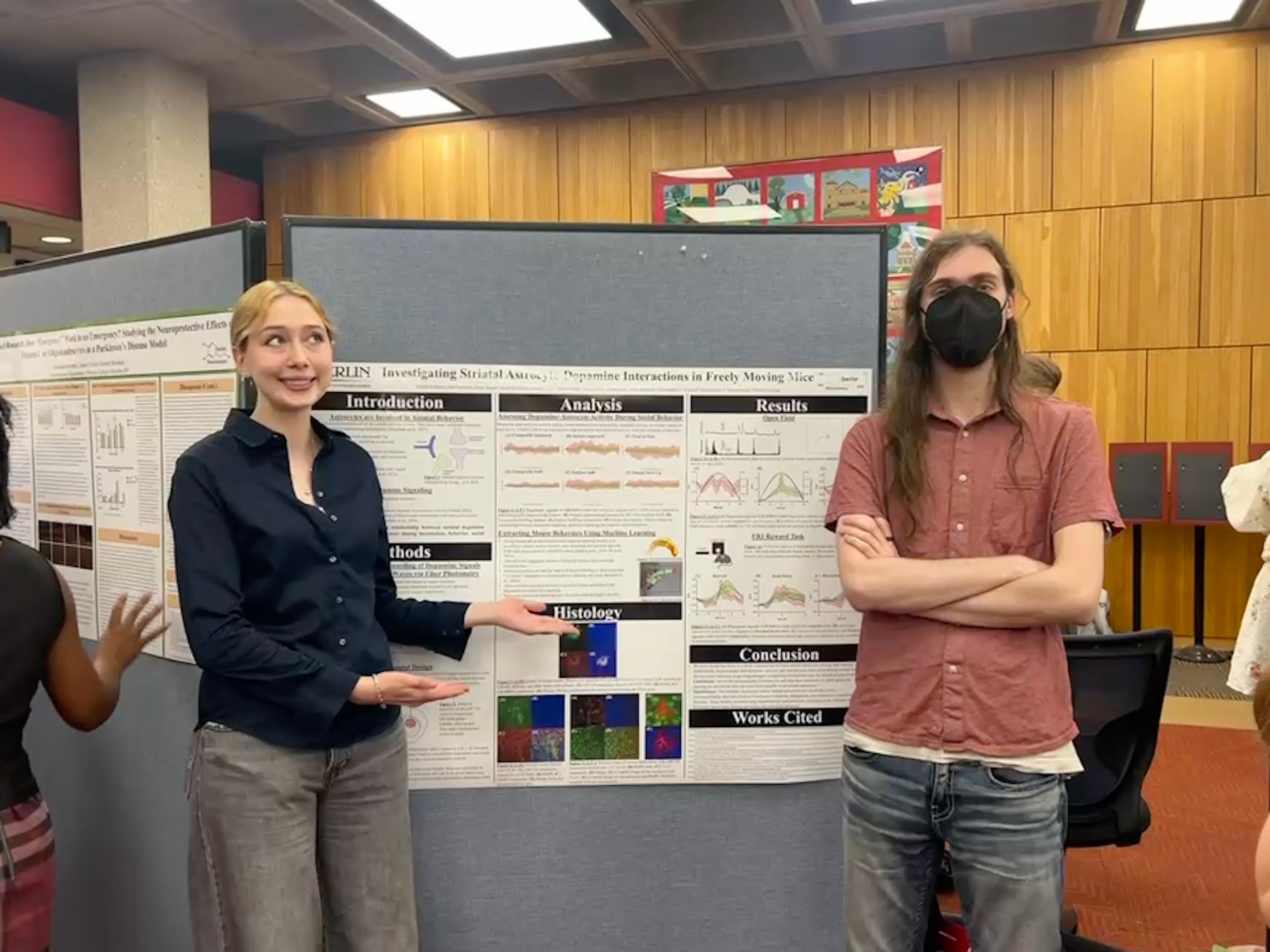
A hallmark of stimulant drugs like cocaine or amphetamine is their ability to increase repetitive, focused behaviors known as stereotypies (or the singular, stereotypy). The cause for this is not entirely clear, but it does seem to be associated with drug-induced increases in the neurotransmitter dopamine. When dopamine levels are high, the area of the brain charged with selecting appropriate actions is overloaded, leading to a repetitive series of actions that are effectively purposeless, though few studies have measured a distinct link between dopamine activity, brain activity resulting from this activity, and stereotyped movements simultaneously. The aim of this study is to measure real-time changes in brain activity while tracking movement in mice, to determine exactly how dopamine may contribute to stereotyped behaviors. Moreover, new behavioral tracking approaches will allow us to reveal distinct aspects of behavior in greater detail than ever before.
Why is your research important?
This work is important, as stereotyped motor disorders are a hallmark of stimulant abuse and can significantly interfere with one’s daily life. Additionally, diseases like obsessive-compulsive disorder are thought to be associated with neural activity akin to that seen in stimulant-induced stereotypy, suggesting a potential overlap in underlying mechanisms.
What does the process of doing your research look like?
As of right now, I am still in the initial research and piloting stage of this specific project, as it will ultimately contribute towards my honors thesis. However, my broader work in the lab has involved both computational and experimental work with animal subjects.
What knowledge has your research contributed to your field?
This research will hopefully contribute to the neuroscientific field’s knowledge about dopamine, glial cells, behavior, and stereotyped behavior.
In what ways have you showcased your research thus far?
I have presented related research within the Howard lab at the Oberlin College Research Symposium.
How did you get involved in research? What drove you to seek out research experiences in college?
I got involved in research after taking the Neuroscience 201: An Introduction to the Brain course, where I was able to get an idea of what research even looked like at Oberlin. I then reached out to a few professors, and found one that aligned well with my research goals. I wanted to seek out this experience because I had never really considered it an option before, but the course sparked a curiosity in me that I felt compelled to explore further.
What is your favorite aspect of the research process?
My favorite aspect of the research process is behavioral work, as it allows me to directly observe how exactly certain interventions or conditions influence actions.
How has working with your mentor impacted the development of your research project? How has it impacted you as a researcher?
Working with my mentor has impacted the development of my research project by allowing me to take a certain level of control over the direction of this study while still providing helpful guidance and support. His support and encouragement towards my ideas has not only empowered me to develop a deeper sense of ownership and confidence in my research, but also helped me grow into a more capable and independent researcher.
How has the research you’ve conducted contributed to your professional or academic development?
This research has given me opportunities to develop techniques or skills that would not otherwise be accessible to most other undergraduate students, such as fiber photometric work.
What advice would you give to a younger student wanting to get involved in research in your field?
I would recommend that anybody interested in research in any department, regardless of whether they are a major or have even taken a course in that area. Research at Oberlin is very open to everyone, so don’t assume you’re not qualified to participate.
Students

Selena Frantz ’26
fourth-year- Major(s):
- Neuroscience, Law & Society