
Student Project Profile
Examining Neuroprotective Effects of Melatonin Within Combinatorial Parkinson’s Disease Treatment
Project Title
Examining Neuroprotective Effects of Melatonin Within Combinatorial Parkinson’s Disease Treatment
Faculty Mentor(s)
Project Description
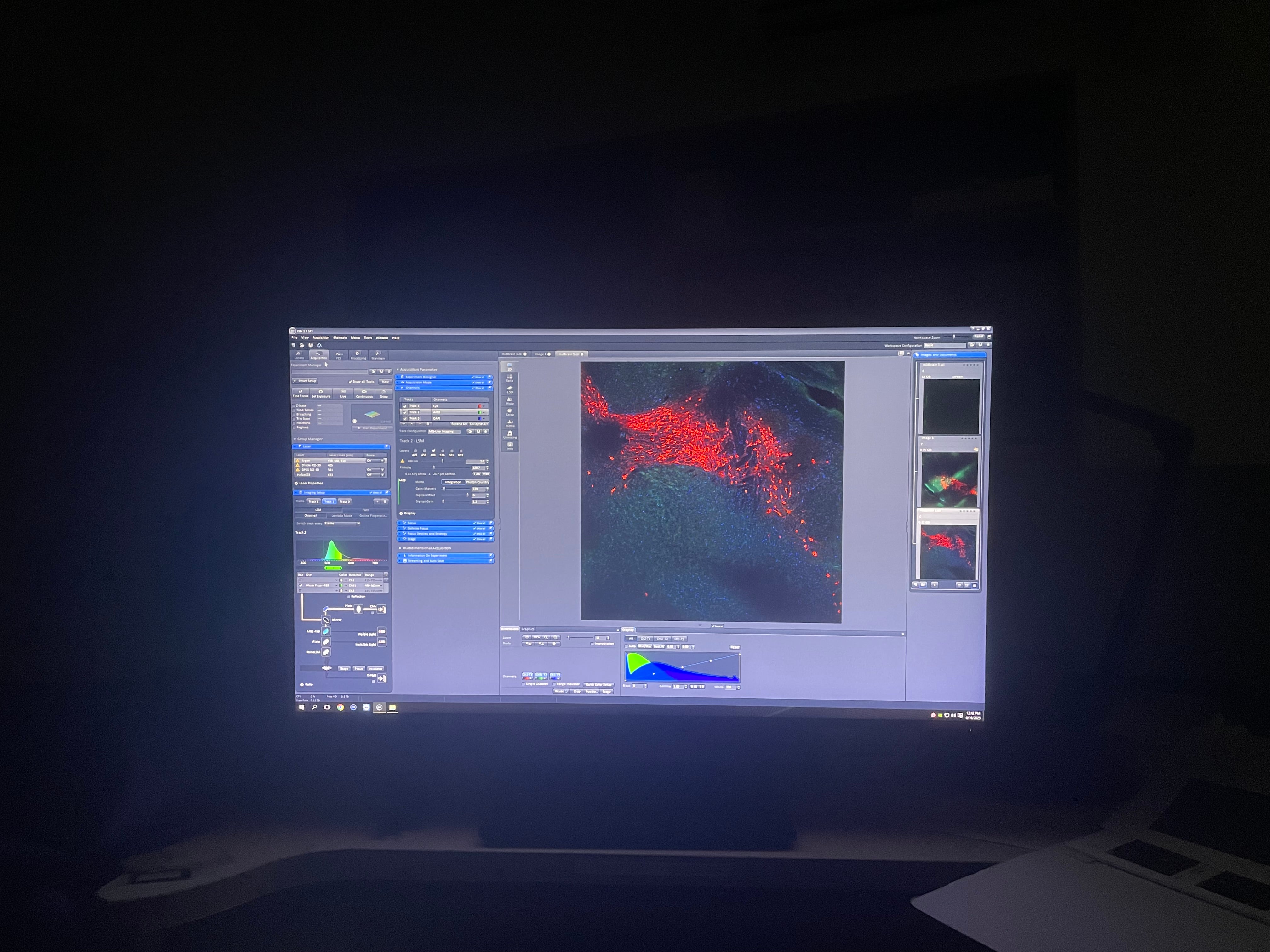
This project aims to expand on the data collected from a previous honors project conducted by Brycen Lesikar: “Exploring a Neurogenic and Antioxidant Combinatorial Approach to Parkinson’s Disease Treatment.” Measuring the amount of surviving dopaminergic cells in Parkinsonian mice could indicate the effectiveness of the antioxidant melatonin as a neuroprotective compound. By completing the data analysis associated with this project, we will be better able to ascertain the advantages and disadvantages of our model of Parkinson's Disease, contextualizing any observed neuronal loss, behavioral assay data, and neurotrophic impacts. Depending on the results of this data analysis, melatonin may become more of a focus in our research.
What does the process of doing your research look like?
A lot of our lab’s research is student-driven and headed by seniors completing honors projects. These seniors become mentors and project leaders in the lab, setting expectations for lab conduct and explaining concepts to newer lab members. I really looked up to all of the honors students that I knew in the Howard lab.
In what ways have you showcased your research thus far?
A few months after joining the Howard lab, two of my labmates and I presented on striatal patch-dopamine interactions in freely moving mice based on research conducted by honors student Haoyuan Gao ‘24. I also assisted honors student Sophia Krikawa ‘25 in presenting her research on dopamine-astrocyte signaling in freely-moving mice.
How did you get involved in research? What drove you to seek out research experiences in college?
Experiential learning has always solidified my understanding of different subjects. Being in a lab seemed to be a really hands-on way of applying already-learned concepts to an unexplored question.
What is your favorite aspect of the research process?
I really enjoy reading journal articles that build on or deconstruct older neuroscience research. It’s very interesting to me to see how so many research topics evolve over time as scientific understanding and analytical tools improve.
How has working with your mentor impacted the development of your research project? How has it impacted you as a researcher?
My mentor has always encouraged me to be curious, responsible, and kind to myself. I feel that I have learned so much about what it means to be self-disciplined while also being patient with my learning process.
How has the research you’ve conducted contributed to your professional or academic development?
I have had the opportunity to observe, in real time, concepts of neuroscience that I had previously only learned through lecture and lab demonstrations. Being able to apply these concepts to lab work has given me a deeper understanding of neurodegeneration, neurogenesis, and dopaminergic signaling.
What advice would you give to a younger student wanting to get involved in research in your field?
Don’t be afraid to reach out to both professors and students and talk about what you’re interested in! Be open to learning about new things – you never know what may end up piquing your interest in the long run.
Students
Henry Feller ’26
fourth-year- Major(s):
- Neuroscience