
Student Project Profile
Generating Fused in Sarcoma (FUS) Knockout Cell Lines Using CRISPR
Project Title
Generating Fused in Sarcoma (FUS) Knockout Cell Lines Using CRISPR
Faculty Mentor(s)
Project Description
Amyotrophic lateral sclerosis (ALS) and frontotemporal lobar degeneration (FTLD) are two neurodegenerative diseases with a common feature of the pathogenic accumulation of fused in sarcoma (FUS). FUS is a highly expressed RNA/DNA binding protein that regulates various cellular functions. Mislocalization of the FUS protein has been linked to both ALS and FTLD pathology. The Johnson Lab utilizes immortalized cell lines to study triggers of FUS mislocalization which is integral in understanding both ALS and FTLD. Our current cell lines express high levels of FUS, inhibiting our ability to examine how different FUS variants impact function. We aim to develop two new cell lines that do not express endogenous FUS (termed knockout, FUS KO) through the use of the clustered regularly interspaced short palindromic repeats Cas9 system (CRISPR-Cas9). Human embryonic kidney 293T cells (HEK293T) and U-2 OS are used to create these FUS KOs. We hypothesize that by creating stable FUS KO cell lines with CRISPR our experiments will become more consistent by eliminating differences in short term expressing mutations. Cells are currently undergoing clonal isolation to generate a population of cells that do not express FUS. Overall, this study aims to provide insight for future studies on FUS and its role in neurodegeneration by creating a new tool for stably expressing novel FUS mutations.
Why is your research important?
Neurodegenerative diseases, especially rare ones, do not get much attention from the general public and researchers despite the drastically lower quality of life people who have these diseases report. They change people’s lives forever and can be virtually unpredictable until it is too late. Putting time and effort into researching these diseases gives hope and answers to people suffering from these devastating conditions.
What does the process of doing your research look like?
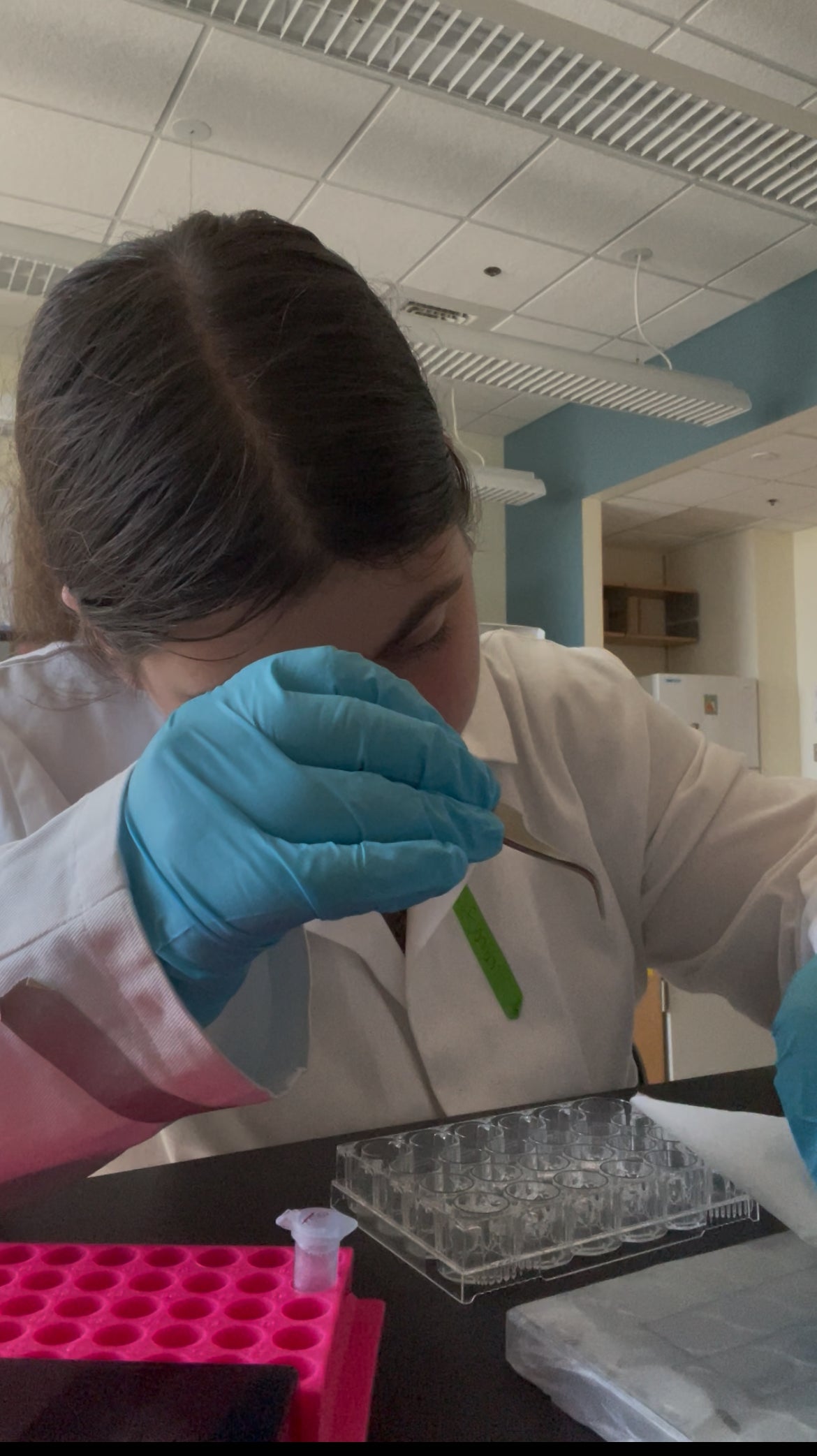
In my research I culture a couple of different cell lines that I then use in various experimental procedures. I study the protein fused in sarcoma (FUS) and different variants of the protein and how it impacts various cellular processes such as cellular localization.
What knowledge has your research contributed to your field?
My research has added to the field’s knowledge because FUS has been linked to two debilitating neurodegenerative diseases. Overall mechanisms of this protein and its variants has remained largely unknown and I have begun to look into how the endogenous version of the protein localizes versus the protein's variants and what implications it may have in protein function.
In what ways have you showcased your research thus far?
I had the opportunity to present at a couple of conferences last year which introduced me to many people and gave me a chance to share my research at a professional level. Interacting with mentors from all over and discussing with a diverse group of peers from across disciplines provided me with transferable skills I got to take back with me to Oberlin.
How did you get involved in research? What drove you to seek out research experiences in college?
I was sitting in my neuroscience introduction course and Professor Johnson mentioned starting a lab. I had no previous experience but wanted to work more hands-on in a lab. Going to an undergraduate only institution with extensive research opportunities has enabled me to be independent and learn skills I thought I would have to wait to be exposed to.
What is your favorite aspect of the research process?
My favorite aspect of the research process is becoming confident in a technique so I can specifically address issues and inconsistencies. Troubleshooting has taught me how to become more adaptive as a researcher and how to dissect each step of an experiment developing a better understanding of the work I am doing.
How has working with your mentor impacted the development of your research project? How has it impacted you as a researcher?
Working with my mentor, Professor Johnson, has taught me so much about the research process and how to conduct myself and approach questions that do not yet have answers. I have learned how to interact with and dissect literature and apply that to my work and finding gaps in the field. I have become more curious and confident in my abilities to contribute to a field that once felt unachievable.
How has the research you’ve conducted contributed to your professional or academic development?
Conducting research, especially during research intensive times such as winter term and over the summer has shown me my true passion for this line of work. I have learned to view failure not as something that is scary or disappointing but a chance to try again with more knowledge. Being able and excited to keep showing up has been an incredibly valuable lesson.
What advice would you give to a younger student wanting to get involved in research in your field?
I would tell younger students to get involved early and often. Simply by reaching out and having those extra conversations with your professors and demonstrating your commitment can result in forming meaningful long lasting relationships. If your first attempt at getting involved in research is unsuccessful keep trying because soon enough someone will be able to take you on.
Students
Haley Gottesman ’26
fourth-year- Major(s):
- Neuroscience