
Student Project Profile
Understanding the Role of RNA/DNA-Binding Protein fused in sarcoma (FUS) in Cell Viability Using Flow Cytometry
Project Title
Understanding the Role of RNA/DNA-Binding Protein fused in sarcoma (FUS) in Cell Viability Using Flow Cytometry
Faculty Mentor(s)
Project Description
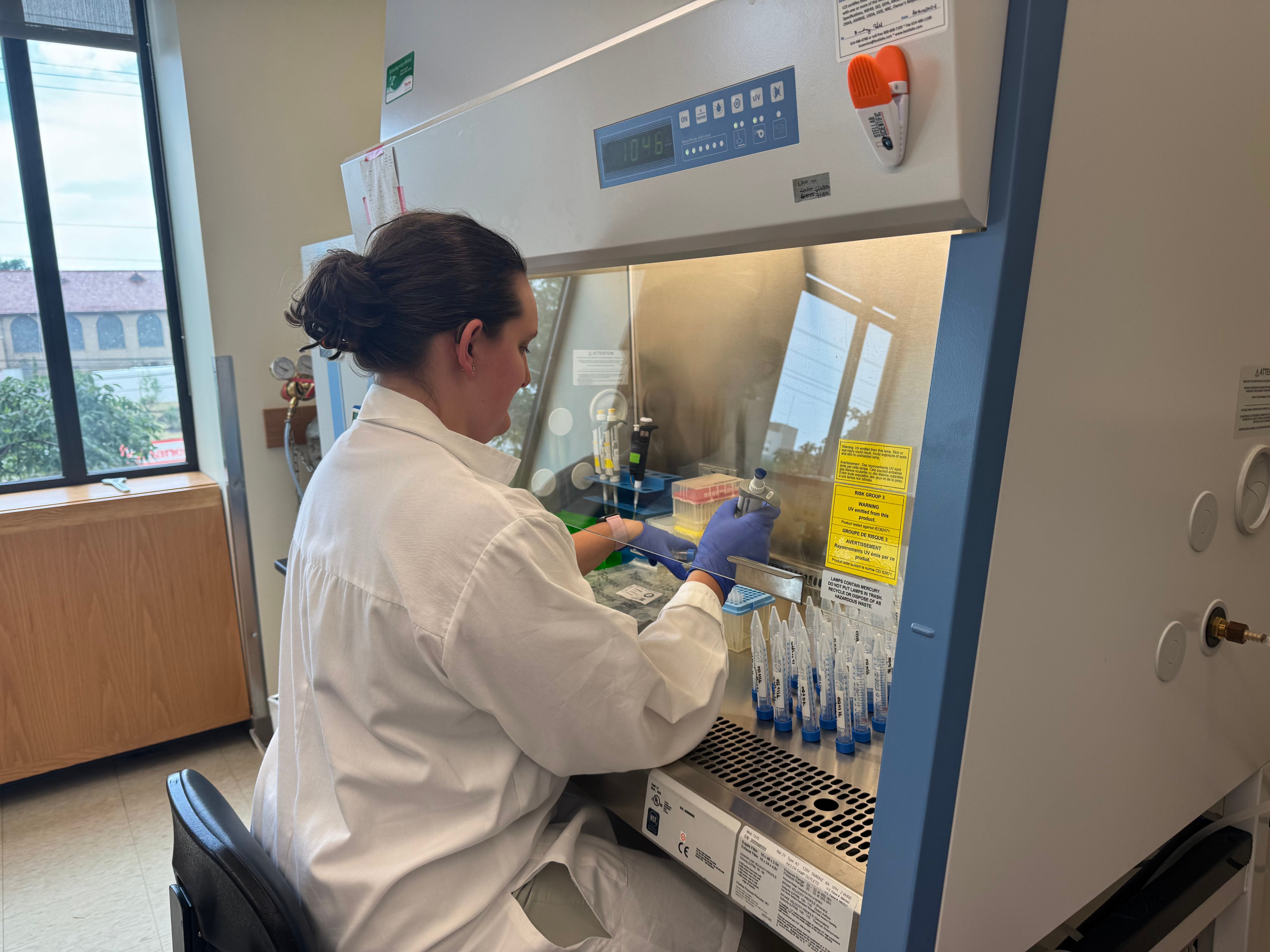
Fused in sarcoma is a RNA/DNA binding protein with multiple functions within the cell. It is primarily localized to the nucleus, but it must shuttle between various cellular compartments to accomplish its functions. Cytoplasmic accumulation of FUS has been linked to two different neurodegenerative diseases: amyotrophic lateral sclerosis (ALS) and frontotemporal dementia (FTD). Various genetic and non-genetic factors can trigger FUS cytoplasmic accumulation, such as N-terminal phosphorylation of FUS which is triggered when the cell undergoes double strand DNA damage. Even though cell death is a known factor of ALS/FTD symptoms, no one has shown how these modifications impact cell survival. As such, we utilized flow cytometry to study whether expression of mutated FUS impacted cell survival. We manipulated immortalized human cells to force expression of various cytoplasmic FUS mutants, then stained cells with a live/dead stain called propidium iodide to assess cell viability. Completion of these studies will inform how differences in the FUS protein affect cell viability.
Why is your research important?
Everyone has been impacted by dementia to some extent throughout their lives and knows how difficult a diagnosis is on everyone involved. People with FUS-FTD are told that they have dementia but the cause is unknown, which is not true for all types of FTD. Given that 10% of FTD cases have cytoplasmic aggregations of FUS, this research could provide further evidence that FUS contributes to the neuron degeneration associated with these formerly idiopathic cases of FTD. If the pathogenesis of FTD can be identified, treatments targeting the cause of neuron degeneration can be developed.
What does the process of doing your research look like?
The cell viability protocol takes three to four days to run. I work with immortalized human cells, which I plate in a little dish on the first day and then transfect, or force them to express mutated proteins, on the second day. If I am running a stress condition I will treat them with hydrogen peroxide for three hours and then give them a 24 hour rest, if I am not stressing the cells I will move straight on to the viability test. When I run the test, I stain the cells with a DNA-binding dye which stains dead cells, and then I load the cells into a machine that graphs the way the light scatters. Our computer software can then sort the cells and we can get a percentage of live versus dead cells.
What knowledge has your research contributed to your field?
While we have not yet finished our experiments, the results of our research can be used to show the impact of post translational modifications of FUS on cell health and viability. This is the first step in understanding how phosphorylated FUS and its associated cytoplasmic aggregations cause neuron degeneration in FTD.
In what ways have you showcased your research thus far?
This summer I gave a presentation to the other research fellows at the Oberlin Summer Research Institute about the methods of my research, my results until that point, and the troubleshooting work I had done.
How did you get involved in research? What drove you to seek out research experiences in college?
I came into college knowing that I wanted to study neuroscience, but I didn't know what I was most interested in within that broad field. After taking two cell-focused neuroscience courses, I became curious about cellular research. I reached out to my introductory neuroscience professor to ask about what this type of research looked like, and I was offered a place in her lab for the summer.
What is your favorite aspect of the research process?
My favorite part of the research process is troubleshooting and watching the results come together. It is so satisfying to learn something new from an experiment you have performed, whether it is information that could be put in a paper or just a clearer understanding of how to better run your protocol.
How has working with your mentor impacted the development of your research project? How has it impacted you as a researcher?
Professor Johnson has been instrumental in my development of many important research skills, but most importantly she has helped me to develop my confidence. She encourages me to try things and see how they work out, and to figure out how to best organize my experiments in the way that makes sense to me. I have become so much more confident in my scientific abilities and am a strong independent researcher after two months under her guidance.
How has the research you’ve conducted contributed to your professional or academic development?
This summer I have encountered a lot of opportunities to troubleshoot. It can be so frustrating when things go wrong, but ultimately it feels worse when I give up and don't ever figure out what happened. In the last two months I have had lots of practice learning how to manage my frustration with setbacks and how to continue going with my research, which is a very important skill in all aspects of my life.
What advice would you give to a younger student wanting to get involved in research in your field?
My best piece of advice is to have an open mind about your research experience. It is so easy to get stuck in one thing that you're interested in, but it is really important to try all different kinds of labs and take advantage of all the opportunities that are available. I was so certain that I wanted to do people-focused research when I started college, but after taking this opportunity for cell research I learned that I actually really enjoy cell biology!
Students
Elizabeth Huettig ’27
third-year- Major(s):
- Neuroscience