
Student Project Profile
Investigating the effects of a phosphorylated variant of RNA/DNA binding protein FUS on cell viability using the colorimetric MTT assay
Project Title
Investigating the effects of a phosphorylated variant of RNA/DNA binding protein FUS on cell viability using the colorimetric MTT assay
Faculty Mentor(s)
Project Description
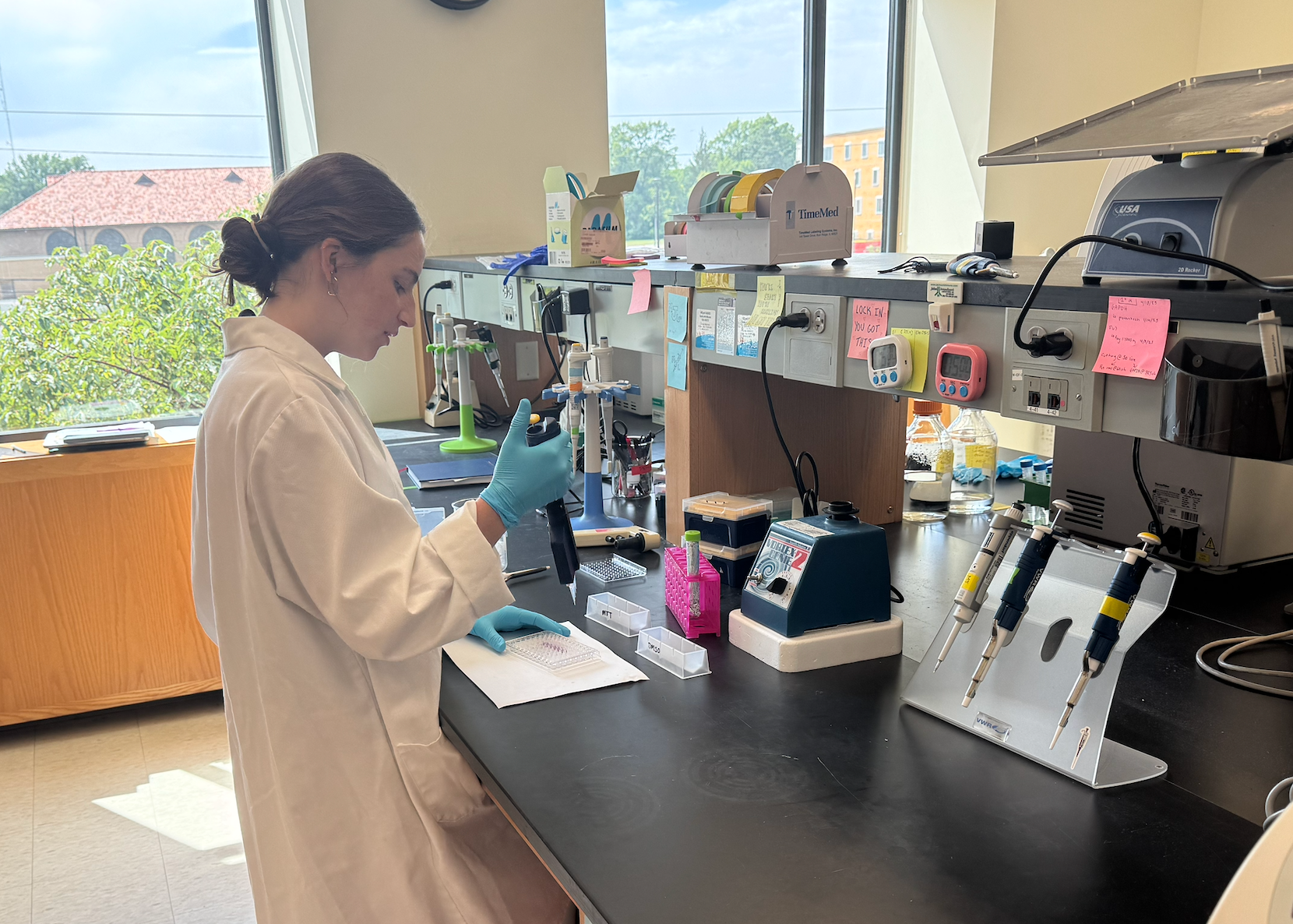
While amyotrophic lateral sclerosis (ALS) is characterized by motor symptoms and frontotemporal dementia (FTD) by cognitive symptoms, the two are closely linked neurodegenerative diseases. These diseases share genetic and pathological markers of disease such as the cytoplasmic accumulation of protein fused in sarcoma (FUS). FUS is an RNA/DNA binding protein that shuttles between the nucleus and cytoplasm to accomplish its roles in the cell, including transcriptional regulation, splicing, mRNA trafficking, and DNA repair. Loss of nuclear/cytoplasmic shuttling causes FUS accumulation into cytoplasmic aggregates and cell death. Understanding triggers of FUS accumulation is integral to understanding the disease process. Past research shows that the cytoplasmic mislocalization of FUS may be triggered by double-strand DNA breaks. This activates DNA repair processes resulting in N-terminal phosphorylation of FUS. There is conflicting evidence whether this modified FUS accumulates in the cytoplasm. I tested whether expression of this FUS variant (PM FUS) affected cell viability. I utilized the colorimetric MTT assay to assess cell health. This data will provide a basis for further investigation into how the modification of FUS contributes to FUS pathology of ALS and FTD.
Why is your research important?
Understanding novel causes of neurodegenerative disease like ALS and FTD will provide the basis for future therapeutic interventions.
What does the process of doing your research look like?
I maintain a line of cells that I use for my experiments. When they are ready, I manipulate the cells to express different variants of the RNA/DNA binding protein FUS. From there, I expose them to baseline conditions and a stressor and then use an MTT assay to determine cell viability.
What knowledge has your research contributed to your field?
I have been studying the role of a specific series of post-translational modifications (PTM) on a protein closely linked to disease. Through this work, I hope to understand how PTMs may contribute to cell health and damage.
In what ways have you showcased your research thus far?
I have given a short talk to other Oberlin Summer Research Institute fellows about the background, mechanisms, and significance of my research.
How did you get involved in research? What drove you to seek out research experiences in college?
My current mentor, Professor Johnson, was a huge part of my path to research. In her Introduction to Neuroscience class Professor Johnson encouraged me to critically analyze and ask questions about leading research in the field. After discussions about research papers in office hours, I had many questions about her personal research, and following some good discussions about what she was doing and hoping to achieve, she offered me a spot in her lab.
What is your favorite aspect of the research process?
So far I have really enjoyed lab meetings, where once a week the students and professor all get together to talk about what we’ve discovered and what might have gone wrong in our research. This way, we all get to troubleshoot together and I've been introduced to new ideas and concepts that I hadn’t previously considered.
How has working with your mentor impacted the development of your research project? How has it impacted you as a researcher?
As a mentor, Professor Johnson emphasizes the importance of autonomy and student driven research. As such, I have learned how to plan my own experiments, look for answers in past research, and brainstorm how to troubleshoot my failures. My experience with Professor Johnson has pushed me to understand the purpose of the lab fully, instead of being assigned work without much context. The independence and outside of the box thinking that I have learned under Professor Johnson are skills that I believe will live with me for the rest of my research career.
How has the research you’ve conducted contributed to your professional or academic development?
Not only has working in a research lab contributed to my base of knowledge, but I’ve gained some really valuable skills. I have learned how to balance cooperation and independence in an academic and professional setting, as well as how to keep myself organized when there is an overwhelming amount of intricate lab work.
What advice would you give to a younger student wanting to get involved in research in your field?
Be genuinely curious! My research journey started by asking many many questions. Even if you don’t have an interest in research right now, it’s always a good idea to read academic papers in your field of interest and talk with your professors about what they are doing in their research. In my experience, because I showed genuine curiosity in research here at Oberlin and saw it as a way to learn instead of pad my resume, my current research mentor was happy to take me on.
Students
Madeline Deep ’27
third-year- Major(s):
- Neuroscience, Flute Performance