
Student Project Profile
Investigating the Potential Neuroprotective Effect of Methylene Blue Treatment in α-Synucleinopathies
Project Title
Investigating the Potential Neuroprotective Effect of Methylene Blue Treatment in α-Synucleinopathies
Faculty Mentor(s)
Project Description
α-synuclein (α-Syn) accounts for almost 1% of the brain’s total protein. It regulates myriad processes, including dopamine release, plasma membrane shape, and immune responses. However valuable and ubiquitous, mutations in or overexpression of α-Syn can result in protein misfolding and aggregation, leading to protein inclusions that disrupt cellular homeostasis. These inclusions characterize a class of diseases known as α–synucleinopathies, such as Parkinson’s disease, Lewy Body Dementia, and Multiple Systems Atrophy (MSA) that have shared downstream pathogenic molecular biology. Methylene Blue (MB), an established therapeutic drug for the blood disorder methemoglobinemia, exhibits neuroprotective effects in Parkinson’s and Alzheimer’s disease, as well as Huntington’s disease (a recent finding in our lab), because it enhances cellular systems which regulate abnormal protein build-up and protect mitochondrial health. Therefore, we are investigating the potential neuroprotective effect of MB on oligodendroglial cells that express genetic changes in α-syn expression and function. We will use biochemical assays to examine the influence of MB on cell health and function, protein aggregation, oxidative stress, and mitochondrial bioenergetics. Further, we seek to examine the effect of MB on the transcriptome in oligodendroglial cells to identify further mechanisms of α-syn pathology and MB neuroprotection.
Why is your research important?
About 2.5 million people in the U.S alone are expected to have a form of synucleinopathy, and there are currently no cures and few-to-no disease-modifying therapeutics. Therefore, it is imperative to investigate the effects of potential neuroprotective compounds that can help to assuage aspects of the molecular pathogenesis.
What does the process of doing your research look like?
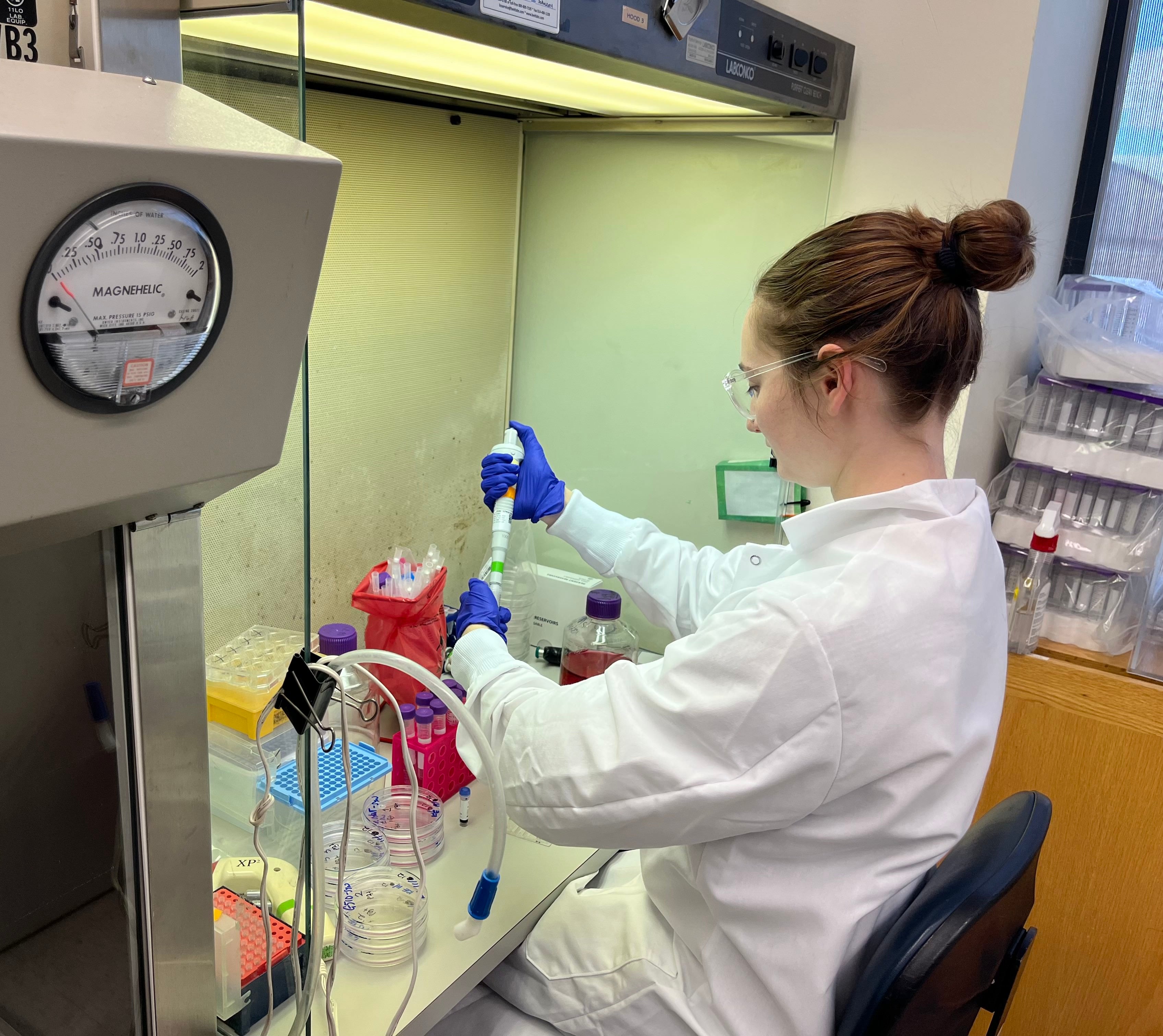
I culture my own cell lines and expose them to methylene blue and a toxin, hydrogen peroxide. I then either harvest the cells or add dyes to the cultures directly that can help visualize and/or quantify readouts of molecular mechanisms like cell stress, protein expression, organelle function, or organelle morphology.
What knowledge has your research contributed to your field?
As we are investigating several versions of α-Syn, our work can seek to highlight differential pathogenesis between point mutations and overexpression of wild-type α-Syn, which can invite further work on identifying druggable targets. We have also identified the protective effect, thus far, of methylene blue on cell health and viability, reducing death in mutated cell lines. We have also started to test and identify a rescue effect methylene blue is able to enact against toxin exposure in our cell lines, namely to hydrogen peroxide.
In what ways have you showcased your research thus far?
I have presented three posters at the Oberlin College Undergraduate Research Symposium. I also presented a poster on recent work in the lab at the Society for Neuroscience Conference, mGluRs undergraduate Neuroscience Conference hosted at Oberlin, and the ABRCMS Conference.
How did you get involved in research? What drove you to seek out research experiences in college?
In 6th grade, I fell in love with molecular biology and found myself wanting to pursue research questions surrounding the molecular mechanisms underlying disease, eventually focusing on neurodegeneration. In college, wanting to pursue these research questions led me to speak to my professors about their work and express my interest in their labs, which led to me working with Professor Jason Belitsky and Professor Gunnar Kwakye. Outside of Oberlin, I reached out to PI’s at Mount Sinai and performed research for two summers in Dr. Fanny Elahi’s lab to study CADASIL, a genetic form of vascular cognitive impairment, using induced pluripotent stem cells at Mount Sinai Icahn school of Medicine.
What is your favorite aspect of the research process?
I really enjoy cell culture and the satisfaction of running biochemical assays that make the molecular world visible in some capacity, and quantifiable. I also enjoy having a sense of independence that boosts my confidence in laboratory techniques, with a firm support system in an advisor willing to guide me through the research process. I also like asking research questions pertinent to health contexts, and harnessing the basic science perspective to study disease.
How has working with your mentor impacted the development of your research project? How has it impacted you as a researcher?
Professor Kwakye has helped to guide my research questions and experimental designs, leading me to think in directions I had not initially considered, or to test different mechanisms. Speaking with him helps me to think about gaps in knowledge that exist in the scientific community, along with my own personal gaps in knowledge that drive me to supplement my thinking with what I had not previously considered. Professor Kwakye helps me think critically about science both specific to a project, and related to general experimental design, such as including proper controls in my assays.
How has the research you’ve conducted contributed to your professional or academic development?
My experience in Professor Kwakye’s lab has prepared me for other research experiences, including working at Mount Sinai. The scientific content related to our research also helps me better engage in my biochemistry and neuroscience classes. Professor Kwakye also places an emphasis in his mentorship on bettering his student’s ability to understand scientific literature, effectively communicate our findings to myriad audiences, and connect our research to wider contexts including public health, all of which cultivate mindsets that prepare us for graduate school and beyond.
What advice would you give to a younger student wanting to get involved in research in your field?
I think a student needs to be aware that working in research is different from a class; it is very practical. Working in a lab entails monitoring the scientific concepts involved with their experiments–both the mechanisms of an assay and the proper elements of experimental design that allow for clean science and identifying true effects. Students entering a lab should be ready to work with others, communicating effectively, listening to what everyone has to teach, being open to suggestions and critique, and meaningfully contributing to projects.
Students

Kayla Elias ’25
fourth-year- Major(s):
- Neuroscience, Biochemistry