
Student Project Profile
Manifesting Queerness in Contemporary Chinese Art
Project Title
Manifesting Queerness in Contemporary Chinese Art
Faculty Mentor(s)
Project Description
The works of artists Chi Peng and Ma Liuming each depict the artist’s own naked body engaged in acts of defiance, from queer sex to questioning binaries of gender and nation. This paper investigates how contemporary Chinese artists use their bodies to challenge the dominating pressures of normativity and express queerness. I define queerness as modes of existence, identities, or self-expression that resist heteronormative sexuality and gender identity expectations. These artists, each active in Beijing at the turn of the 21st century, harnessed their bodies to represent the expansive nature of their experiences with late-20th-century China’s unprecedented urbanization, social change, and economic development. Through analyzing Chi Peng’s photoseries Consubstantiality (2003) and I Fuck Me (2005), Ma Liuming’s series of Fen-Ma Liuming performances (1994-2004), and other works, I aim to answer the following questions. How does an artist represent their body within a space (nation, society, or physical environment) that seeks to repress its impact? How can the body serve as a tool to represent queerness? How does queerness manifest through these works? Through Ma Liuming and Chi Peng’s experimental performances and images, we can build an image of the inherent power contemporary art holds for expressing queerness. This paper addresses a gap in scholarship on queer Chinese art, illuminating the exploration of queerness as a performance of the body in Chinese contemporary art from the 1990s and 2000s.
Why is your research important?
My research rejects a heteronormative interpretation of contemporary Chinese experimental art, aligning its queer potentiality within the context of China’s modern sociopolitical environment, highlighting how artists construct queer self expressions as well as visualize identities and possible realities through their art.
What does the process of doing your research look like?
Lots of time spent contemplating images and text, reading books, translating Mandarin terms, taking incoherent notes and translating them into academic writing, and requesting a vast number of books via Interlibrary Loan and OhioLink.
In what ways have you showcased your research thus far?
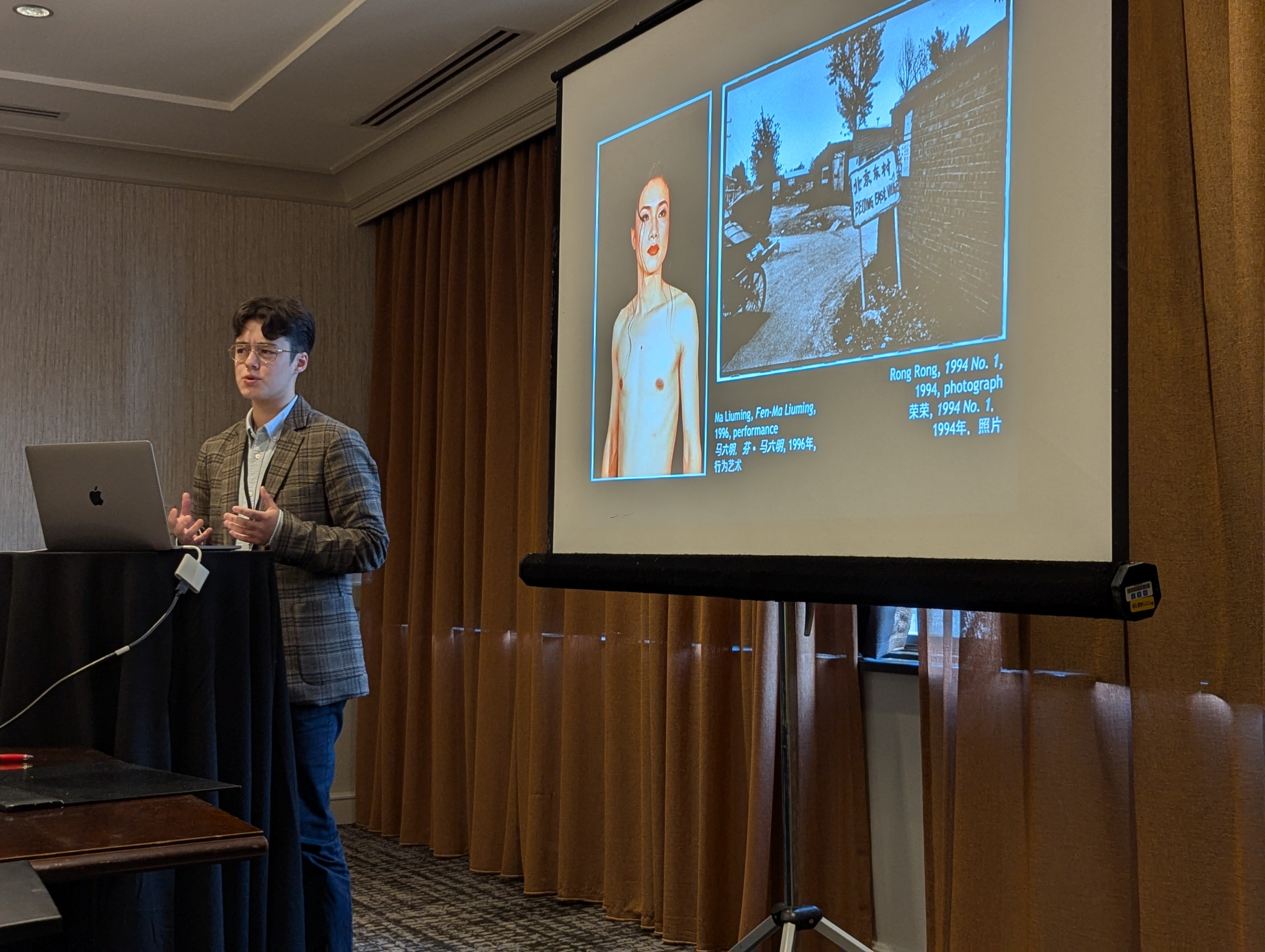
In October, I presented the early stages of my honors thesis paper on an undergraduate panel at SECAC 2024 in Atlanta, GA (see attached photo). I wrote and gave a 17 minute talk based on my research thus far. Attending the conference and sharing my research with fellow undergraduates and professionals in the field was an incredible opportunity.
How did you get involved in research? What drove you to seek out research experiences in college?
As a first year student, I wouldn’t have predicted I would engage in research. All I knew was that I loved to research and write papers in my art history classes. In junior year, after completing a final paper in my art history seminar, I realized I wasn't ready to conclude my work on the topic. So, I inquired about opportunities to continue research outside of classroom instruction and decided to propose an honors thesis.
What is your favorite aspect of the research process?
My favorite aspect of the process is being able to work with and explore my topic over an extended period of time, developing new ideas based on my readings and research. As I become more and more familiar with the ideas and concepts I’m exploring, I get excited about integrating them into my argument.
How has working with your mentor impacted the development of your research project? How has it impacted you as a researcher?
Professor Perry’s support and guidance has been an extremely impactful component of my trajectory as an Oberlin student. She supported my topic from its very first iteration, providing constructive feedback that gave me the confidence to propose a larger research project, and still pushes me to ask and answer questions that I might not consider individually. Furthermore, meeting with my advisor one-on-one allows me to gain confidence expressing my thinking verbally, and I can tell that I am growing better at communicating about my research.
How has the research you’ve conducted contributed to your professional or academic development?
Being engaged in the research process has contributed to my growth as a student; I feel more confident expressing my ideas both verbally and through writing. My passion for my topic has also contributed to my decision to apply to art history graduate programs.
What advice would you give to a younger student wanting to get involved in research in your field?
My advice is to find the topic or question that you can’t stop thinking about–focus on what excites you–and take advantage of all opportunities to explore it further.
Students
Lee Must ’25
fourth-year- Major(s):
- Art History, Psychology