Oberlin Alumni Magazine
The Trailblazers
As the long-running co-hosts of Radiolab, Jad Abumrad ’95 and Robert Krulwich ’69 made sound investments in the art of storytelling.
May 28, 2025
Travis O’Daniel ’26
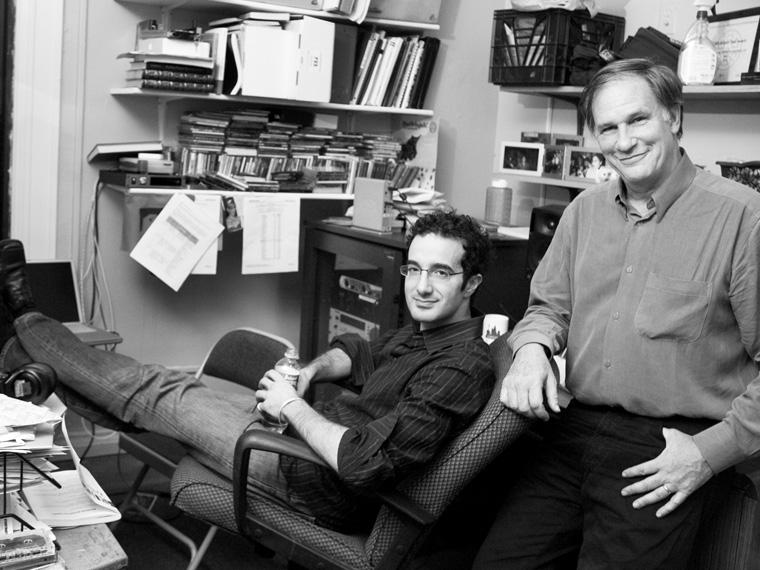
Buoyed by their time at Oberlin, Jad Abumrad ’95 and Robert Krulwich ’69 tell imaginative stories across mediums.
Photo credit: Todd France
As the long-running co-hosts of Radiolab, Jad Abumrad ’95 and Robert Krulwich ’69 made sound investments in the art of storytelling. Launched by Abumrad in 2002, the show is widely credited for launching podcasting into the cultural zeitgeist.
Radiolab conveys complicated topics—for example, how we define race, what forms our ideas of self, and how plants communicate with one another—in an accessible, sonically interesting way. Episodes layer interview segments into live dialogue and Abumrad’s innovative use of music—the latter of which Krulwich describes as an “audio cushion for thinking.”
The early days of Radiolab were full of experimentation. Operating on WNYC’s AM frequency on Sunday nights, the show existed in a low-stakes environment with few listeners. This lack of audience pressure, coupled with the creativity that often comes with late-night/early-morning studio access, allowed Abumrad and Krulwich to freely explore unconventional audio storytelling—like a time when the owner of the studio they recorded in said their concept was “all wrong.” They happened to be recording at the time and decided to put the negative feedback into the actual episode.
“It was very impractical,” Krulwich recalls with a smile. “Like jazz improvisation—we’d go in and talk, and then we’d make another version because we had to correct all our mistakes. Then we’d make another version—and then another version. And then we’d have 13 takes on things, and Jad had to edit all of them into place while I went to the beach or sipped Coca-Cola or something.”
Radiolab’s inventive sound design was just as attractive as its hodgepodge narrative improvisations. For example, Abumrad once orchestrated an entire orchestral symphony, complete with a full choir, to convey the feeling of a mantis shrimp seeing a rainbow.
“[The sound] was kind of a product of who we were—and are—and what we had chosen to think about,” Abumrad explains. “Robert is the most musical storyteller you will ever meet in your life—metaphors fall out of his mouth without him even thinking—so part of it was me responding as a musician to him. It was really a question of whether we could get our imaginations and his musical sense running together.”
Krulwich, who held high-profile hosting roles in print, radio, and TV news, admitted that some of his peers initially had trouble understanding the appeal of Radiolab. “Funny looks, it turns out, mean you actually have got a stand-up triple,” he quips. “I’m doing something right because [TV host] Diane Sawyer thinks I’m a maniac. That is one of the Oberlin inheritances: You learn to measure your success by the funny looks.”
It paid off for Krulwich and Abumrad to trust their instincts. Today Radiolab has more than 10 million downloads monthly. While they no longer host the show, their current projects continue the Radiolab spirit. Abumrad is teaching and lecturing at Vanderbilt University, where he set up a research lab and community space called Studio 608; has a new audio series due in late 2025; and is composing and working on theater pieces. Krulwich, meanwhile, is working on science projects at museums and stories for CBS.
Today, many Oberlin students are hoping to capture Radiolab’s spark with podcast experimentations of their own. Abumrad and Krulwich have their own theories about why Obies gravitate toward the medium.
“There’s something about the dare—you’re not afraid to try,” Krulwich says. “Maybe Oberlin gives you a dare. Something about it is curiosity. Oberlin may attract a certain number of people who are just intensely curious about what they’re seeing and learning and experiencing.”
Abumrad agrees. “Oberlin attracts a certain kind of person and then engenders in them a deep restlessness. The Oberlin student is a very dissatisfied person. They’re not happy with the world as it is—and weren’t before they got there. [That’s] amplified when they’re on campus. You get a sense of, ‘You’re gonna hear me!’ I think that funnels people to podcasting: Anywhere you can express who you are and what you think, you’ll find Obies there.”
This story originally appeared in the Spring 2025 issue of the Oberlin Alumni Magazine as part of the feature "A Pipeline to Podcasts."
You may also like…
Jane Wickline ’21 Finds Community in Comedy
A Q&A with the Saturday Night Live cast member and Dukes cofounder
When Stars Align
The Oberlin Contemporary Music Ensemble shines on Jennifer Koh ’97’s "The American Concerto, Volume One."
Wright On, Sister
Would the Wright brothers have invented their airplane without the support of their sister, Katharine Wright Class of 1898? Probably. But they might not have been the first.