Tied Together in a Single Garment of Destiny
October 8, 2025
Alicia Smith-Tran ’10
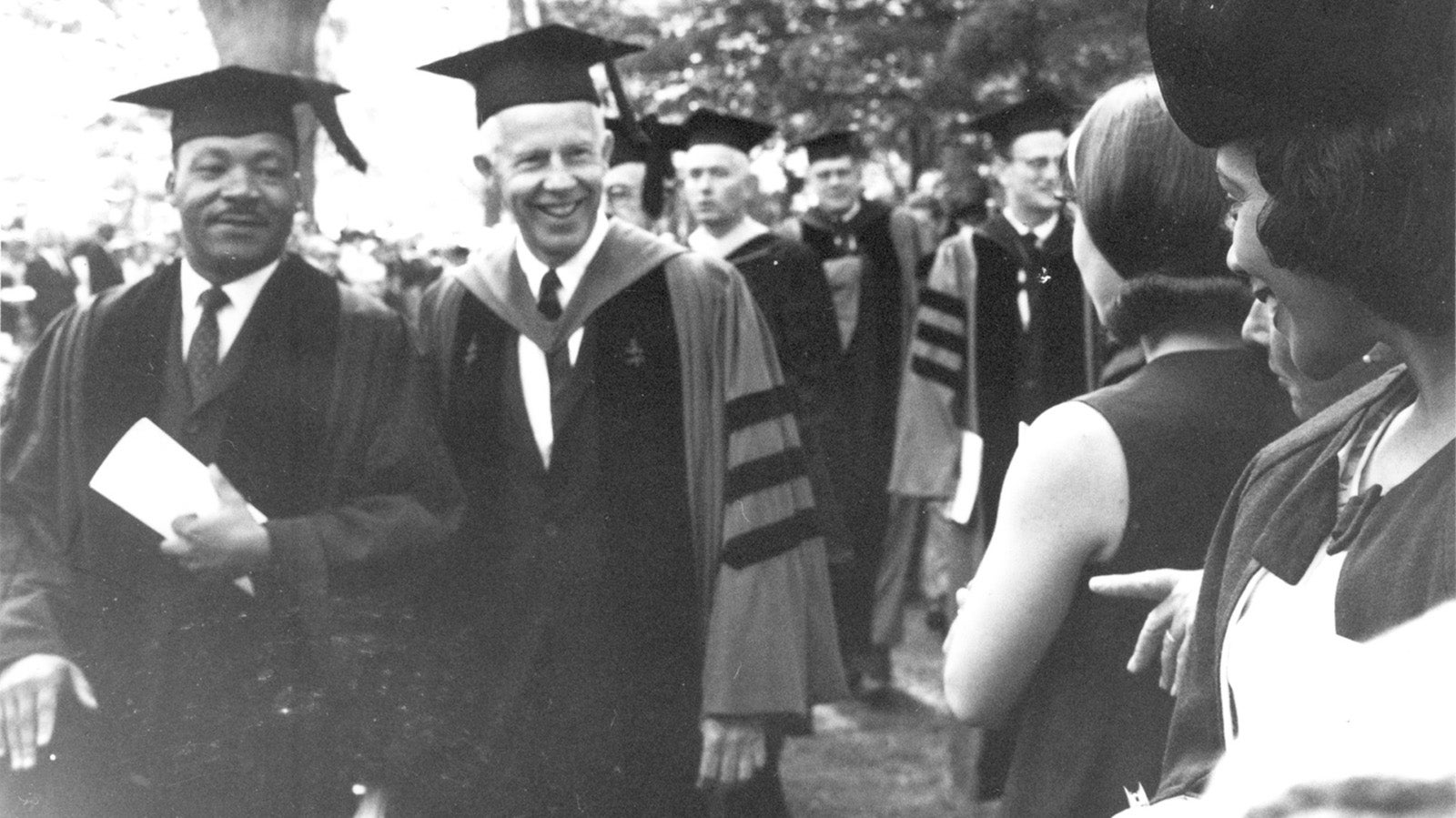
Header photo: The Reverend Dr. Martin Luther King Jr. and then-Oberlin College President Robert Carr, pictured on campus in June 1965.
Header photo credit: Courtesy of Oberlin College Archives
On June 14, 1965, the 483 graduates from the Class of 1965, their families, and other members of the Oberlin community (including what was reported as a record number of alumni) gathered to see civil rights activist the Reverend Dr. Martin Luther King Jr. receive an honorary degree and deliver his speech, “Remaining Awake Through a Great Revolution.”
King’s Commencement speech was the last in a series of visits he made to campus. According to the Oberlin College Archives, King delivered three talks during his first visit to Oberlin in February 1957, including one at Finney Chapel and another at the First Church of Oberlin. King was invited to speak on campus again in November 1963, but he could only deliver a two-minute speech due to severe flu symptoms. Fortunately, King was able to give full remarks in 1964 when he delivered another speech on campus titled “The Future of Integration” shortly after winning the Nobel Peace Prize.
Although all of King’s speeches were memorable in their own right, the Class of 1965 likely remembers his final remarks at Oberlin on graduation day the most.
The day was extremely hot, recalls Lisa Hirsh ’65. “It was graduation, so you know what graduation’s like: Your mind is all over the place. You’re moving away from your friends and have no idea what you're doing next," she says. "So the day was a bit of a blur. But what I do remember is that it was absolutely extraordinary to have Martin Luther King [as our speaker].”
King’s speech emphasized the theme of “staying awake” and being alert to the injustices of the world. After summarizing the fable of Rip Van Winkle, King elucidated: “The most striking fact about the story of Rip Van Winkle is not that he slept 20 years, but that he slept through a revolution. While he was peacefully snoring up on the mountain, a great revolution was taking place in the world—indeed, a revolution which would, at points, change the course of history. And Rip Van Winkle knew nothing about it; he was asleep.”
The crowd sensed the momentous nature of the speech, says Katy Dawley ’65. “King was extremely inspirational, talking about his experiences, about the Montgomery boycott, and about what was about to happen: Freedom Summer. He received a massive standing ovation. That was quite thrilling.”
Oberlin students have long had their eyes wide open and turned toward societal injustices, and the Class of 1965 was no exception. “We were all very politically active and very aware. People went down South to register voters and build houses, and there was a Carpenters for Christmas,” Hirsh said, referencing a 1964 civil rights effort led by members of the Oberlin community to rebuild the Antioch Missionary Baptist Church in Ripley, Mississippi, after it was burned down following the Mississippi Freedom Vote. “It was just in the water.”
The tendency of Obies to hyperfocus on righting wrongs is exemplified by Marcia Aronoff ’65, who shared that her engagement with social justice efforts sometimes meant that her classroom pursuits at Oberlin went by the wayside.
“It certainly made the Commencement speech seem like the right culmination of our four years at Oberlin,” she says.
Following King’s speech, the Class of 1965 scattered as its members took the next steps in their formal education and budding careers. But his message and words stuck with the graduates, who departed Tappan Square and remained socially engaged during subsequent chapters of their lives.
“King challenged us to use [our] education to move forward and improve life in the United States,” Dawley says. “And people in my class did.”
Hirsh, for example, moved to Washington, D.C., for a position at the White House Conference on Children. “It was a really cool time to be in Washington,” she says. “Lyndon Johnson was there, and it was the beginning of the War on Poverty. I got to meet the president and Lady Bird and began to think about policy, which I hadn’t done.”
From there, Hirsh had the opportunity to write for an urban affairs-focused magazine called City, where she covered welfare reform and large-scale law. “It was a dream job for a young reporter,” Hirsh recalls. One of her more memorable assignments required a trip to rural Kansas to investigate the challenges physicians and patients faced in their efforts to provide and receive medical care. Hirsh says many of the issues she wrote about as a young journalist, including rampant physician shortages and difficulties obtaining food, remain relevant.
Like other Oberlin alumni who pursue careers related to medicine and well-being, Dawley took a path that aligns with a part of King’s speech when he reflected on a trip to India and stressed the importance of serving disadvantaged groups: “How can one avoid being depressed when he sees with his own eyes millions of people sleeping on the sidewalks at night; no beds to sleep in; no houses to go into. And most of these people have never seen a physician or a dentist.”
Charged with a desire to improve access to health care, Dawley dedicated the majority of her career to promoting positive childbirth outcomes and advocating for marginalized women, serving as a midwife in a low-income area of Philadelphia. She later earned her doctorate in nursing and history from the University of Pennsylvania and directed the Midwifery Education Program at Philadelphia University.
While access to health care in the United States has grown since King’s speech with the establishment of Medicaid and Medicare shortly after the Class of 1965 graduated and the passage of the Affordable Care Act in 2010, Dawley echoed Hirsh’s concerns about health care access and decisions that may hinder social progress in ways that contradict the call made by King.
“I don’t know what will happen now with cuts to Medicaid, because that was the support that provided the prenatal care and the intrapartum care,” Dawley says, the concern evident in her voice. “I don’t know what’s going to happen to poor women in this country.”
As with Aronoff, the energy of the times so firmly pulled Grace Wittig Owens ’65 during her early undergraduate years that she felt “guilty” spending her time in classrooms. Owens contemplated dropping out to spend more time doing civil rights work, but was convinced to stay. She finished her undergraduate education at Oberlin, meaning she was able to see King at her graduation with her peers and hear a line from the speech that had unexpected ripple effects well into her adult years.
“All life is interrelated, and we are all caught in an inescapable network of mutuality, tied in a single garment of destiny,” King declared. Years later, Owens returned to this idea amid her social justice work in Idaho: She was part of the committee that advocated for establishing Martin Luther King Jr. Day as a holiday in the state.
“I came up with the idea of having pins made that were in the shape of Idaho with threads going across,” she said, alluding to her return to King’s “single garment of destiny” allegory.
The phrase stuck with her for so long because of how well she felt it described the community she was surrounded by during her upbringing. Having grown up with a single mother, Owens recalls that she often spent time with her mother’s diverse social network, many of whom held different social identities from her own.
“Our living room was always filled with her friends—and her friends were everybody,” she says. “So my two brothers and I grew up with Black, white, Catholic, Jewish, gay, [and] straight [people].” Another woman was “treated differently because she was allowed to have a dog around,” Owens remembers. “As a child, I didn’t understand that, but it was because she was blind. ... [These friends] were literally our family. They were the threads in our mutual garment of destiny.”
In another full-circle moment, Owens, who spent most of her career as a teacher, was later awarded the Dr. Martin Luther King Jr. Memorial Award by the National Education Association for her human rights efforts in Idaho.
In subsequent years, the message of King’s 1965 Commencement speech continued to resonate at Oberlin in both classrooms and Tappan Square.
King’s numerous speaking engagements, including his speech in Tappan Square, served as a topic of academic inquiry for Leah Falk ’07 for a linguistic anthropology course at Oberlin. Falk had a particular interest in how King modulated his language to reach specific audiences and his ability to effectively deliver powerful messages to those tuned in to his guidance.
“I remember being struck by the thesis of the speech and its sort of poetic refrain, this idea of ‘Don’t stop paying attention,’” Falk says. “You can’t look away from change, which is kind of how I feel now. That really resonated.”
Fifty years after King made his speech on campus, Owens and other members of the Class of 1965 made their way back to Northeast Ohio for their 50th reunion, where they witnessed Michelle Obama addressing the Class of 2015 in the same space where King stood a half-century before. Obama foregrounded themes from King’s remarks, including the importance of staying alert and not shying away from pressing social problems.
“I want to suggest that if you truly wish to carry on the Oberlin legacy of service and social justice, then you need to run to, and not away from, the noise,” Obama said. “Today, I want to urge you to actively seek out the most contentious, polarized, gridlocked places you can find. Because so often throughout our history, those have been the places where progress really happens.”
Owens noted how relevant King’s and Obama’s remarks continue to be today. “Having her talk about going toward the problems rather than away from them was really meaningful,” she said. “That’s what stays with me.”
Aronoff similarly expressed a sense of pride in her graduating class for persistently pushing for change and supporting causes that help the most marginalized segments of society.
“People in our class have continued to be engaged, and it’s one of the things that brings me joy,” she says. “People who may not have been activists while they were at Oberlin have found important ways, whether through their church or through activities of an enormously wide variety, to make a difference in their communities and the country.”
A sense of urgency to seek out the “contentious, polarized, gridlocked places” continues to drive Hirsh, who still finds ways to take on King's call to focus on improving nearby communities.
“I always have in my mind, ‘How can I contribute?’ I’ve recently worked on local political campaigns, and it makes a difference,” she says. “When I think of what Dr. King did, he not only charged us, but he did a major thing [by demonstrating] how to keep hope alive in desperate times. He modeled that you have to keep going, no matter what. I feel like it was kind of a plumb line for my life.”
Alicia Smith-Tran ’10 is a writer and the William G. Smith Associate Professor of Sociology and Comparative American Studies.
In 2015, the Class of 1965 honored its 50th reunion—and Dr. Martin Luther King, Jr.’s speech at their Commencement—by establishing the MLK Internship Fund. Over the last 10 years, 117 Oberlin students from the college and conservatory have received awards to pursue internships at law firms, music festivals, nonprofits, museums, and more. At the 60th cluster reunion for the Classes of 1964, 1965, and 1966 in October 2025, alumni will be able to view items from the Oberlin Archives related to the 1965 Commencement (including Dr. King’s speech) and celebrate the fund’s anniversary. If you feel inspired to support Oberlin students, you can contribute to the fund here.
You may also like…
Jane Wickline ’21 Finds Community in Comedy
A Q&A with the Saturday Night Live cast member and Dukes cofounder

When Stars Align
The Oberlin Contemporary Music Ensemble shines on Jennifer Koh ’97’s "The American Concerto, Volume One."
Wright On, Sister
Would the Wright brothers have invented their airplane without the support of their sister, Katharine Wright Class of 1898? Probably. But they might not have been the first.