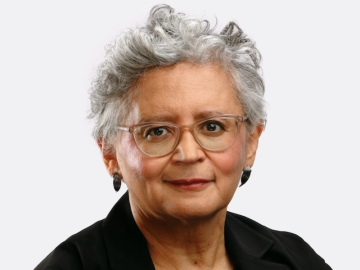
Oberlin Honors the Class of 2026
Nearly 800 graduates march—and celebrate—at May 25 Commencement ceremony.
May 25, 2026
Communications Staff

Photo credit: Scott Shaw
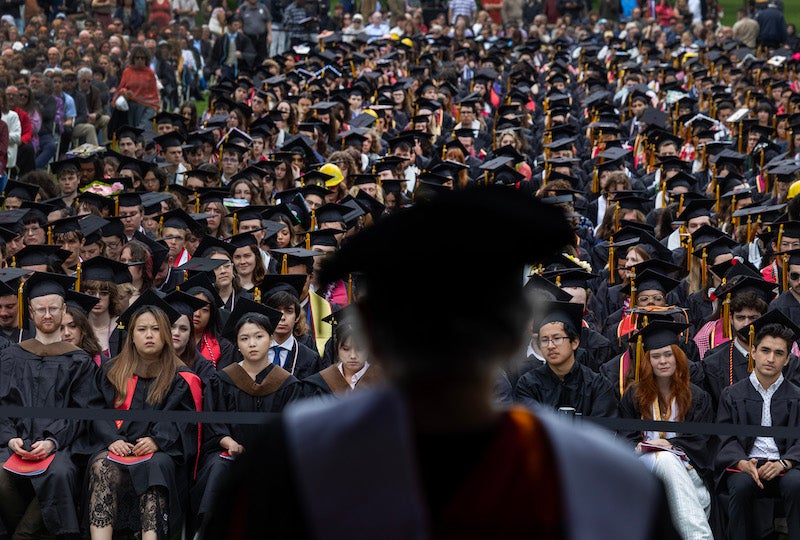
Gray skies eventually gave way to sunshine as nearly 800 graduates of Oberlin’s Class of 2026 gathered in Tappan Square on Memorial Day to celebrate Commencement.
The ceremony, featuring a keynote address from philanthropy leader Cecilia A. Conrad, capped a weekend of Commencement and Milestone Reunion festivities that included family socials, conservatory recitals, and an Illumination celebration that was moved indoors to dodge persistent rain.
Students processed onto the square in black robes, many of them adorned with colorful sashes and cords, to the strains of "Pomp and Circumstance," performed by the Commencement Brass Ensemble.
The celebration opened with an invocation from Multifaith Chaplain David Dorsey, followed by greetings from Board of Trustees Chair Charles S. Birenbaum ’79. Delivering his first Commencement remarks as chair, Birenbaum reflected on his family’s longstanding ties to Oberlin, including daughter Julia ’17.
“People who graduate from Oberlin do important work,” he said. “People who graduate from Oberlin push the borders of knowledge and energize society. You, too, will do this through your art, your music, creative writing, research, intensive study and analysis, and hard work.”
President Carmen Twillie Ambar welcomed the Class of 2026 by thanking students for contributing so much “to Oberlin’s success” and reminding them that they had not reached this milestone alone.
“I would like you to acknowledge the people who helped you be here—namely your parents, your grandparents, your families, your friends,” she said.
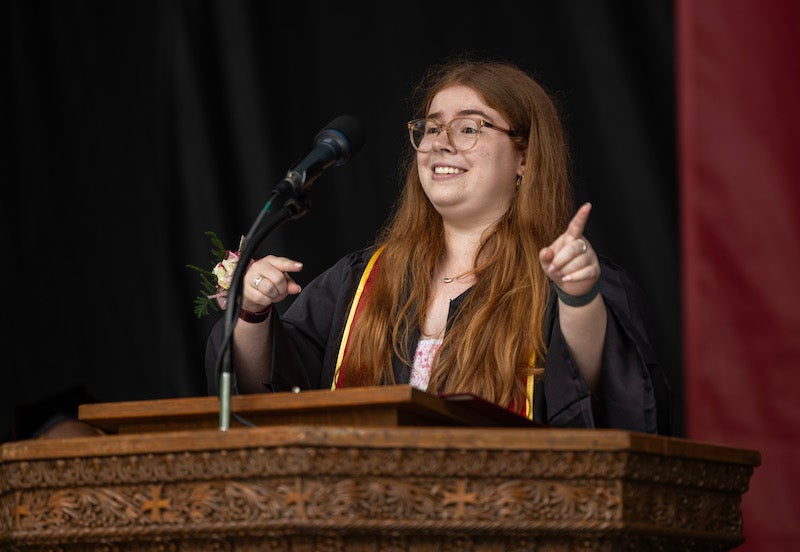
Ambar then introduced student speaker Katie Priscott, who graduated with a degree in creative writing, a minor in dance, and a concentration in arts administration and leadership. Priscott (pictured below, at podium) urged her classmates to resist diminishing their accomplishments with the qualifier “just,” citing examples such as: “It’s just two pirouettes—I should be able to do three.”
She acknowledged the difficulty of graduating into “a country, an economy” that is difficult to think about for too long “without a pit growing in your stomach,” and the temptation to “fall into the void of the ‘justs’—that we’re just not equipped to do anything to make a difference, that it’s just too hard.”
Before concluding, Priscott offered one exception: “It’s for all of us to proudly say, ‘I just graduated from Oberlin College and Conservatory!’”
Oberlin recognized six leaders in public service, scholarship, the arts, and the community, with Oberlin faculty and trustees presenting honorary degrees and awards to exceptional alumni and friends of the college.
Chloe E. Bird ’86 received an Honorary Doctor of Science for her work as a leading sociologist in women’s health, whose research on structural inequities has helped advance policy and institutional change.
Internationally acclaimed dramatic soprano Christine Goerke received an Honorary Doctor of Music in recognition of her celebrated opera and concert career and her mentorship of young artists.
Carla D. Hayden, who served as the 14th Librarian of Congress and was the first woman and first Black person to hold the position—as well as the first professional librarian confirmed to the role in more than 60 years—received an Honorary Doctor of Science. She is widely recognized for transforming the Library of Congress into a more open and accessible institution.
Economist Cecilia A. Conrad, founding CEO of Lever for Change and former head of the MacArthur Fellows Program, who is recognized for advancing equity in charitable giving and expanding opportunities for nonprofit innovation, received an Honorary Doctor of Humane Letters.

Additional honors recognized leaders in service and alumni achievement. Rosa Gadsden received the Award for Distinguished Service to the Community for her longstanding work as volunteer and outreach coordinator for Oberlin Community Services and for her impact across Lorain County. Leah Modigliani ’86 received the Alumni Medal for her pioneering work in finance and for her 24 years of service on the Oberlin College Investment Committee.
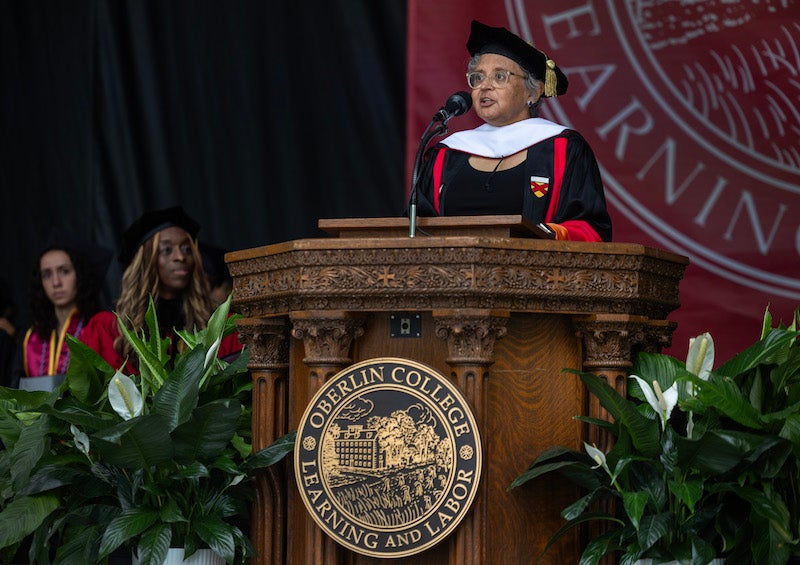
In her Commencement address, Conrad (pictured above, at podium) reflected on her years leading the MacArthur Fellows Program—popularly known as the “Genius Grant,” the $850,000 fellowship awarded to individuals demonstrating extraordinary creativity.
“Fifteen Oberlin alumni have been named MacArthur Fellows—more than any other liberal arts college,” she said, arguing that Oberlin’s blend of arts, sciences, and interdisciplinary learning creates unusually fertile ground for innovation and creative thinking.
She pointed to alumni fellows such as wheelchair designer Ralph David Hotchkiss ’69, biologist Richard Lenski ’76, palliative care pioneer Diane Meier ’73, pianist and writer Jeremy Denk ’90, and theater director Julie Taymor ’74 as examples of Oberlin graduates whose work reshaped fields and improved lives.
If you spend most of your time in rooms where you think you are the smartest person, find different rooms.” —Cecilia A. Conrad
One of the speech’s most memorable moments came when Conrad recounted calling Oberlin alumna Rhiannon Giddens ’00 to inform her that she had been selected as a MacArthur Fellow in 2017. Conrad recalled Giddens responding, “Oh good. Maybe I can try writing the opera I dreamed about.” Conrad noted that the resulting work, Omar—which tells the story of a Muslim scholar enslaved in America—premiered in 2022 and later won the Pulitzer Prize for Music.
Conrad connected the story to her broader point: that creativity flourishes when people are given resources, encouragement, and room to take risks. Throughout the address, Conrad distinguished between “Big C creativity,” the rare, world-changing innovation associated with MacArthur Fellows, and “little c creativity,” the everyday capacity for divergent thinking and problem-solving. She warned graduates that creativity in American society is declining and argued that Oberlin’s liberal arts environment helps preserve the ability to make “unexpected connections and find new paths to solve problems.”
“You are graduating with something statistically unusual,” she told the class, urging them to nurture that creative spark long after Commencement.
Conrad closed by offering four pieces of advice:
- “Never stop learning.”
- “Take some risks.”
- “If you spend most of your time in rooms where you think you are the smartest person, find different rooms.”
- “If you get to be in the room where it happens, hold the door open for others to join you.”
Conrad noted that society’s biggest challenges—including inequality, climate change, democracy, and health—“will not be solved by algorithms or by playing it safe,” but through collaborative creativity and inclusive leadership.
“The phone may ring for one of you,” she concluded, referring to the legendary call from MacArthur. “But the work worth doing doesn’t wait for the call.”
Find more photos from Commencement and Milestone Reunion Weekend on Oberlin's Flickr.
You may also like…
Katie Priscott to Deliver 2026 Student Commencement Address
The creative writing major explored artistic opportunities throughout her time on campus.

Oberlin Announces 2026 Commencement Honorees
Oberlin College and Conservatory announces its 2026 commencement honorees, featuring keynote speaker Cecilia Conrad and distinguished leaders in health, music, and public service.

Cecilia Conrad to Deliver Commencement Address to Class of 2026
Founding CEO of Lever for Change and former MacArthur Foundation leader will address the graduating class on May 25.