
Oberlin Earns Key Sustainability Honor
Carbon Neutral Award commemorates achievement of 20-year campus decarbonization goal.
May 6, 2026
Office of Communications
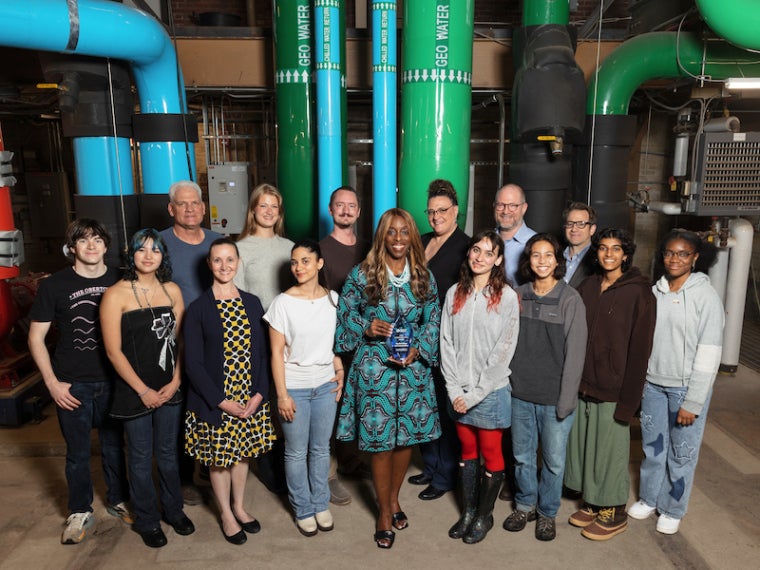
Oberlin President Carmen Twillie Ambar (center, with Carbon Neutral Award) celebrates Oberlin's achievement with students and staff from the Office of Energy and Sustainability and other offices vital to campus sustainability efforts.
Photo credit: Tanya Rosen-Jones '97
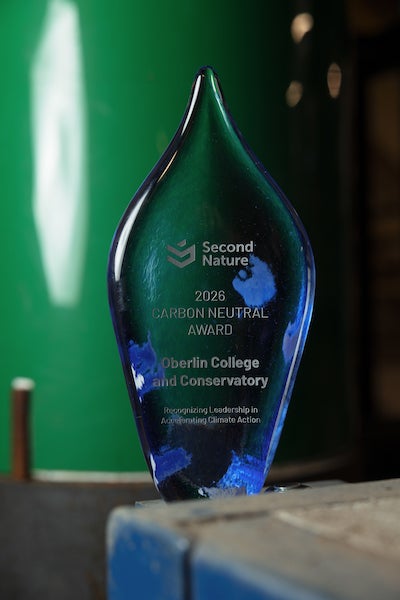
Oberlin has earned the 2026 Carbon Neutral Award for its longstanding commitment to decarbonization. The honor was presented at the 2026 Higher Education Climate Leadership Summit in Chicago, hosted by the higher education climate advocacy nonprofit Second Nature in March.
The summit recognized the 20th anniversary of a prominent climate commitment signed in 2006 by Oberlin and 11 other U.S. colleges and universities. That pact formally set Oberlin on a path toward carbon neutrality—a mission accomplished in 2025.
Although the landmark climate commitment grew to include some 900 U.S. higher ed institutions, Oberlin is one of only 17 U.S. campuses to claim carbon neutrality, according to Second Nature. It is the only carbon-neutral campus in Ohio.
“Oberlin has been proactive about meeting the challenge of carbon neutrality,” says Oberlin President Carmen Twillie Ambar. “We’re not avoiding our responsibility to future generations. We are acting now to address our aging energy system and thereby creating a more sustainable campus—and planet.”
Pivotal to Oberlin’s achievement was a four-year initiative to transition the campus from its century-old fossil-fuel-based heating system to geothermal heating and cooling. Commissioned in late 2024, the new system saves an estimated 5 million gallons of water annually and improves campus energy efficiency by 30 percent.
“Oberlin College and Conservatory is deeply proud of its commitment to academic and artistic excellence and its role as a worldwide leader in championing social justice causes,” says Chris Norman, senior director of energy and sustainability, who accepted the award for Oberlin.
“It’s a great point of pride for us to strive for the same level of excellence in our environmental stewardship. We have made remarkable strides over the past 20 years, and we look forward to redoubling our efforts in the years ahead.”
Oberlin’s Carbon Neutral Award coincides with the completion of third-party verification of the institution’s carbon-neutrality claim, a review of data conducted by UL Solutions in 2025 and early 2026. According to Second Nature, Oberlin is the only college or university in the nation to have completed third-party verification of its carbon-neutral status—a step the organization calls a model for institutions everywhere.
“Oberlin has been a campus climate action leader for decades,” says Steve Muzzy, climate programs senior manager at Second Nature. In particular, he notes that Oberlin's decarbonization efforts have achieved an 84 percent reduction in emissions that occur on site—a frequently used means of measuring carbon footprints of companies; Oberlin’s rate of reduction is much higher than that of other carbon-neutral campuses. Such efficiency significantly reduces the institution’s reliance on purchasing carbon offsets—a common shortcut widely used by institutions to achieve carbon neutrality “on paper.”
Oberlin is a leader in showing a responsible path to carbon neutrality that prioritizes decarbonization and continues that progress after achieving neutrality.”
—Professor Alex Barron, Smith College
"Decarbonization is one of the core pillars of any real strategy to fight climate change, and that's why it's so essential that colleges show students that these kinds of big changes are possible,” says Alex Barron, an associate professor of environmental science and policy at Smith College and a leading researcher on decarbonization in higher ed.
"Research in our lab has shown schools can claim carbon neutrality even while increasing actual emissions,” Barron says. “Oberlin is a leader in showing a responsible path to carbon neutrality that prioritizes decarbonization and continues that progress after achieving neutrality."
According to a study led by Barron of more than 600 U.S. colleges and universities, only six schools reduced emissions by at least 60 percent through active decarbonization. “Oberlin was the only carbon-neutral school on that list,” he notes.
"Based on our research to date, Oberlin is the only school in the U.S. that has achieved carbon neutrality for direct emissions primarily by actively decarbonizing campus."
Learn more about Oberlin and carbon neutrality on Oberlin.edu.