
Campus News
Memorial Minute: Samuel Goldberg, 1925-2023
The Emeritus Professor of Mathematics died July 21, 2023, at the age of 98.
February 25, 2026
Michael Henle
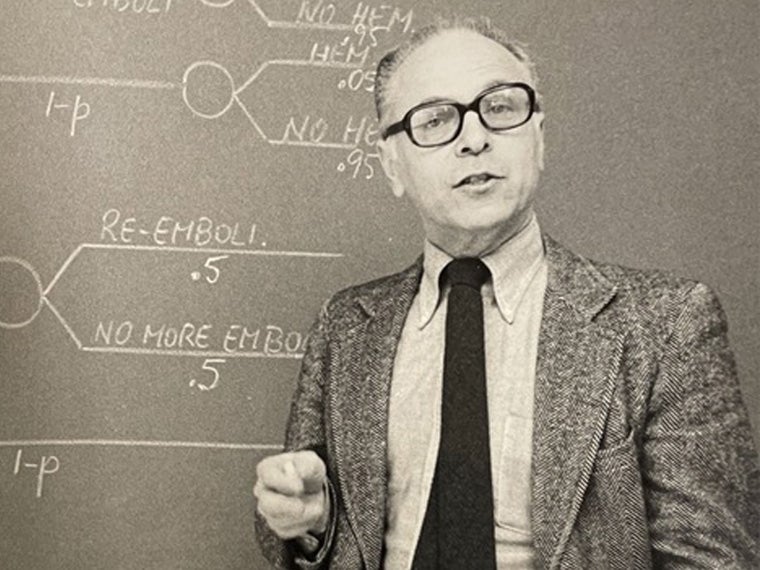
Photo credit: Courtesy of Oberlin College Archives
Emeritus Professor of Mathematics Samuel Goldberg died July 21, 2023, at the age of 98.
Born in March 1925, he lived at home in the Bronx until graduating from City College in 1944. After being drafted into the U.S. Army, he became a T/4, a punch card operator in the Army's Special Engineering Detachment at Los Alamos. The future Nobel Prize winner Richard Feynman was also in this unit and played poker with Sam.
Sam later earned a doctorate at Cornell University. After teaching three years at Lehigh, he came to Oberlin in 1953, shortly after marrying Marcia Chinitz. Marcia earned a master's in art history at Oberlin, and researched and wrote papers in the field. Their son, David, was born in 1955.
Sam taught at Oberlin from 1953 until 1985, becoming a full professor in 1960. He spent time away from Oberlin at MIT, Harvard, the University of Michigan, the London School of Economics, the University of Western Australia, and Mombasa, Kenya.
His pioneering textbook, Introduction to Difference Equations with Illustrative Examples from Economics, Psychology, and Sociology, appeared in 1960. Translated into Spanish, German, and Japanese, it remains in print. It was pioneering in two ways. Difference equations are still the mathematics underlying today’s ubiquitous computer modeling. Sam also controversially applied these equations to the social sciences. Integrating technology and quantitative ideas into the liberal arts curriculum became a major theme of Sam's research and teaching. He published three additional books and numerous papers.
Sam was also active in civic affairs. He helped establish the Oberlin Improvement and Development Corporation and the Oberlin Cable Co-op and served on the board of the Allen Memorial Hospital. A long-time supporter of the ACLU, he chaired the Oberlin chapter in 1962. He also contributed extensively to various professional organizations.
When Sam spoke, people listened. He dominated the many faculty committees on which he served. He led the group that in 1964 persuaded the college to purchase its first computer. The late Professor of Mathematics Eddie Wong stated, "If you had a question, you went to see Sam. When you came out of his office, you knew, without his telling you, what you should do."
As a teacher, Sam was attentive to individual students and an effective mentor, inspiring many students to pursue graduate studies. Additionally, he walked Imelda Yeung Powers ’81 down the aisle at her wedding when her family was unable to travel to the U.S. for the ceremony.
Above all, Sam was a commanding presence in the classroom. His lectures were elegant, carefully organized, and logically presented. An outstanding feature was his board work: Sam started each class at the top left corner, with the goal of ending at the lower right corner exactly 50 minutes later. He often succeeded.
Still, Sam could be intimidating. Jerry Butters ’68, retired from the Federal Trade Commission, writes, "Mr. Goldberg started his Probability course at 8 a.m. sharp, even on Saturday morning. Before class, he had filled up much of the board with equations in his impeccable handwriting. I usually got up at 7:45 and was often late. Trying to sneak in once, Mr. Goldberg spotted me, pointed to the board, and cried out, ‘Butters! Why is this true?’ I answered as best I could but was too winded to be convincing.”
Robert Bosch ’85, now the James F. Clark Professor of Mathematics at Oberlin, remembers that Sam on occasion might lock the classroom door, forcing late-comers to knock. Additionally, Robert remembers that Sam had a deep hatred of paper clips, considering them the very worst of human inventions. Points might be deducted for work handed in clipped rather than stapled.
Glen Satten ’79, a statistician at Emory University School of Medicine who retired from the CDC, writes that Sam “was furious with me for taking calculus-free statistics as a senior. But his class did me no harm! He was an excellent teacher. I wish I'd told him I became a statistician. I have his book on difference equations here somewhere."
In 1985, Sam retired from Oberlin to work for the Sloan Foundation in New York, where he assisted in distributing millions of dollars to liberal arts colleges. He returned to Oberlin in 1990 while remaining affiliated with the organization. In 2004, he and Marcia moved into Kendal at Oberlin.
Samuel Goldberg was an academic pioneer, an outstanding writer and teacher, a distinguished citizen, a remarkable individual, and a master expositor of mathematics.
Memorial Minute written and read at a general faculty meeting by Emeritus Professor of Mathematics and Computer Science Michael Henle.