
Campus News
Memorial Minute: Randolph E. Coleman 1937-2025
The professor of composition died April 24, 2025, at the age of 87.
June 22, 2026
Steven Plank
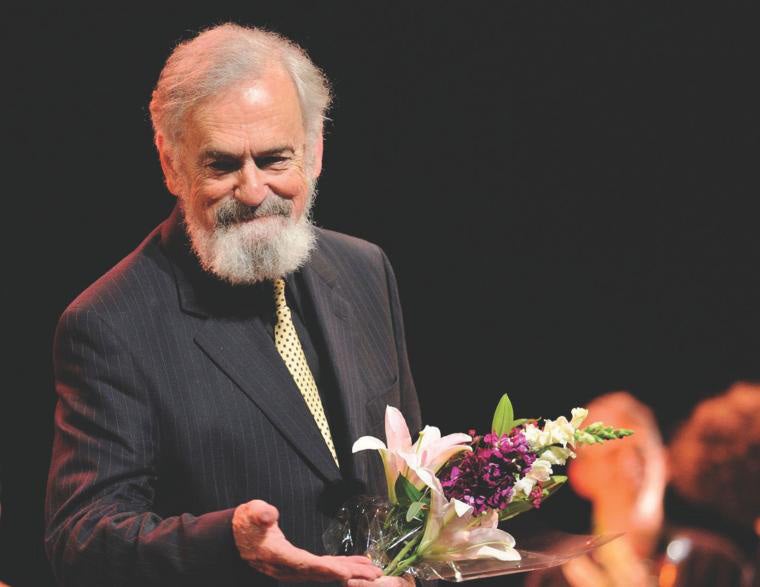
Photo credit: Roger Mastroianni
Randolph Early Coleman, professor of composition, died April 24, 2025, at the age of 87.
The mission statement of Oberlin’s former Inter-Arts Program states, “We seek to probe that which is unknown and see the familiar in a new way.” An innovative creative endeavor of the 1970s, the program was one whose origins and artistic ethos bore the distinctive stamp of Randy Coleman, and its mission statement is one that captures well the outlook of this iconic member of the Oberlin composition faculty from 1965-2009.
Randy grew up in Charlottesville, Virginia, and his southern upbringing echoed through his life in his gracious and generous hospitality, love of porch sitting, penchant for storytelling and recollection, and a sensitivity to the poetry of home and place. His early collegiate studies were at the University of Virginia as a creative writing student; fortuitously, he was there at the same time that William Faulkner was writer-in-residence. He then went to study music at Northwestern University, from where he earned his bachelor’s, master’s, and doctoral degrees. After a brief time teaching at Winthrop College, he joined the Oberlin faculty.
At Oberlin, he found both inspiration for his compositional journey and an appreciative audience for the large body of work he created along the way. In his early days, the composition faculty was an eclectic group, with little duplication among them of styles, pedigrees, and approaches. Randy was the modernist, post-modernist, label-resistant radical—he enjoyed being outside the mainstream—but a simple radical frame does not describe his life-long quest to discover new ways of doing things, to work outside the well-established systems.
Unsurprisingly, his pedagogy focused not only on craftsmanship, to which he gave ample attention, but also on students discovering their own voices. This shared respect for discovery produced generations of interesting, highly successful students who went on to earn major honors: the Pulitzer Prize, the MacArthur Fellowship, the Guggenheim Fellowship, and Grammy Awards.
Randy was also a passionately curious intellectual who was impressively well-read across many disciplines, with particular depth in literary criticism, cultural history, and critical theory. His course in trends in contemporary music was legendary for its critical explorations and inculcated a love of the life of the mind. Students may have come to the class seeking a guru, but they left as critical thinkers.
On occasions like these, one typically trots out a list of accomplishments. Randy’s list is certainly impressive: Guggenheim, Fulbright, and Rockefeller Fellowships; commissions by major ensembles such as Eighth Blackbird; or becoming the founding chair of the Society of Composers, Inc. Yet his long presence in our midst was valued for so much more. He was famously a “talker,” relishing conversations and, more often than not, taking the leading role in them. But he was also a remarkably sensitive listener, wise and understanding of the human condition. People often sought out his ear; he was a compassionate friend, indeed.
He annotated his books with a ruler in hand, had an elegant handwriting unrivalled among us today, took to pin-stripe button-downs with a dress tie in the later years of his teaching, could produce by hand print-ready music manuscripts that would outshine any digital product today, and knew how to enjoy a martini on the front porch on a late summer afternoon with a book in hand, or better still, a conversation emerging.
In Faulkner’s As I Lay Dying, the character Cash says, “I don’t know if a little music ain’t about the nicest thing a fellow can have.” Randy would surely agree. He was a brilliant individual who enlivened Oberlin for decades.
We mourn the loss of an Oberlin icon, and give our deepest condolences to his wife, Rebecca Cross, their son Schuyler Coleman, and Randy’s children, Rachael Brehm and Ian Coleman.
Memorial Minute written and read at a general faculty meeting by Andrew B. Meldrum Professor of Musicology Steven Plank