
Campus News
Memorial Minute: Marcia L. Colish, 1937-2024
The Frederick B. Artz Emerita Professor of History died at the age of 86.
June 22, 2026
Leonard V. Smith
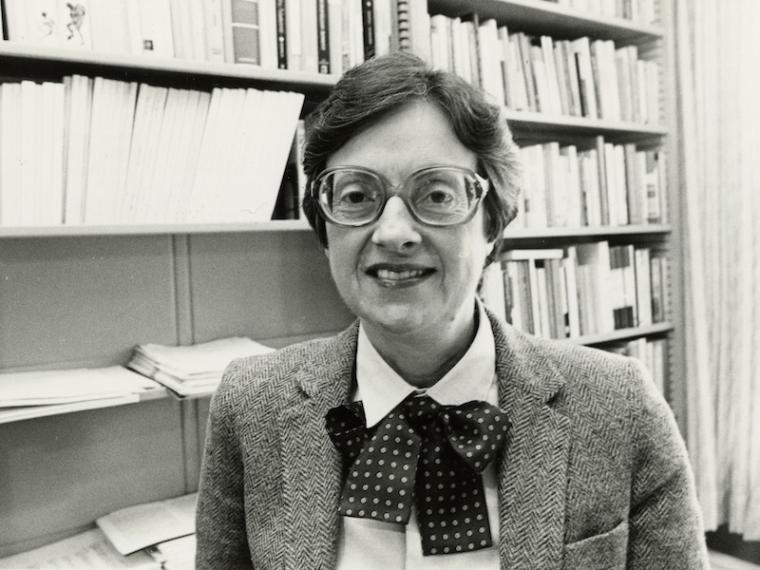
Photo credit: Courtesy of the Oberlin College Archives
The History Department and the Oberlin community lost one of our giants of the 20th century on April 9, 2024, with the passing of Frederick B. Artz Professor of History Emerita Marcia Colish. She served on the Oberlin faculty from 1963 until her retirement in 2001.
Marcia came to us from an academic world that in many ways no longer exists. Few of us, in many respects, lament its demise. A graduate of Smith College, she earned her doctorate at Yale University in 1965, four years before Yale admitted women as undergraduates. It is difficult to imagine what it must have been like being a woman in the unapologetically patriarchal and often misogynist academic environment of the early 1960s. Senior faculty would routinely tell women graduate students that they had no business being there. Yet in her own way, Marcia thrived in this environment, and beat these patriarchs at their own game.
In a word, she outworked and outsmarted them. In the end, perhaps, she also intimidated them, with her intelligence and her personal presence. Yet beneath a formidable exterior lay one of the warmest, kindest and most supportive individuals ever to grace our faculty. No one ever gave better advice to her junior colleagues, as teachers, scholars, or citizens.
Space does not permit the recounting of her many, many scholarly accomplishments. For more than four decades, Marcia Colish was a major, internationally known voice in Medieval European intellectual history. She wrote nine books, four of them after she retired, not to mention more than 90 scholarly articles, 40 of them after she retired. Her most recent article appeared in 2024.
Her books included two-volume studies of the Stoic Tradition and of Peter Lombard. Perhaps her best-known book was her masterful synthesis of her teaching and research, Medieval Foundations of the Western Intellectual Tradition (1997). Her numberless awards and fellowships include a Guggenheim and an NEH, alongside memberships at the Institute for Advanced Study, the Wilson Center, the National Humanities Center, and much more.
What can we learn from Marcia Colish’s life, and from this generation of women in academia? She showed us that we should not try to play someone else’s game, professionally or personally. We should make up our own. At the same time, we should respect how others play their game.
It remained a truism around Oberlin for decades that Marcia had no personal life. It was all work, work, work, a truism that she herself did little to discourage. Some of us understood that this truism was untrue. Marcia had friends and family to whom she was intensely devoted. She also had some surprising interests. She took flying lessons after she got tenure in 1969, claiming this was her alternative to psychotherapy. Marcia also knit sweaters for departmental babies and taught a then-young colleague how to drive, with a stick shift. She did not expect anyone to have her life. The point was and is to construct lives meaningful to ourselves.
Marcia’s life showed the importance of never being bullied. She led two major anti-discrimination campaigns at Oberlin. One in the 1960s conquered the then-common nepotism rule. Such rules prohibited both members of a married couple from working for the college, which at the time profoundly discriminated against women.
In the 1990s, she and Paula Richman of the religion department led the efforts to reform a hopelessly antiquated sexual harassment policy. In both campaigns, her capacity to intimidate bullies among her colleagues served her well. One unjustly crossed Marcia at a faculty meeting only at one’s peril. Yet she knew how to tune out political “noise “ at Oberlin and focus on the things that actually mattered, though she appreciated that one person’s “noise” could be another person’s issue of vital importance. No one had a more acute sense of which were the right battles to fight.
Last but not least, Marcia Colish showed us that you can have it all, right here at Oberlin. You can have an outstanding scholarly career, a fine teaching career, be an exemplary citizen of the college, and have your own kind of life. Those of us who knew her well have missed her ever since she retired nearly 23 years ago, and we miss her more today.
Memorial Minute written and read at a general faculty meeting by Frederick B. Artz Professor of History Leonard V. Smith.