
Campus News
Memorial Minute: Hirschel Kasper, 1935-2024
The professor of economics died April 4, 2024, at the age of 89.
June 22, 2026
James E. Zinser
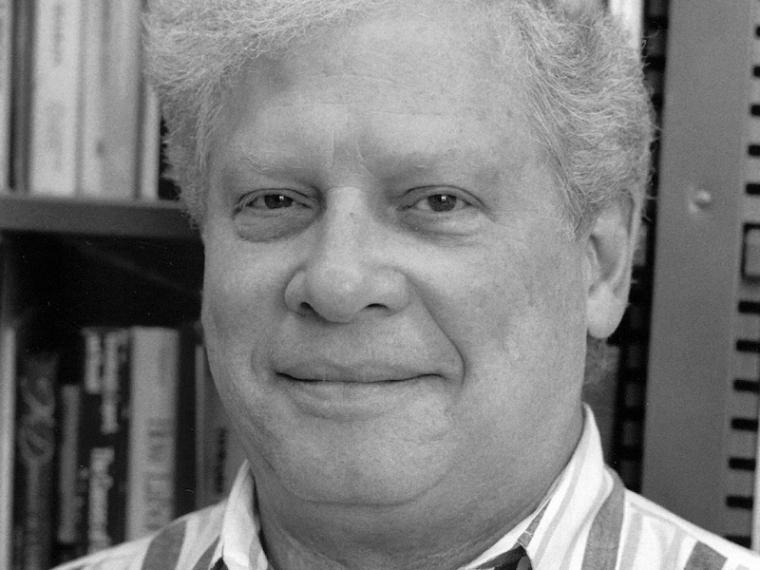
Photo credit: Courtesy of Oberlin College Archives
Hirschel Kasper, professor of economics, died April 4, 2024. He was 89 years old.
Born in Providence, Rhode Island, he was the first child born to Russian immigrants who arrived in the U.S. before World War I. He earned a bachelor’s degree from Boston University in 1956 and a master’s degree and a doctorate from the University of Minnesota in 1959 and 1963, respectively. Hirschel’s dissertation focused on the relationship between the asking price of labor and unemployment duration, challenging accepted notions about the willingness of unemployed workers to accept wage reductions in response to long-term unemployment. While finishing his doctoral thesis, he taught for a year at Iowa State University.
In 1963, Hirschel accepted a position at Oberlin College, arriving with his wife and children. He remained employed at Oberlin until his 2017 retirement, a 54-year stay briefly interrupted only by teaching and research appointments at the University of Wisconsin-Madison (1966-67), the University of Glasgow (1970-71 and 1975), Cornell University (1977-78), and Princeton University (1985-86).
At Oberlin, Hirschel was a popular but exceptionally challenging teacher. The economics department estimated that more than 4,000 Oberlin students took his introductory course, while his intermediate and advanced courses covered labor economics, labor-management relationships, and the public policy of poverty and affluence. Hirschel is remembered for the rigor of his lectures and assignments, as well as his encouragement, kindness, and humanity. He was an inspiration for the many Oberlin graduates who went on to teach. Several former students who are now professors of economics emphasized their desire to “be like Hirsch” or that they are “trying to do a Hirschel Kasper imitation when they teach.”
Hirschel’s research also reflects his 54-year commitment to teaching and learning. His coauthors include many Oberlin faculty and graduates, in addition to colleagues from his visiting appointments. Of his more than three dozen publications, a majority focus on teaching. In particular, Hirschel’s research emphasized the education of economists, placing specific emphasis on the impact of liberal arts education on future doctoral candidates; faculty turnover; the dynamic aspects of academic careers; the evolution of tenure-track appointments; and the role of collective bargaining in higher education. Beyond the academy, his publications on labor economics considered multiple topics, including the effects of journey-to-work costs on wages, the effectiveness of final-offer arbitration, unemployment rates for newer entrants into the labor force, right-to-work laws, and the effects of the size of the bargaining unit on labor-management relationships.
Hirschel’s last book, Incentives and Choice in Health Care (MIT Press), edited with Frank Sloan ’68, was a compilation of papers presented in Oberlin at a conference he organized that brought a dozen health care professionals and scholars to campus. Not only were several of the papers written by Oberlin alums, but all of the discussants were Oberlinians. Research reported in the book emphasized the importance of economic incentives for both patients and providers.
Often invited to evaluate economics departments at other universities, Hirschel reflected on this work and Oberlin’s own experience with such evaluations in The Journal of Economic Education article “Peer to Peer: Right and Wrong Lessons for Department Reviews.” He was an associate editor of that journal for almost 20 years and served on the Board of Editors for the Quarterly Review of Economics and Business. He was a member of the American Association of University Professors (AAUP), often contributing short commentary for Academe, and was a consulting member of the AAUP Special Committee on Hurricane Katrina and New Orleans Universities.
Hirschel served for many years as a labor arbitrator under the auspices of the American Arbitration Association (AAA) and the Federal Mediation and Conciliation Service. He was on permanent panels to hear labor disputes in mining, local government, and law enforcement. In 2003, Hirschel received the Golden Gavel Award from the AAA for his “decades of service and wise counsel.”
Above all, Hirschel Kasper was a respected, generous colleague with amazing clarity of thought and purpose who was always available to consult about teaching and research and to mentor new professors. Indeed, former students and colleagues comment fondly on Hirschel’s “open door” policy that found many people stopping in after hours for conversation, support, understanding, and guidance. One of Hirsch’s Oberlin coauthors said, “An important measure of a professor’s contribution is the impact on his or her students, and especially in this regard, Hirsch excelled. He was a model professor and moreover an outstanding example of what liberal arts colleges have to offer.”
Memorial Minute written and read at a general faculty meeting by Emeritus Professor of Economics James E. Zinser.