
John Petersen ’88 Earns AI Grant for Community-Building Project
The Paul Sears Professor of Environmental Studies, Sciences and Biology discusses his work as part of Oberlin’s AI Micro Grant Program.
November 19, 2026
Communications Staff
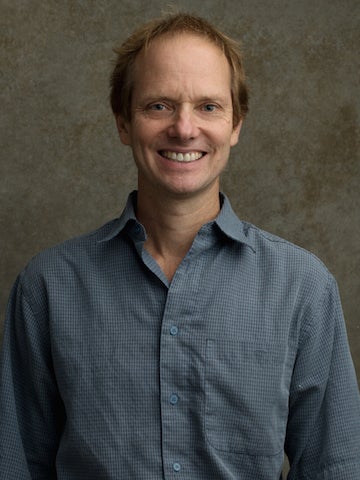
John Petersen ’88, Paul Sears Professor of Environmental Studies, Sciences and Biology, has been awarded a grant as part of Oberlin College’s AI Micro Grant Program.
“We’re developing an AI application that gathers events from multiple organizations’ calendars and integrates them into a unified community calendar,” he says. “The larger purpose is to strengthen community connections. A good community calendar is civic infrastructure; it helps people find opportunities to participate, learn, volunteer, and connect with one another.”
Please explain the work/research you’ll be conducting with the grant:
The problem is familiar: organizations struggle to get the word out, while community members must search across many websites to discover what is happening nearby. Asking organizations to submit the same information to multiple calendars creates extra work and leaves gaps.
The application we’re developing builds on Oberlin’s Community Dashboard, which shares community information through websites, digital signs, and a weekly newsletter. In our application, AI agents read organizations’ event listings and translate their different formats into consistent calendar entries. A human reviewer checks the entries before publication. Our initial work has connected 12 organizations and brought 170 events onto the calendar.
Are there any students assisting you in this work?
This project is a collaboration between me and Frank Kusi Appiah ’29. I would not have applied for the grant without his commitment to participate.
One of the things I have most enjoyed about my career at Oberlin is developing students as collaborators. Frank brings expertise that makes that relationship especially rewarding. He is native to the world of AI and understands the evolving landscape of AI agents and agent-assisted coding more deeply than anyone I’ve met in my generation. He serves as both a technical collaborator in developing the application and my expert and guide as we explore this world together.
I bring experience developing community-based applications and working with community partners; Frank brings technical knowledge and a sense of the possibilities these emerging tools offer. Together, we are exploring how to turn those possibilities into applications that express Oberlin’s commitment to learning, collaboration, and community engagement.
What academic or professional goals do you have after this project is complete?
My goal is to move from a promising pilot to a reliable tool that community partners can use and sustain. That requires continued testing, refinement, and human oversight. There is considerable interest among our partners in Cleveland, and I would like to extend the application there once it is ready.
We also want to tailor information geographically, so that events, jobs, and volunteer opportunities appear on nearby digital signs and relevant neighborhood websites and newsletters. More broadly, I hope this work provides a model for students, faculty, and community partners to develop AI applications around locally identified needs.
In terms of AI, what developments or updates do you hope to see in the near future?
There is an irony in using tools supplied by enormous technology corporations, with substantial environmental and economic costs, to create hyperlocal community benefits. I want us to engage directly with that tension as we explore what AI can make possible.
I hope to see smaller, more efficient models that can be adapted to specific tasks and operated locally. For our project, that could mean running specialized calendar agents on college-managed servers, with greater local control over the tools and their use.
Great caution always needs to be exercised given the power and potential downsides of AI tools. To me, the current emphasis on building large-scale data centers is likely a bubble that will result in damage to the environment, centralization of corporate power, and loss of jobs. But I don’t think the technology needs to play out that way! At Oberlin, I would love to explore small, campus-based data centers powered by carbon-free electricity, with their waste heat captured to help recharge our geothermal system. This is 100% technologically feasible. The opportunity is compelling: infrastructure that supports teaching and research, contributes useful heat, and enables applications that build community.
The question is no longer simply whether we use AI, but how—and whose purposes it serves.
Read more about Oberlin’s AI Micro Grant Program here.
You may also like…
Oberlin Reimagines Humanities Education Through $1.487M Grant
New “HOPE” initiative centers humanities learning with real-world impact.
Longman Professor Emeritus of English and Creative Writing David Young Dies at 88
Longman Professor Emeritus of English and Creative Writing David Young died on Saturday, May 3. He was 88. An esteemed poet, translator, editor, and scholar, Young taught at Oberlin between 1961 and...

Peter Takács—A Half-Century Celebrated
This spring marks the official conclusion of Takács’ tenure, after an incredible 48 years of teaching. Many of his former students from around the world are set to convene for a celebratory concert in Warner Concert Hall on May 12
