
Interview: Jon Seydl, John G.W. Cowles Director of the Allen Memorial Art Museum
Get to know the new head of Oberlin's on-campus art museum—and why he's so thrilled to be here
November 24, 2025
Annie Zaleski
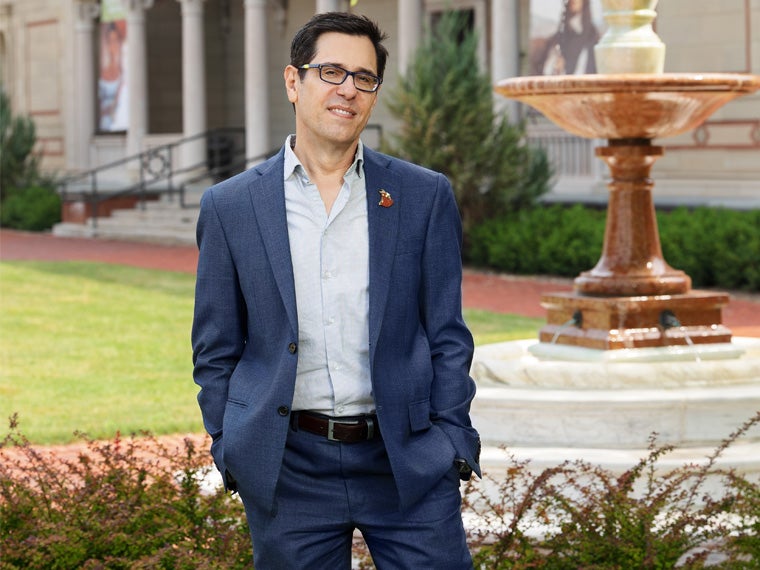
"I love university museums. I find them genuinely liberating places to work," says Jon Seydl, the new John G.W. Cowles Director of the Allen Memorial Art Museum.
Photo credit: Tanya Rosen-Jones '97
Over the summer, Oberlin welcomed Jon Seydl as the new John G.W. Cowles Director of the Allen Memorial Art Museum. Seydl, who previously worked for the Cleveland Museum of Art and came to Oberlin after serving as director of the Krannert Art Museum at the University of Illinois Urbana-Champaign, was already familiar with the Allen. He’s always had a “soft spot” for self-portraits by Michael Sweerts and William Hogarth in the museum’s collection. Years ago, he and the Allen’s former director, Andria Derstine, also worked on a project together that involved museum staff and Oberlin students. “They were so creative and hardworking and really imaginative,” he recalls. “It was a revelation.”
Seydl earned a bachelor’s degree in art history at Yale University and a doctorate at the University of Pennsylvania in early modern Italian art history, giving him a strong background in art from the Renaissance to 1800. “But the older I get—and the more I spend time in museums—I now tend to go to the things I know least about,” he says. “I’m always learning something brand new.”
Once Seydl began to settle in at Oberlin, both on campus and in the city—he says people recognize him by his adorable 30-pound dog, Lenny, a mutt “with a heavy dose of pit bull”—he took time to answer questions about his career and what he hopes to bring to Oberlin.
What drew you to the Allen Memorial Art Museum and Oberlin?
I mean, who wouldn’t be drawn to the Allen? [Laughs.] There are a whole bunch of reasons. I love university museums. I find them genuinely liberating places to work. You never have to make an excuse for research because research is actually valorized in an academic setting. The fact that you can work with faculty across disciplines is amazing. And Northeast Ohio was a draw for us.
The intense work the Allen does with students and faculty, along with the use of the collection, is incredible. In the summer, I was meeting faculty who were telling me about their work with the museum. And it comes from so many different disciplines. The museum’s not just there for art history or studio art; it’s for the whole campus. What happens at all academic museums happens so much more deeply here, with such a high level of quality and diverse touch points. It’s really dazzling.
What drew you to this line of work?
When I was a kid, my sister was the one with artistic talent, not me, and she took art lessons. This was in Lehigh Valley, Pennsylvania, and the only place to go was the Allentown Art Museum. It was far enough away from our house that it wasn’t a drop-off/pickup situation; we had to stay. While we were waiting, we only had two options: One was to stay in the museum, and the other was to go shopping. I hated the shopping option—and I loved the museum environment.
It took me outside of myself into a completely different world. I loved the focused, contemplative environment, but also the one where I was interacting with my parents. We were all looking at things together and learning from scratch. Fundamentally, as a visual person, it was a great place in general. That always stuck with me. I interned at a local museum in high school and college, and I had a job at the campus art museum.
I’m old enough that mental health was not really a topic you talked about a lot in college. But in retrospect, I realized I was using time in the two campus museums at Yale as a way to rest, restore, heal, and pull myself out of ordinary life and step back and reflect. That’s a really important role for museums—what I often call sanctuaries. And it’s something I always want to emphasize to students, faculty, and really anybody who visits: Think of your museum as a site for mental health and wellness.
Don’t get me wrong: I also love coming into a museum when it’s incredibly lively and noisy and there’s a lot going on. These spaces—and the Allen is a really great example of that too—can go from calm to bustling to calm again in a really healthy and important way.
I’m always impressed at the connections the curators at the Allen make in terms of putting art together that you would never expect.
Another thing that’s distinctive about the Allen is that many of the exhibitions don’t involve loans from other places because the collection is so astonishing and varied. You can do that work with what’s already here. There’s a Cindy Sherman photograph in a current exhibition [Femme 'n isms, Part II: Flashpoints in Photography]. It’s not in a Cindy Sherman exhibition; it wasn’t held back for some photo-specific project. It’s in a project that’s about women and femme artists, and the juxtapositions are incredibly interesting. [Curators are] guiding you to a particular perspective, but it’s open-ended enough that you’re also able to create space for your own thoughts.
Of the things you’ve done in your career to date, what are you proudest of?
When I was at the Cleveland Museum of Art, I had the opportunity to reinstall the entire collection of European art during 1500 to 1800. That was, like, 12, 14 galleries. It’s a privilege that only a few curators will have in their lifetime; it doesn’t happen for everyone. It was amazing to be able to do that. And I go to the museum today, and there’s still traces of that work on view.
I had a great opportunity to do some really, really interesting interdisciplinary exhibitions. The students that I’ve worked with over time have all gone on to interesting and successful careers in the arts or in the museum. I was incredibly proud and privileged to work with each of them. And I would say that the turn toward the community in Champaign-Urbana was something that I feel has a lasting impact and was hard won.
What do you want to bring to your position at the Allen?
Like any wise leader, you spend a lot of time observing first. The thing that I’m observing is that there’s some areas where it’s best in business, best in class, and it runs like clockwork. One area for growth I see for the Allen is community engagement. We do incredible work with the college, and we’re a really important part of the city of Oberlin. But I also recognize that we are the museum for Lorain County, which is a place that is underserved by arts organizations. And I know there are ways that we could be a much stronger partner across the county. I have experience in precisely that work. It’s something I’ve done in my previous position. Opening the museum up in a more active way to a bigger community is something I’m really, really excited about.
As we like to say, “Art is for everybody.” You never know who’s going to see something in a museum that’s going to change the course of their life or give them a spark to think that they can be something unexpected. It’s so powerful.
Literally inscribed into the frieze on the entrance to the building is, “The Cause of Art is the Cause of the People,” that William Morris quotation. I take that incredibly seriously. That really is like my guide stone. That’s what the building and the collection was created to be, to have that social importance for a much wider group.
And the thing that I like best is developing longer-term partnerships with community groups—to develop something that can be on a three-to-five-year arc, at the very least. That involves a really intense phase of trust-building in the beginning. But the museum can play a really important part in connecting students to the broader community. Our Gallery Guide program, for example, is one obvious way to do that.
What else do you want people to know about you?
I want to know people. I want them to introduce themselves to me. I don’t want the director’s office to feel like a thing that’s completely apart. I deliberately chose to live in the city of Oberlin. I loved living in Cleveland, but I really want to be here, and I want to be an active part of the community. It’s been great. And I feel like having a dog in Oberlin is the key to everything. You just meet everyone.
This article originally appeared in the Fall 2025 Oberlin Alumni Magazine.
You may also like…
In the Fold
Aimee Lee ’99 is a renowned hanji scholar and teacher. Having found her inspiration at Oberlin, she now shares her art and knowledge with the world.
The Body, The Host
An award-winning Allen Memorial Art Museum exhibition challenges the prevailing narrative of the 1980s HIV/AIDS epidemic.

Oberlin College Names Jon Seydl as Director of the Allen Memorial Art Museum
Oberlin College and Conservatory is pleased to announce the appointment of Jon Seydl as the new John G. W. Cowles Director of the Allen Memorial Art Museum. He will begin his tenure on July 1.
