Independent Scientific Research Opportunities Abound During Winter Term
January 20, 2020
Hillary Hempstead
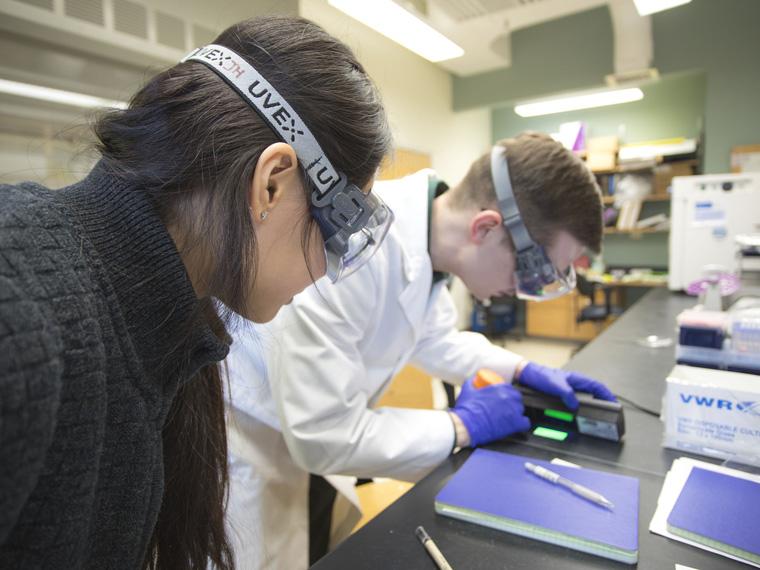
Students conduct independent research in Professor William Parsons’ lab during Winter Term.
Photo credit: Yvonne Gay
In Professor William Parsons’ Chemical Biology and Organic Chemistry Research Winter Term project, students delve deep into independent scientific research.
Assistant Professor of Chemistry and Biochemistry William Parsons’ lab focuses on understanding the functions of proteins in the body that, to date, have not been well-characterized. In doing this, the hope is to not only contribute to fundamental knowledge in biology but also to potentially identify new targets to treat disease.
“Our approach is to make new chemical compounds in the laboratory that can be used as probes of protein function,” says Parsons. “These compounds could then potentially serve as templates for the development of medicinal compounds.”
Most students in Parsons’ lab begin their work by designing methods for accessing new chemical structures that can potentially serve as probes. Parsons explains that by starting from commercially available reagents, students perform a short sequence of chemical reactions to access new chemical matter. They then have the opportunity to study how the new chemical compound they have made behaves in a cellular context.
Fourth-year Alyssa Chow took the opportunity to use Parsons’ Chemical Biology and Organic Chemistry Research Winter Term project to conduct her honors research. Chow says she values the extended period of time that Winter Term allowed her to devote to her work.
“This Winter Term has served as the most crucial time of my honors project with Professor Parsons in terms of collecting data,” says the biochemistry major. “Unlike the limited time available during the semester, Winter Term allows me to commit myself full time to lab work with Professor Parsons’s supervision and guidance. This work ranges from trying new experiments to repeating old experiments to confirm previously-observed results.”
Parsons says that the most important aspect of performing research at the undergraduate level, particularly during Winter Term, is getting the opportunity to experience what it is like to conduct independent scientific research where the results of your experiments are not known to anyone until you perform them.
“In a traditional teaching lab experience, students perform experiments that typically have been run many times before and have highly predictable outcomes. During an original research experience, you quickly learn that what you discover is not only new to you but also all of your colleagues, including your faculty mentor.”
You may also like…
In the Fold
Aimee Lee ’99 is a renowned hanji scholar and teacher. Having found her inspiration at Oberlin, she now shares her art and knowledge with the world.
The ABCs of STEM Research
At Oberlin, undergraduates work alongside faculty members on incredible scientific breakthroughs.
Formulating a Future: Finding a Calling in Pharmaceutical Science
Chemistry major Alex Xie ’26 utilizes CELA’s research fellowships and scholarship advising to transition from campus labs to a future in pharmaceutical research.