Oberlin Alumni Magazine
Cooking Up a Cinematic Gem
Peter Miller ’84’s documentary on Italian cooking legend Marcella Hazan stirs up positive acclaim.
August 4, 2025
Annie Zaleski
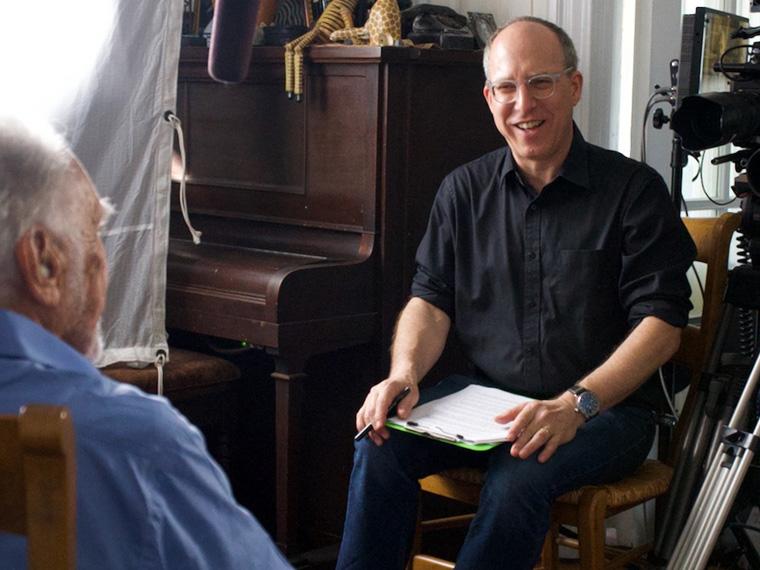
Peter Miller '84 interviews Victor Hazan, the husband of Marcella Hazan.
Photo credit: Anna Miller '19
Peter Miller ’84 likes to cook dinner with his wife Valerie Marcus ’84 most nights of the week. More often than not, Miller says the couple’s “go-to source of cooking wisdom” is a cookbook by Marcella Hazan, a legend in the world of Italian cuisine.
“We’ll look at an ingredient we bought at the local farmer’s market and ask, ‘What would Marcella do?’” he notes. “Her glorious, smoky, Italian-accented voice lives in our heads as we cook.”
One night, after the couple had spent hours painstakingly making ravioli from Hazan’s “exacting recipe,” Miller had a thought: Hazan deserved a documentary illuminating her impact. Her husband and son embraced the idea (Hazan had died in 2013) and Miller set to work telling her life story.
“And what a story it turned out to be,” he says. “[She’s] a disabled immigrant woman with dual doctorates in science, who had never cooked until she married and moved to America, but went on to transform how Americans cook and understand Italian food.”
The resulting documentary, Marcella, won a 2025 James Beard Award for Best Documentary and premiered on PBS American Masters in July 2025. (You can stream the documentary on the latter’s website or watch it on most streaming platforms.)
Marcella is just the latest cinematic achievement for Miller, an Emmy- and Peabody Award-winning filmmaker who majored in government and lives in Manhattan with Marcus, an entertainment lawyer at Ziffren Brittenham LLP. (Daughter Anna Miller ’19, meanwhile, is an assistant to a theatre agent at CAA.)
Miller is the founder of Willow Pond Films, which has produced acclaimed films such as Sacco And Vanzetti, A.K.A. Doc Pomus, and Jews And Baseball: An American Love Story. At the moment, he’s working on a new documentary about the Greenwich Village Halloween Parade (“an amazing institution embodying New York at its most subversive, outrageous, and creative”), producing a PBS series about solutions to America’s mental health crisis, and researching a new film about his grandfather, who he says died in 1931 under “mysterious circumstances.”
Annie Zaleski: In what ways did Marcella differ from the past films you've made?
Peter Miller: I make historical and biographical documentaries and am convinced that real life can often be way more interesting than fiction. But I realized early on in this project that it was both the story of one person’s eventful life and also a film about cooking. So I relocated our cameras into the kitchens of our interview subjects, asking questions about Marcella as they prepared her iconic recipes. These scenes were surprisingly moving, as the emotions of memory and food combined into something deep and spiritual.
What were the most surprising things you learned about Marcella Hazan through the course of production?
Marcella had an outsized impact on America’s food culture, but other than her own memoir, she hasn’t been the subject of a biography. And though she was frequently on TV, usually preparing a recipe on a morning talk show, few people ever thought to ask her about her life’s story. I knew that Marcella herself had to play a central role in the storytelling, and found passages from her writings to be read by an actor, as well as a handful of precious archival video clips in which she talked about her life.
Marcella’s story is a powerful lens into the changing role of women in the 20th century, as well as disability, immigration, and the transformation of American food ways. But at the heart of the story is a fascinating, complex woman. Marcella was famously tough, didn’t suffer fools, and bluntly spoke her mind. The only time Valerie and I met her, back in the 1990s, she managed to insult us in just under a minute. We were cool with that—it was Marcella!
Where is Marcella's impact seen on American food and cooking, and why is she such a pivotal figure?
Julia Child called Marcella “my mentor in all things Italian.” Her obituary in the New York Times declared that the impact Marcella had on how American cooked Italian food is “impossible to overstate.” She came along at a time when Americans were rethinking food, in the 1970s when culinary visionaries like Alice Waters were advocating for local, in-season ingredients.
Marcella’s message about traditional Italian cooking, rooted in the best ingredients and generational knowledge, resonated with people like me. She taught us to use extra virgin olive oil, good parmesan cheese, balsamic vinegar, and enough salt. For generations of home cooks, she’s known reverentially by her first name, like Madonna or Cher: Marcella.
We hear a lot about how, for example, Joni Mitchell having polio changed her guitar technique and gave her a unique approach to the instrument. How did Marcella's disability do the same for food preparation and the way she approached cooking?
Marcella came of age at a time before the disability rights movement and the Americans with Disabilities Act (ADA), when attitudes and language surrounding disability were different than they are now. She had severely injured her right hand as a child and it never healed properly. For the rest of her life, she said, she would hide her injured hand; in early photos, we see her covering it with a shawl or hiding it behind her back.
When she became famous, Marcella described her discomfort at seeing her disabled hand on television. It’s possible that coping with her injury helped shape the formidable, willful person she would become. Marcella was one of America’s most revered chefs, without the ability to hold a knife or roll pasta with her dominant hand.
How did attending Oberlin influence the way you approach filmmaking?
First of all, attending Oberlin—and being a co-op member for four years—taught me to cook. And cooking and documentary filmmaking are similar activities. Both depend on great ingredients, collaboration, and passed-down technique. But more than that, Oberlin taught me to listen, think, develop arguments, craft narratives, and seek deeper meanings in the stories I tell. I was a government major and a history minor, and the books I read, papers I wrote, and seminars I participated in gave me skills that I still draw on in everything that I do.
Looking back, where and how does attending Oberlin come up in your work and life?
There wasn’t a film program when I was there and I fell into documentary making by accident. I had thought I’d be an activist after I graduated, and hadn’t realized that wasn’t really a job. But I had focused on labor studies at Oberlin and a great documentary maker who was working on a film about unions needed an assistant. I went from that job to a long stretch working on Ken Burns’ historical documentaries, and also started making my own films. I learned enough technical skills to make a living as a documentary filmmaker, but I’m beyond grateful for my liberal arts education at Oberlin, which was the best training of all.
What advice do you have for current students as they think about their time at Oberlin and/or future career?
I took classes in a dozen departments, from history to politics to studio art and music. I was involved in campus activism, was a DJ at WOBC, and played in punk bands. I also cooked meals for a hundred hungry co-op members, learning to work in an industrial kitchen. I know that everyone needs to find a career once they finish school, but I would encourage current Obies to soak up all of the wonder, weirdness, purpose, and joy that makes Oberlin such a vibrant community.
You may also like…
Jane Wickline ’21 Finds Community in Comedy
A Q&A with the Saturday Night Live cast member and Dukes cofounder
When Stars Align
The Oberlin Contemporary Music Ensemble shines on Jennifer Koh ’97’s "The American Concerto, Volume One."
Wright On, Sister
Would the Wright brothers have invented their airplane without the support of their sister, Katharine Wright Class of 1898? Probably. But they might not have been the first.