
Student Project Profile
Curricular Alignment for Environmental Education in Primary and Secondary Public Schools through Data Visualization and Storytelling
Project Title
Curricular Alignment for Environmental Education in Primary and Secondary Public Schools through Data Visualization and Storytelling
Faculty Mentor(s)
Project Description
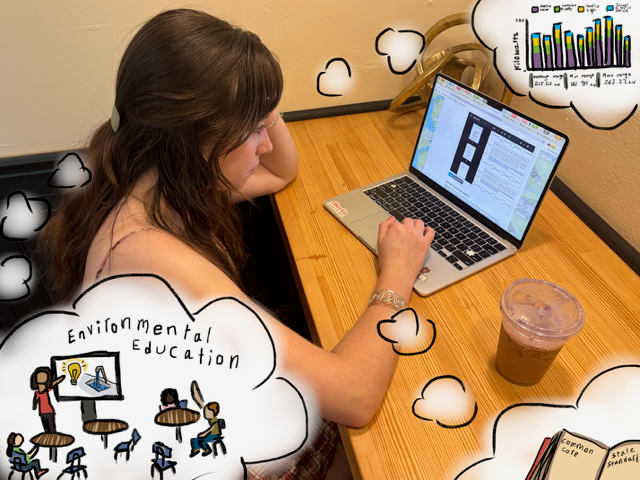
My project intends to assess the impact of Environmental Dashboard-based lessons and to explore curricular alignment for environmental education within the Oberlin public school system. I am researching the Common Core curriculum, Ohio’s Learning Standards, Oberlin City Schools’ curriculum, and the New York climate education legislation with the goal of identifying areas of opportunity for alignment with environmental education material in K-12 classrooms. I will utilize the Environmental Dashboard (ED) infrastructure that is already embedded in the Oberlin school system with hopes of being a model for other school districts or states. I am working to refine a repository of multidisciplinary lessons around the ED and environmental education to be available for use by educators. I plan to lead a “Dashboard Docents” afterschool program to train students on ED features and technology. These students would then act as guides for their peers to understand and utilize the ED and data dashboard screens in each school. I also hope to complete Air quality story user testing, taking content created by the ED team for the Great Lakes Science Center and utilizing Oberlin students as a test group because of their similar demographic to the story audience.
Why is your research important?
My research is important because environmental education in K-12 public schooling is vital to ensuring the next generation of consumers, activists, politicians, or innovators understand their impact and how they can catalyze positive change. Environmental education has been established as broadly beneficial for student learning outside of sustainable behavior. Though many school systems and educators want to implement environmental education, they must accomplish the specific goals of state standards and school-specific curricula, leading to limited attention being given to environmental education.
What does the process of doing your research look like?
My research process consists of reading about existing environmental education research and venues, common core curriculum and state standards, prior Environmental Dashboard application, and current legislation related to environmental education. I also put a lot of time into speaking with community partners and understanding the priorities of school systems and educators. Later on in my research, I will hopefully be conducting pilot studies of air quality user testing and a Dashboard Docents afterschool program.
What knowledge has your research contributed to your field?
My research has contributed to refining a repository of lessons for educators to use for environmental education, and identifying diverse venues for Environmental Dashboard application in classroom learning activities. I hope that my research will aid in concretizing the need for environmental education, even in states like Ohio.
In what ways have you showcased your research thus far?
I participated in tabling for the Environmental Dashboard at the Midwest Climate Summit in March of 2026. I spoke to attendees about my Dashboard projects and intended research. I also presented about my work in curricular alignment for the Dashboard in class this past semester, EVSS 354: Practicum in Environmental Communication. We presented to a variety of community members, partners, and staff, and did a more formal presentation at Kendal at Oberlin. I also have had the opportunity to speak at other community events, such as the Oberlin Farmers Market.
How did you get involved in research? What drove you to seek out research experiences in college?
I got involved in research by going to a faculty panel on research opportunities for STEM disciplines organized by BRANCHES and Oberlin Undergraduate Research. I declared my Environmental Studies major as a junior, so I was a bit late in the game and unaware of research opportunities within the department. I was excited that this panel included Environmental Studies faculty, and dove into conversation with Professor Petersen at the lunch that followed the event which led to subsequent meetings and discussions and my eventual Honors research project.
What is your favorite aspect of the research process?
My favorite aspect of the research process is engaging deeply with community members and uncovering existing histories and work that I can bring to the surface and continue to build on. My project will involve close collaboration with Oberlin City Schools among other community venues and organizations. It is so meaningful to have an embodied research practice where I am not only reading educational documents but working with students and community partners.
How has working with your mentor impacted the development of your research project? How has it impacted you as a researcher?
Working with Professor Petersen has been invaluable in the development of my research project as he has a lot of knowledge about the field of environmental education and has pioneered his Environmental Dashboard technology in public schools. Professor Petersen is embedded in the Oberlin community in so many ways, able to connect me with a variety of community partners and local materials, while also bringing me into tons of exciting Dashboard projects in Oberlin and beyond.
How has the research you’ve conducted contributed to your professional or academic development?
My research project has involved me with projects and people that I could see my professional career being modeled after, and given me the connections to make that a reality. I have had the opportunity to attend and speak at different conferences, including the Association of the Advancement of Sustainability in Higher Education this coming fall.
What advice would you give to a younger student wanting to get involved in research in your field?
I would tell students who want to get involved in Environmental Studies research to just go talk to the department faculty – even if they have never spoken to them. I did not know my current mentor at all before attending the research panel, and taking those preliminary actions to get involved is so worth any short-lived uncertainty or awkwardness. Use your Oberlin resources and connections the most you possibly can!
Students
Rayna Moxley ’27
- Major(s):
- Environmental Studies, Creative Writing