
'Remaining Awake Through a Great Revolution'
January 15, 2021
Office of Communications
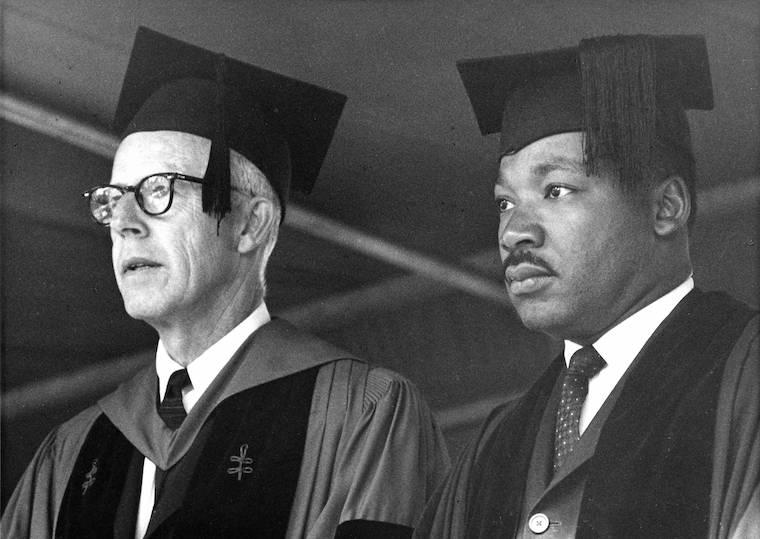
The Rev. Martin Luther King Jr. and Oberlin College President Robert Carr at the 1965 graduation exercises.
Photo credit: Arthur E. Princehorn courtesy of Oberlin College Archives
On this Martin Luther King Jr. Day we look back at the civil rights activist's visits to Oberlin College, and the powerful 1965 commencement speech he gave in Tappan Square.
The Rev. Martin Luther King Jr. visited Oberlin College several times, first in February 1957, a few months after he and the Montgomery Improvement Association successfully ended the bus boycott. During this visit he presented three topics to the Oberlin community: "Justice Without Violence" and "The New Negro in the South" at the First Church of Oberlin and "The Montgomery Story" during a noon assembly at Finney Chapel. Rev. King returned to Oberlin in November 1963, but was too sick with the flu to speak. His two-minute speech received a three-minute standing ovation. In October 1964, shortly after being awarded the Nobel Peace Prize, his talk in Finney Chapel titled "The Future of Integration" was heard by an estimated 2,500 people. This visit was accompanied by death threats. Local police officers attended the talk to provide protection for him and his press secretary.
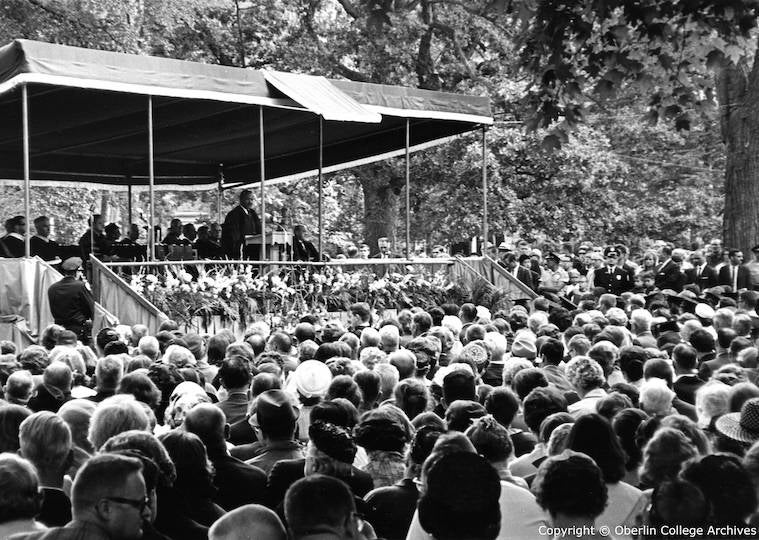
In 1965, Oberlin College awarded Rev. King an honorary degree. His commencement speech, "Remaining Awake Through a Great Revolution," was heard by 483 members of the graduating class along with a record number of returning alumni.
Read Rev. Martin Luther King Jr.’s 1965 commencement address.
The photographic images in this article may not be downloaded or reproduced. Permission for reproduction must be sought from the Oberlin College Archives.
You may also like…
Oberlin Honors the Class of 2026
Nearly 800 graduates march—and celebrate—at May 25 Commencement ceremony.
Katie Priscott to Deliver 2026 Student Commencement Address
The creative writing major explored artistic opportunities throughout her time on campus.

Oberlin Announces 2026 Commencement Honorees
Oberlin College and Conservatory announces its 2026 commencement honorees, featuring keynote speaker Cecilia Conrad and distinguished leaders in health, music, and public service.
