Winter Term: The Auto Drink Dispenser
September 8, 2020
Yvonne Gay
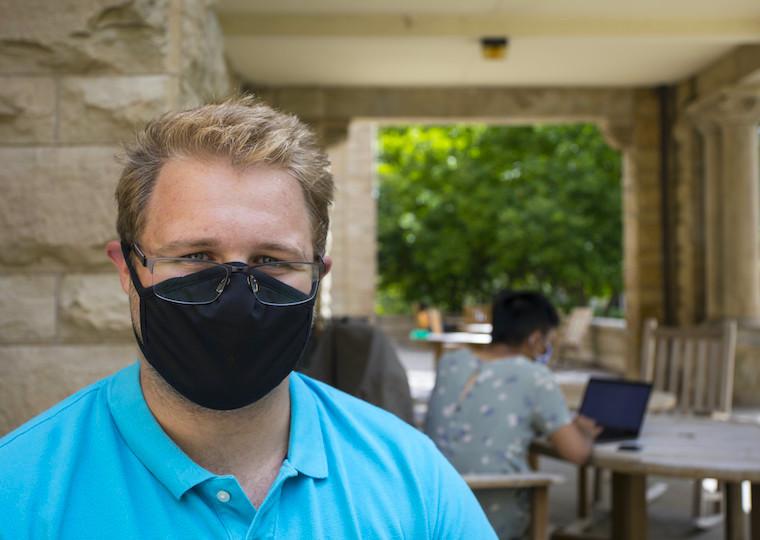
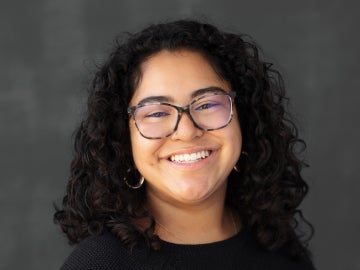
Thomas Heffer ’21 on the porch of Wilder Hall.
Photo credit: Yvonne Gay
Creating an auto drink dispenser is something Thomas Heffer ’21 had toyed with for quite some time. However, his busy schedule wouldn’t allow him to actively pursue it. It wasn’t until COVID-19 forced everyone inside that he was able to learn everything necessary about his endeavor and Oberlin’s August Winter Term gave him the motivation to do it.
It wasn’t until COVID-19 forced everyone inside that he was able to learn everything necessary about his endeavor and Oberlin’s Winter Term in August gave him the motivation to do it.
‘‘The original design was just done sitting at a computer with a keyboard and typing all of the inputs. Basically, I imagined a Coke freestyle machine needing to be wiped down after every time a customer used it,’’ explains Heffer. ‘‘But with COVID-19 there was a potential need to adapt the system so it would be better.’’
The reincarnation of the auto drink dispenser he coded for his project was partly based on a freestyle beverage machine and a replicator from Star Trek, he says. By having the system lead to a bunch of gravity-fed bottles, he could make it seem as if the liquid was appearing out of nowhere.
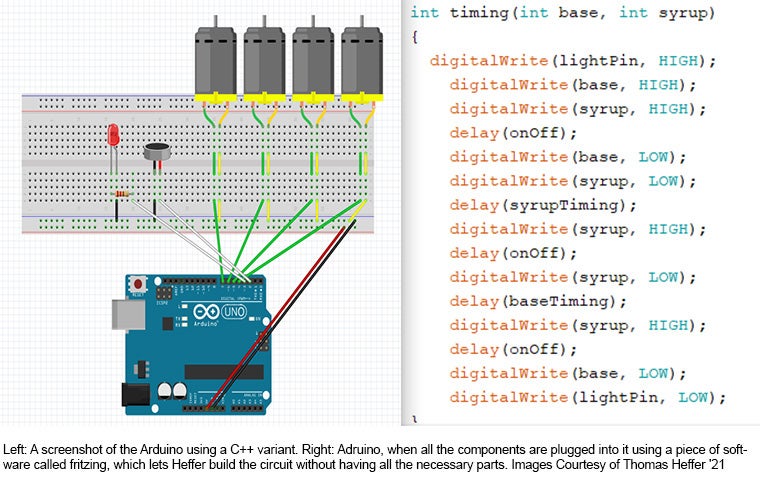
To achieve his design, Heffer decided to switch from Python coding to an Arduino language (a subset of C++ programming) because it has a better interface and a physical device that he could do preliminary testing with rather than just doing a pure coding project, he says.
‘‘I also used the Arduino Uno, which is a minicomputer that I can very easily control compared to other interfaces,’’ says Heffer. ‘‘Since the system would have to then have a motion sensor and a mic, I thought it would be better to stick with just that. The system could be adapted to have something similar to an Xbox Kinect rather than a voice system, but I don't have the programming knowledge right now to undertake that mountain.’’
A geology major, Heffer returned to campus in August. Although programming is not related to his major, he is thankful for the working knowledge he gained with Python. “Given that programming is seeping through every field and turning us all into programmers, I think it is a necessity in the modern job market as a skill,” he says.
You may also like…
In the Fold
Aimee Lee ’99 is a renowned hanji scholar and teacher. Having found her inspiration at Oberlin, she now shares her art and knowledge with the world.
From Capitol Hill to Mellon Mays: A Journey in Engaged Scholarship
Through CELA, Aina Tasso ’27 integrates Bonner service, Congressional internships, and Mellon Mays research to build a future in scholarship and public service.
Connecting Hawaiian Identity and Global Advocacy
Isabel Handa ’26 shares how Oberlin’s Mellon Mays fellowship and CELA resources helped her bridge Hawaiian identity with global diasporic advocacy and research.