Oberlin Reimagines Humanities Education Through $1.487M Grant
New “HOPE” initiative centers humanities learning with real-world impact.
August 31, 2026
Communications Staff
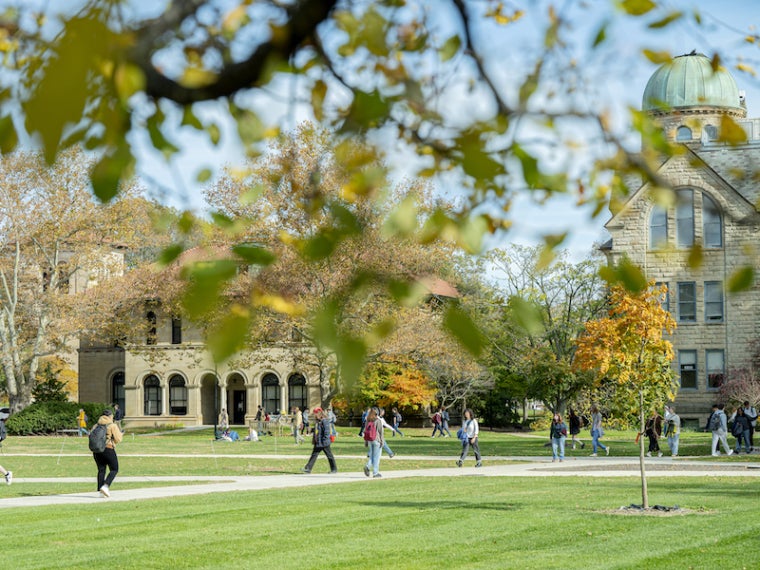
Photo credit: Mike Crupi
What if a literature course ended not with a term paper, but with a museum exhibition, a podcast, or an interactive digital map?
At Oberlin College and Conservatory, that's the idea behind “HOPE,” a new educational model that invites students to use the humanities to understand the world—and help shape it.
Supported by a $1.487 million grant from the Mellon Foundation through its Humanities for All Times initiative, HOPE—short for Humanities-Oriented Public Engagement—will bring together students and faculty to explore pressing social issues through collaborative humanities research. The grant makes possible eight interdisciplinary research hubs and some 45 new or revised humanities courses, engaging hundreds of students each year while also funding faculty workshops, research fellowships, fieldwork, and partnerships with museums, archives, nonprofits, and community organizations. Students might:
- Study how Latino communities have been represented on television and create a guide to help writers and producers develop more thoughtful and accurate portrayals.
- Produce walking tours and audio guides that uncover hidden histories in nearby Cleveland, Akron, and Lorain.
- Build interactive digital maps tracing Japanese American wartime incarceration and broader histories of immigration and detention in the United States from the 20th century to today.
"The HOPE model expands students' understanding of what humanities research can be and whom it can serve," says Laura Baudot, senior associate dean of the College of Arts and Sciences and project director of HOPE. "Instead of working alone or writing solely for the classroom, students will collaborate on projects that respond to the priorities of community organizations. The grant builds on Oberlin faculty's longstanding commitment to community-engaged teaching and public scholarship, giving students more opportunities to connect research, creativity, and public life."
The Mellon Foundation, the nation's largest private funder of the arts, culture, and the humanities, created the Humanities for All Times program in 2021 to help liberal arts colleges connect humanities education with civic engagement, community partnerships, and students' commitments to social change. Oberlin's first HOPE research hubs and courses will launch in fall 2027.
HOPE is more than an acronym: It is our initiative's guiding principle. It references the active work of envisioning and forging a new and better world, even when it seems impossible." —President Carmen Twillie Ambar
"HOPE is more than an acronym: It is our initiative's guiding principle," says Oberlin President Carmen Twillie Ambar. "It references the active work of envisioning and forging a new and better world, even when it seems impossible. HOPE challenges and prepares students not only to study the world critically, but to imagine how they can help shape it through collaboration, creativity, and public engagement."
For David Kamitsuka, dean of the College of Arts and Sciences, HOPE also reflects the broader role of the humanities in a fractured and uncertain moment.
"In a time of rising alienation, pessimism, and even despair, the humanities are more essential than ever in helping people reconnect with one another and the wider world," Kamitsuka says. "Through HOPE, students, faculty, and community partners will work together to explore urgent social issues while using the creativity and insight of the humanities in service of the public good."
Several of the first HOPE research hubs and courses will explore how borders, migration, memory, and political power shape everyday life.
"When we think about the politics of migration, our minds might immediately jump to public policy," says Carmen Merport Quiñones, assistant professor of comparative American studies. "In my HOPE class, students will learn how national borders shape everyday life: from the food we eat to the songs on our playlists. Through events, installations, and exhibits created with community partners, we'll chart new routes through debates about migration."
Lecturer of Cinema and Media Studies David Gutherz wants students to see how history continues to shape the places they live.
"In my course Fascism, Media, and Public Memory in America, students will examine how the century-long struggle against fascism has shaped America's physical and cultural landscape. Traces of that history are all around us: in overgrown memorials, social clubs, and repurposed eugenics facilities. You just have to learn to see them. Together, we'll create digital maps, walking tours, audio guides, and museum exhibitions that bring those histories to life. I want students to leave believing scholarship can help them live more fully in the world they have inherited—and are helping remake."
As Ambar puts it: "HOPE reflects Oberlin's longstanding belief that education should prepare students not only for careers, but for thoughtful participation in civic and community life."
You may also like…
The ABCs of STEM Research
At Oberlin, undergraduates work alongside faculty members on incredible scientific breakthroughs.
Oberlin Adds Sport Studies and Management Integrative Concentration
Sport is many things: a vehicle for personal inspiration and identity formation, a catalyst for social change, an economic driver, and a contributor to health and well-being. Given all this, sport is...