
Chemistry and Biochemistry
Thalapalage Lab
Research in the Thalapalage Lab
How can we create molecular materials that not only respond to their surroundings but also use external signals to regulate molecular recognition, self-assembly, and chemical reactivity? Biological systems achieve complex functions through reversible and precisely controlled molecular interactions. Designing synthetic systems with similarly adaptive behavior remains a major challenge in chemistry. Our research addresses this challenge by exploring how molecular structure, noncovalent interactions, and electronic properties can be coupled with chemical and physical stimuli to produce materials with tunable behavior.
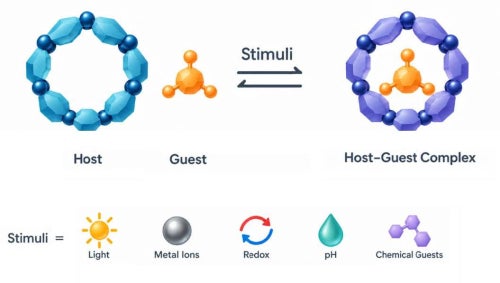
Our lab designs and synthesizes dynamic molecular systems whose structures and functions can be controlled by light, metal ions, redox conditions, pH, and molecular guests. We are particularly interested in responsive macrocycles, carbon-rich molecular architectures, supramolecular assemblies, and polymers. By combining synthetic organic chemistry with supramolecular design, we investigate how molecular recognition and noncovalent interactions govern the assembly, transformation, and disassembly of complex structures. Techniques including NMR, UV–Vis and EPR spectroscopy, mass spectrometry, and electrochemistry allow us to connect molecular structure with function and uncover the mechanisms responsible for responsive behavior. Ultimately, we aim to develop adaptive molecular materials whose properties can be reversibly programmed, with potential applications in sensing, selective capture and separation, catalysis, and advanced functional materials.
View Visiting Assistant Professor Thalapalage's faculty bio.