
Leading Through Uncertainty | Bonus Release
From FAA groundings and Microsoft outages to cyberattacks and disruptions at financial institutions, recent events have left many people asking the same question: What's happening, and what comes next?
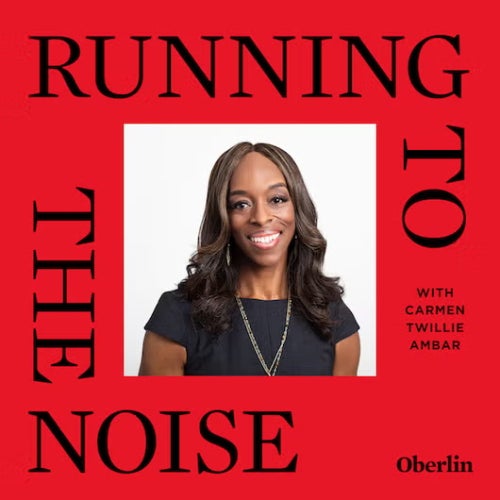
In this timely bonus release of Running to the Noise, Oberlin College President Carmen Twillie Ambar shares her approach to leading through crisis, including one of the most consequential decisions of her presidency: closing campus during the COVID-19 pandemic.
Listen Now
Andrea Simakis: I'm Andrea Simakis, Director of Media Relations at Oberlin College and Executive Producer of Running to the Noise. The recent FAA grounding, the Microsoft outage, and disruptions at financial institutions have left a lot of people asking the same questions: What's happening? And what do we do next?
Living with disruption is a feature of our lives today, not a bug. So how do we prepare for a future where the ground is always shifting? We sat down with Oberlin College President Carmen Twillie Ambar to ask how she thinks about leadership in moments like this. What does she do first? What does she say when people are looking to her for answers and she's still figuring out what's happening herself?
In this bonus release of Running to the Noise, President Ambar talks about what it means to be a steady voice in uncertain times and takes us inside one of the hardest decisions of her presidency.
Carmen Twillie Ambar: So it's interesting when you're dealing with, um, crisis. So my mindset is always, let's slow down. It's actually the opposite of what I think you feel in the moment because crisis makes you feel like you need to speed up. But my view of it is let's slow down. And for me, the slowing down is, okay, what are the most important things in this moment?
And, you know, if, if I were sitting in some of these leaders', uh, shoes, you know, the most important thing is to help, is to think about health, safety, right? And what are the things that we can say that are truthful and right that helps people know that they are safe, right? Um, and so that's the first order of business.
And then the second order of business is to help people know that, uh, the right people are thinking about what the challenge is and how we solve it. So people need clarity about where we're headed. And they don't actually need to know that you know everything. What they need to know is that you realize that there's a significant problem, that you don't have all the answers, but you have a plan for how to get those answers.
And it's actually pretty simple what you have to do. The question is, can you gather all the information in the ways that you need to?
So it doesn't mean that you have to not say something. You can be clear, "We don't have all the information that we need to give you. Here's what we know now, and we're gonna get back to you when we know something further." Um, so you don't wanna confuse slowing down with not providing any information, and nor do you want to be in a situation where sometimes people act so quickly that they just provide the wrong information, right?
And that can be a challenge, too. So slowing down doesn't mean silence, but slowing down does mean that you don't try to answer quickly just because people are clamoring for an answer. And so I try not to let the pressure of the need for people to have an answer force me to answer in ways where I don't really know the truth yet.
One of the things I say all the time, um, is that, everything is not a 10 emergency.
Some things are just a two. But if you treat everything like a 10, then everybody around you is on edge all the time. And I have found over my career that it means that people don't make good decisions, they just can't make good decisions because they are crazed.
And I think that I owe them calmness. I don't know if anybody's ever seen, um, EMTs come to a, to, come to a scene. They do not run in there crazy. They get their stuff off the thing. They're calm. They go, and they deal with it.
It is an emergency. The person's having a heart attack. They do need to get there and work on it. And I think that that type of calmness also creates a calmness in the people who are responding to you, even if you don't have anything earth-shattering to say, people will accept calm, steady leadership even if you don't have all the answers, and that's what's the most important thing to them.
So when we were in the height of COVID, and we had to make a decision to close the campus in the middle of the academic year. So we're in March, we're a couple of weeks away from, uh, spring break, and, um, it is a pretty significant decision to send 3,000 students home and to tell everybody on campus that they're not going to be coming to campus again.
I mean, it seems normal now because we all did it, but at the time it was, it was a very weighty decision, right? I remember the truth of the matter was that I, I had actually not been there the night before, and so the team was not expecting me to make this decision. And I sent a note to the two deans and the chief of staff.
And I said, "Let's meet at 8:00 in the morning." And I walked in and I said, "Hey, I think we need to close campus." And they were actually shocked 'cause that just hadn't been what I had been saying even the night before. And it was one of those decisions that, you know, sometimes you make decisions that you know in the moment have hundreds of ripple effects, right?
Like, so that means every student that's on campus is gonna have to pack up and leave. We announced it on a Thursday, either a Thursday or Friday, and students had to be out of their rooms by Monday. So they had three and a half days to pack up all their belongings, leave, and we had no clue whether they were gonna come back or not.
And I remember thinking at the time that it was such a significant decision that it was gonna require clarity and steadiness so that the campus would not be overwhelmed with panic.
But if you remember at the time, so, so we have this virus that we don't know what it is really. Um, we, we don't know how long this is gonna be. We don't have any real sense of how you contract it and how it's transmitted.
Um, so it was just, uh, a sea of uncertainty, I think is the way to describe it. It's just a sea of uncertainty. When I'm faced with a sea of uncertainty, I try to focus on, but what do you know? So sea of uncertainty. What are the two or three things you do know, Carmen? Well, you do know that the safety of the faculty, staff, and students is the most important thing.
You do know that it's unclear about whether you're going to be able to ensure their safety if they remain here. That became pretty clear, um, 'cause we'd already started hearing about congregate settings and the challenge in congregate settings. And we did know that the students were headed to spring break, a week from then, and so we basically took spring break early so we could give ourselves two weeks to plan, right?
And so we knew that if we gave ourselves two weeks to plan, that maybe we'd have better clarity about what was the right decision. So we know what the decision is, but we need time to make the right decisions, and we can't be worried about the safety of the campus while we're in the midst of making this right decision.
Those were the three things we knew. And because we knew those three things, it became pretty clear that the decision to make was to send the entire campus home. We could always bring people back if that's what we decide to do. But we need time to think about that, and we need to do it in a way where we're not concerned about the health and safety of the campus.
And so I just try to, like lots of people, I try to kind of hone in on what's important. What are the two or three things I do know? How can I focus on those and get to the right decision? And then, as people have heard me say many, many times, you don't try to orchestrate the future, right?
That's, that's folly. What you do try to do is you focus on each decision, and you try to make good ones. And I have said this 1,000 times, honestly, to myself, to remind myself, "Carmen, you're trying to stack up good decisions," because my experience is when you stack up good decisions, in the end, a good outcome happens.
And so is this a good decision? I weigh it against all the things. Okay, yeah, I think this is a good decision. Okay, we made a good one. And I just keep trying to stack 'em up. And I remind people when we're in the midst of things that seem challenging, and there's so many things going on, wait, wait, wait, wait, wait.
All we gotta do is stack up good decisions. Let's don't worry about decision 50. What is decision two? Is that good? Yes, that's the right decision.
Doesn't mean that I haven't made mistakes. I have. I've gotten them wrong. But, you know, if you stack up a lot of good decisions, a wrong decision, hey, you can get back on track 'cause you stacked up a lot of good ones. And that's how I keep myself steady, steady in the face of uncertainty.
Running to the Noise is a production of Oberlin College and Conservatory.