
Undergraduate Research
Oberlin Lab Crawl
Discover research at Oberlin.
The Oberlin College Lab Crawl is an annual open house that provides a fun and informal interaction with different research labs and opportunities around campus. The purpose of the lab crawl is to encourage students to seek out research on campus whether that be in labs, through honors, coursework, and/or volunteering. Lab Crawl gives students the opportunity to interact with research and opportunities on campus, through actual lab experiments, archive research, art practices, and everything in between.
Join us on October 30, 2026 from 12-1:30pm.
Plan out your Lab Crawl
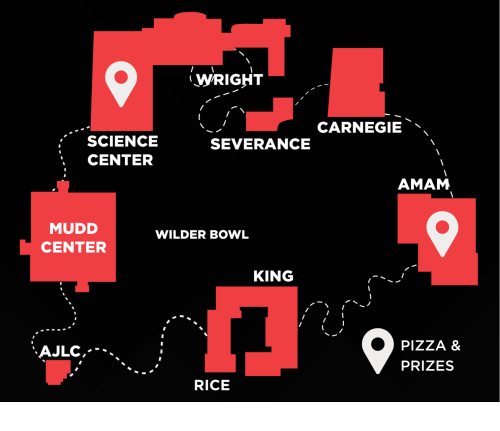
The 2026 Crawls that lead to prizes:
- The Minor Crawl: visit 6 stations - Grab some pizza!
- The Major Crawl: visit 12 stations across 3 different buildings - Get a special edition t-shirt OR tote (your choice!)
- The Exploratory Crawl: visit 16 stations across any of the buildings - Earn a raffle entry for a fun prize bundle!
*Pizza and prizes will be located in the Science Center and the Art Museum
*Trinkets & Treasure will be handed out by most stations as part of Oberlin's Trick-or-Treat event
Lab Crawl Buildings and Participating Stations:
- Art History + AMAM Studio Art Hub: Learn about research opportunities in Art History, Studio Art, and at the Allen Memorial Art Museum! Faculty and staff will be on hand to share how to get involved, ranging from class and honors thesis research to the AMAM Gallery Guide program. Hear from student volunteers about their exciting research projects that engage with the AMAM's collections and beyond.
- East Asian Studies: Learn and use the language to research on East Asia! Find out more about research opportunities in the department.
- Oberlin Creative Music Lab: The Oberlin Creative Music Lab specializes in contemporary, open-form, and guided improvisation. Students rehearse as an ensemble each week to grow together as a cohort and improve upon skills such as listening, interaction, and creative decision-making. The term Creative Music refers to the approach of music making established and embodied by the Association for the Advancement of Creative Musicians and the group seeks to honor the AACM model through a laboratory environment that encourages musical exploration and experimentation.
- ParkArts Humanities Lab: RELG/JWST 360 ParkArts Humanities Lab is a Spring 2-credit project-based course focused on applied humanities research. Projects will be inspired by Oberlin's new campus at ParkArts in Cleveland, which is located on the site of an historic synagogue. In Spring 2026 iteration, we will work on the question, what should Oberlin BA+BFA students know before they begin studying and making art inside an historic synagogue?
- Mellon Mays Undergraduate Fellowship: The Mellon Mays Undergraduate Fellowship (MMUF) is committed to supporting demographic transformation in higher education and to promoting the value of multivocality in the humanities and related disciplines. Come learn more about the possible research disciplines and application process!
- Visions of Mexican Women: In HISP 322, we'll explore the contributions of Mexican Women artists over the past 40 years. Our goal is to recognize how their work –as directors, writers, artists, and composers– has enriched and/or challenged our understanding of mainstream Mexican culture. Ultimately, we'll gain a deeper appreciation of how their creative production has pushed the boundaries for new generations of women artists.
- Oberlin Researches the Perception and Understanding of Sound (OPUS) Lab: We study music perception and cognition using behavioral/experimental methods. Over the past few years, we have been interested in the perception of musical loops (like in pop songs), and how different kinds of musical judgments about a piece of music unfold in the cognitive process.
- The Living Machine: Located in the Adam Joseph Lewis Center for Environmental Studies, the Living Machine is an ecologically engineered system that combines elements of conventional wastewater technology with the purification processes of wetland ecosystems to treat the building’s wastewater and then recycle it within the building. The Living Machine is designed to mimic the internalized cycling of water that takes place in the natural world. The system recycles approximately 70% of the building's water use. A team of student operators maintains and monitors the ecological performance of the Living Machine.
- Carnegie’s Fossil Collection (307): The lab is organizing, updating, and describing the 9,000+ specimens. Examples of our work will be available to lab crawlers.
- Lab at Oberlin for Laser Ablation [LOLA] (304): LOLA uses laser ablation-inductively coupled plasma-mass spectrometry, or LA-ICP-MS, to analyze isotopic ratios and concentrations in natural materials. In the Geosciences Dept, we are analyzing minerals such as garnet to understand ancient pressure and temperature conditions during metamorphism, and other minerals such as zircon and apatite to calculate radiometric ages for rocks and their cooling history!
- OSNAP - Oberlin’s Electronic Microscope (206): OSNAP is Oberlin's divisional electron microscope. It is used by a number of departments. Members of the Oberlin Metamorphic Group will be demonstrating how it can be used to image and measure the chemistry of materials at the micro scale.
- Trace Fossils & Sedimentary Rocks Lab (414): Our lab studies ancient organisms' traces in rocks. We use these clues to understand sedimentary processes, stratigraphy, paleoecology, and paleoenvironments.
- Sociology Department Research: In King 303, meet with faculty and current students to learn about Winter Term and URI courses in the Department of Sociology to get you started in research, as well as what Sociology Honors Research looks like.
- Critical Tech Lab (Rice 11): The Critical Tech Lab examines the relationship between the underlying theories on which computing technologies (such as artificial intelligence) are based, and the social, political and historical factors that influenced the development of those theories.
- Scientists Write Code! What Does It Look Like? (Science Center Commons): Writing software is an integral part of scientific research: scientists craft a wide variety of code across different disciplines and subfields. This project focuses on treating the code scientists write as software artifacts. We consider code from open-source repositories (primarily from biology-adjacent fields) and work to understand attributes such as style conventions and testing approaches.
- Human-Computer Interaction Joint Reading Group (Science Center Commons): As an interdisciplinary field, Human-Computer Interaction (HCI) draws from many different research methods across STEM, social sciences, and humanities. In this reading group, we are exploring the role of theories & methods in HCI and how they shape the ways in which we study relationships between people, information, and technology. Students deep read at least one paper per week and then informally discuss and/or present ideas.
- Center for Student Success: Step into an reflective activity to see how your personal strengths connect and align with research opportunities
- Micro Makerspace: The Micro Makerspace is Oberlin's tiniest makerspace. Don't be fooled by its small size: located in the A-Level of Mudd, CELA's Micro Makerspace squeezes tools into every nook and cranny: we have a sewing machine, Cricut craft cutter, a sewing machine, 3D printers electronics, craft supplies, and more.
- Language Lab: The Language Lab is a dynamic, reservable space equipped for both physical and digital fabrication—featuring 3D printers and scanners, Cricut vinyl cutters, fabrication tools, professional audio recording spaces, and web/CMS hosting support. Combined with guidance from our knowledgeable staff and student lab assistants, it's the ideal campus hub to bring your academic or personal project to life.
- Career Exploration and Development: (CED) sources Winter Term Micro-Internships, some of which are research based. We can also meet 1:1 with students to discuss research opportunities external to Oberlin College.
- The Bonner Center: What does community-based research mean? What is the value of service in the application of classroom concepts? Care deeply about a social issue, but not sure where to start? Talk to staff at the Bonner Center to see what resources are available for community-based learning, service opportunities tailored to your interests, and micro-grant opportunities for community-centered projects.
- Oberlin College Library Internships: Interested in a career in libraries (of any type!)? Stop by to learn more about a paid, spring semester internship in Terrell Library's research and instruction department.
- College Archives: Students are welcome to stop at our station to view photographs, documents, publications, objects, and other materials that document the history of the Oberlin College and Conservatory. Staff will be available to answer questions about the College Archives and discuss opportunities for students to learn about the archival profession.
- Digital Imaging Lab: The Libraries’ DigiLAB provides resources, equipment, procedures, and standards for the creation, hands-on care, and ease of access to digital collections and exhibitions. It also offers training and consulting expertise to students and faculty interested in undertaking digital projects and scholarship that extend the traditional methods of research and knowledge creation.
- Special Collections: Special Collections contains the rare books and manuscript collections of the libraries, as well as research collections in areas like the American Communist Party, second wave feminism, the War of 1812, Spanish theater, and much more. Students interested in working with primary sources on personal research should reach out and work with our curators who can help them access these unique items.
- The Letterpress Studio: The Letterpress Studio is a demonstration classroom featuring an emphasis on the history of media and it is particularly active during Winter Term.
- The Gaybe Lab (A129): The Gaybe Lab focuses on the synergy between molecular biology and public health, particularly as it applies to healthcare-associated infections. Under "Team Pathogenic Potential," we assess the virulent nature of microbes found in the built environment using the live animal infection model Galleria mellonella. Under "Team Public Health," we examine the social determinants of health related to healthcare-associated infections with the goal of developing intervention strategies. Taken together, our research aims to address disparities in the type of microbes studied and the individuals who may contract these infectious agents.
- Population Ecology and Evolution Lab (A132): Research in my lab currently involves either studying the ecology of local crayfishes or phenotypic plasticity in duckweed. The crayfish project focuses on burrowing species and their place in the food web. The duckweed project examines how duckweeds respond to stress by changing the way they use their genes.
- Pike Lab (A138): We work on various aspects of disease ecology, specializing in native mosquitoes and ticks around Oberlin.
- Plant Evolution Lab (K112): In the Moore Lab we investigate the evolution of plant biodiversity. We travel the world to collect plants, and then we use the tools of modern genomics to extract and sequence DNA so that we can uncover the evolutionary relationships among species and populations. Using these evolutionary trees, we can infer patterns of biodiversity and the evolutionary processes that have generated these patterns. Occasionally we even discover undescribed species!
- Blatnik Lab (K211): The Blatnik Research lab studies animal development and how control over the expression of our genes is crucial for the proper development of embryos. In our lab, we use molecular biology and gene editing tools to better understand how non-coding regions of our genes can impose differential gene regulation across different cell types and developmental stages. Using the zebrafish as a vertebrate model system, we are currently exploring how gene expression diversity is critical in the development of an array of cells and tissues: from red blood cells - to skeletal muscle - to the bones of the face!
- Peters Lab (K212): The Peters lab uses a small genetically tractable transparent multicellular organism, C. elegans, to delineate connections between digestion and systemic health and aging.
- A Physiological Lens on Muscle and Respiration (K214): We have two physiological projects underway. One studies molecular ways by which muscular performance is tuned to the demands placed upon muscle, e.g., leading to speeds of contraction varying more than one-hundred-fold across muscles. The other asks whether aerobic capacity varies across the ovulatory cycle and across formulations of oral contraceptives.
- Alex Pike’s Lab (K217): What is the balance between cancer and aging at the cellular level? How does a cell accurately replicate its genome and repair damage to prevent mutation? Our lab uses budding yeast S. cerevisiae to investigate these fundamental questions about the genetic and biochemical regulation of genome maintenance in eukaryotic cells.
- Shakir Lab (K225): Our research focuses on whether musculoskeletal ultrasound measurements can be utilized to identify athletes at risk for injuries during a sports season. Current studies are looking at RTC tendons, patellar tendon, and Achilles tendon. In addition, we have conducted studies looking at identifying whether patient specific parameters can impact response to image guided spine pain procedures.
Neuroscience:
- Howard Lab (A236): The Howard Lab investigates how the brain generates behaviors. We do this through two approaches, first, we measure brain activity during behavior to learn how the healthy brain supports action. Next, we are exploring how Parkinson's Disease disrupts action, and we are investigating novel therapeutics may slow the progression of this disease.
- Behavioral Pharmacology Lab (A242): Our lab uses rodent models to understand the neurobiology underlying complex behaviors and cognitive functions such as attention and impulse control. Current research in the lab is investigating the neural mechanisms mediating sex differences in cocaine-induced impulsivity, sex differences in cocaine withdrawal and sex differences in locomotor responses to cocaine.
- G. Kwakye Lab (A245): Our lab seeks to understand the basis of selective neuropathology in neurodegenerative diseases and investigate the neuroprotective effects of small molecules and Traditional Chinese Medicine in neurological disorders.
- Johnson Lab (A252): The Johnson lab seeks to uncover novel triggers of neuronal death in two neurodegenerative diseases, amyotrophic lateral Sclerosis (ALS) and frontotemporal dementia (FTD). Current research aims to identify (1) novel triggers of protein aggregation and determine (2) how protein aggregation leads to cellular death.
- L. Kwakye Lab (A257): My research investigates how the brain combines information from the different senses in application to music perception. My lab also studies how cognitive factors such as attention influence multisensory integration. Methodology used in my lab include Human Psychophysics, Electroencephalography (EEG), Eye-Tracking, and Computational Modeling.
- Sommer Lab (K104): The MEND lab focuses on how hormones pattern the social brain and how the social brain may underlie neurodevelopmental and neuropsychiatric disorders.
(Bio)Chemistry
- Ryno Lab (K282): The Ryno lab studies how environmental nutrients, like sugars, influence biofilm formation and antibiotic sensitivity. We use basic microbiology techniques to grow E. coli biofilms and using biochemical assays and confocal microscopy we measure their growth and composition. We use quantitative polymerase chain reaction (qPCR) experiments and transcriptomics to measure changes to their gene expression in response to different environments. We measure how these sugars change antibiotic sensitivity by using disk diffusion assays and minimum inhibitory concentration experiments for different classes of antibiotics.
- Belitsky Lab (N371): The Belitsky lab is inspired by melanin pigments. We've developed melanin-inspired coatings that change color in response to metal ions, including lead. This station will feature a demo on colorimetry, a technique we use to quantify the color changes in our materials.
- Teens Talking to Doctors: When and why do adolescents and young adults adhere to medical instructions from their doctors? Our lab extends work on why adolescents obey and share information with their parents to better understand disclosure and adherence in medical contexts.
- Power, Status, and Health Lab: We study the ways in which experiences of disadvantage influence emotion, motivation, and physical health.
- Wu Research Team: Our current research projects focus on using qualitative analytic methods to understand Multiracial emerging adults' experiences of navigating race, ethnicity, and identity within family and peer contexts and across developmental transitions.
- Physics Machine Shop (004): Description and/or demonstration of what the lathes, milling machines, etc. can do, and what they can do to provide students with parts/equipment for their own research. I'll be showing past students research equipment/results. This year I'll be showing my modernized reproduction of the legendary Antikythera Mechanism.
- Ijiri Lab (017): The Ijiri lab studies unusual nanoscale magnetic materials in the form of nanoparticles, thin ribbons, films and fluids. These tiny magnets are of interest for biomedical, data storage, waste remediation, and sensor applications.
- Stalnaker Lab (104): The Stalnaker Lab uses atomic physics and precision measurement techniques to test fundamental physics concepts and look for evidence of physics beyond the Standard Model. We currently have two experiments designed to look for dark matter that use networks of magnetometers and are setting up a trapped atom system for precision spectroscopy experiments.
- Beyond What We See: Exploring the Cosmos through Physics, Code, and Art (208): There’s more to the Universe than meets the eye! Come hold the "baby universe" in your hands and explore how radio signals reveal hidden features of the cosmos—from its early history to magnetic fields and the gas between stars. Discover how we use physics, computers, and data to turn cosmic signals into physical insights, images, and even sound. Bring your curiosity and explore connections across astronomy, mathematics, computer science, art, and music.